Many small and medium-sized businesses today have no shortage of ideas. They know they need a clearer website, a more persuasive landing page, a better service introduction page to support sales. But when they actually start working on it, a familiar bottleneck arises: nobody has enough time to write content quickly and correctly .
This is a very common situation in SMBs. Founders are busy with operations. Marketing has to multitask. Sales may understand the customer but don't have time to sit down and write every headline, every description, every call to action. As a result, websites are slow to launch, landing pages are delayed, or even if they do launch, the content is still quite generic because it was written hastily.
In this context, AI content is beginning to become a valuable asset. Not because it replaces the company's strategic thinking, but because it significantly shortens the most time-consuming part of the process: drafting, structuring, implementing content for each section, and quickly adjusting it to real-world goals.
For SMBs who need speed to launch their websites or landing pages, this is a very significant advantage.
Why is website content and landing page creation often delayed?
Many people think the hardest part is designing or building the page. But in reality, it's the content that takes the longest time to develop.
The reason is quite simple. To create a good website or landing page, businesses must answer a series of questions:
- What should the main headline say so that customers understand immediately?
- The description should focus on benefits or features.
- How concise should a Call to Action (CTA) be to be clear without being stiff?
- Where should case studies, trust signals, FAQs, or processes be included?
- Each section needs to be short or long enough to be readable on the web.
Without a strong content writer readily available, these questions can easily slow down the entire team. Everyone contributes an idea. Each round involves minor revisions. Ultimately, the writing process not only wastes time but also delays the launch progress.
That's why many SMBs don't actually lack website creation tools. They lack a way to generate content faster while still having a foundation for further editing .
Which types of businesses are suitable for AI Content?
Not all businesses need AI content to the same extent. But for the following SMBs, this feature is quite valuable:
The company has a small team: with few people, each person has to handle multiple tasks, and they can't dedicate too much time to handwriting all the content.
Businesses need to launch campaigns quickly: they need a landing page to run ads, offer a promotion, or test a new service, but don't want to wait too long in the writing phase.
Businesses have ideas but don't know how to express them in a way that's suitable for a website: they know what they want to say, but turning it into headlines, descriptions, and CTAs takes more time than expected.
Businesses want to proactively edit content continuously: they need a draft that's quick enough to send to the editor and further optimize.
In other words, AI content is best suited when businesses need to accelerate the website or landing page development process , rather than spending too much time starting from a blank page.
What aspects of websites and landing pages can AI Content support?
This is what most SMBs care about most. AI content doesn't just create generic, long paragraphs. The real value lies in its ability to support specific sections of a page.
Some of the most commonly needed components include:
- Main headline: helps the page open more clearly and get to the main point faster.
- Subheadline or short description: clarifies what the business offers and to whom.
- CTA: Suggestions for shorter, clearer, and more targeted calls to action.
- Service or solution introduction section: helps to present content in a more structured way.
- Benefits section: Shifting from a feature-oriented approach to one that is closer to the reader's needs.
- Basic FAQ: provides a foundation for the frequently asked questions section.
- Content for campaign landing pages: helps create a clearer flow on the landing page instead of piecing together disjointed content.
This is very helpful because most SMBs aren't stuck on a single section. They're stuck on the entire content flow. When AI provides section-by-section support, businesses can visualize the page more easily and make revisions more efficiently.
How does AI Content help speed things up?
The biggest strength of AI content isn't "writing everything for you." Its strength lies in reducing the time from idea to first draft .
Instead of spending hours just thinking up headlines, writing descriptions, and editing each paragraph, businesses can move faster at a more practical pace:
1. Have a quick draft so you don't get stuck on a blank page.
This is a huge advantage. The hardest part is usually getting started. Once you have a decent draft, it's always much easier to revise it than to start from scratch.
2. There is a clearer structure for each section.
Many SMBs don't lack content, but they lack the ability to organize that content to fit the web's reading rhythm. AI can help create an initial framework, allowing businesses to clearly see which sections should address which.
3. Reduce the time spent on internal communication.
Once a draft is available, the team can provide feedback on a solid foundation. This is much faster than everyone imagining a different design and constantly making revisions.
4. Supports faster landing page creation when running campaigns.
For landing pages serving advertisements or short-term offers, speed is crucial. AI content helps businesses shorten preparation time, allowing them to focus more on implementation and optimization.
What is the process for using AI content effectively?
AI Content is most useful when used as a deployment assistant, not as a button to grab content and publish it verbatim.
A logical process would typically be as follows:
Step 1: Clearly define the page's objectives.
Is this page for introducing the business, generating leads, selling services, or running campaigns?
Step 2: Provide a brief but clear description for the AI.
The more accurately you describe the target audience, industry, style, and goals, the more accurate the first draft will be.
Step 3: Extract content by section
Instead of requiring one overly long article, it's better to structure it into sections such as headline, description, call to action, benefits, and FAQ.
Step 4: Refine to your brand language.
This is a crucial step. AI helps speed things up, but the final touches still require human fine-tuning to ensure the brand voice and product are accurately represented.
Step 5: Upload to website or landing page and further optimize.
Once the content is on the page, businesses can continue to adjust it based on actual feedback and user behavior.
This process helps AI content become an integral part of the workflow, rather than just a text-generating tool.
AI content doesn't replace thinking, but it significantly reduces repetition.
This is a point that needs clarification.
Businesses still need to know what they're selling, to whom, where they're different, and what they want customers to do next. AI doesn't replace that strategic direction. But AI can significantly reduce repetitive tasks like drafting, brainstorming, opening the first section, or transforming disjointed ideas into more structured content.
For SMBs, this is far more about tangible value than grand promises. Businesses don't need a tool that "completely writes for them." They need a tool that helps generate content faster so that their websites and landing pages aren't slowed down by the writing process .
How does GTG CRM support AI content for websites and landing pages?
GTG CRM is suitable for businesses looking to speed up the website and landing page development process while keeping everything in a more streamlined flow.
When businesses need to create content for their website or landing page, AI Content in GTG CRM can assist in generating content for key sections such as headlines, descriptions, CTAs, and other content on the page. This helps the team avoid starting from a blank page every time they need to refresh the website or create a new landing page.
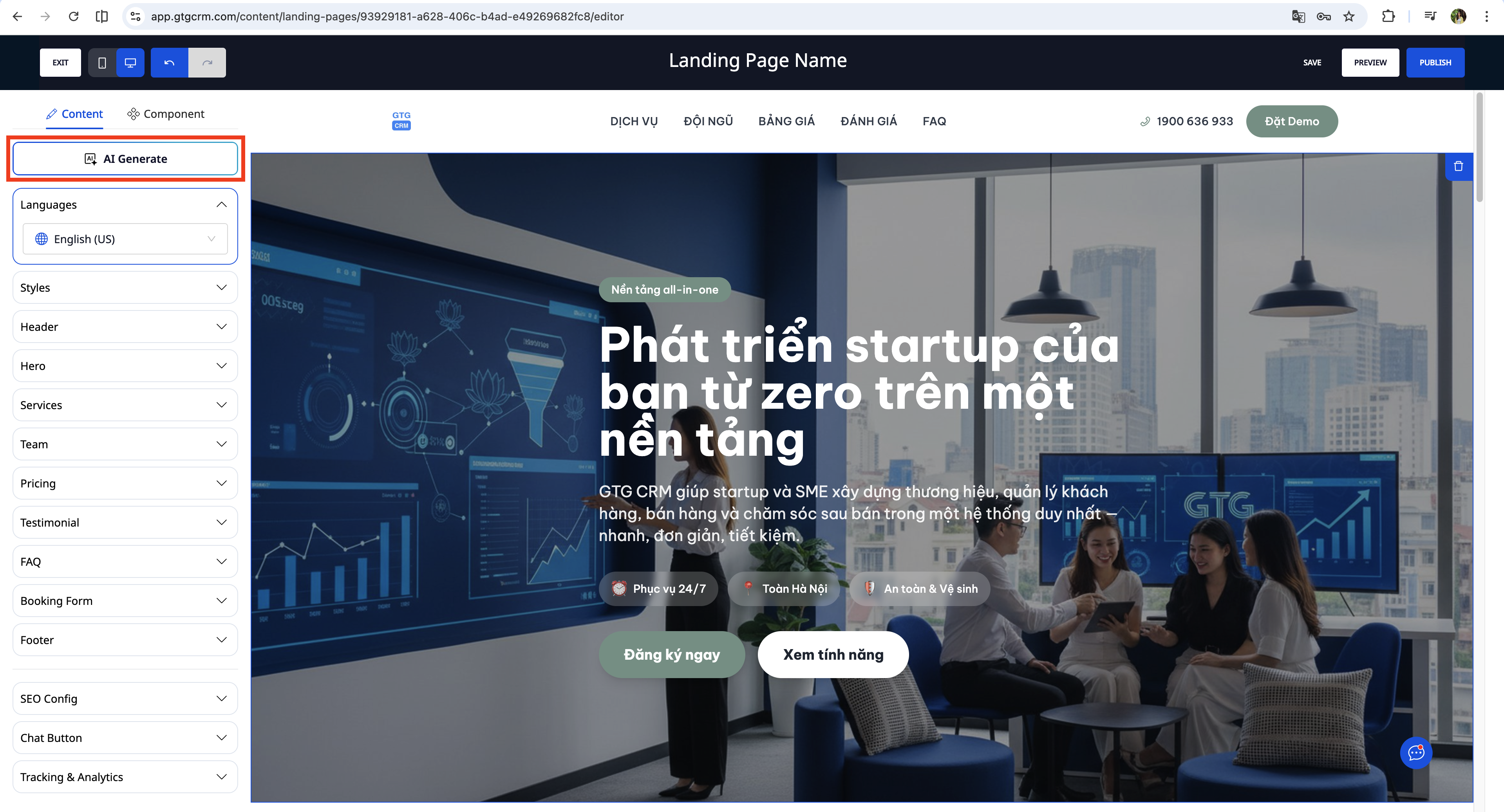 The key value here is that AI Content doesn't stand alone. It integrates seamlessly with website and landing page development within the same system. This allows businesses to write faster, edit during the page creation process, and shorten the time from idea to a ready-to-launch page.
For SMBs that are short on time but still want web content with a clearer foundation, this is a very practical approach.
Conclude
Many small and medium-sized businesses have no shortage of needs for websites or landing pages. They simply lack the time to write the content in a timely manner and with the right structure.
AI Content addresses that very bottleneck. Not by completely replacing the team, but by helping businesses generate drafts faster, develop clearer section-by-sections, and significantly shorten content completion time.
If your business is looking to speed up the website development process, launch landing pages faster, and reduce the burden of writing content from scratch, then AI Content is a feature worth considering during the scaling phase.
With GTG CRM, businesses can integrate AI content directly into their website and landing page development workflow, rather than separating it into a distinct step. This allows for faster content creation, saving time and enabling campaigns to be implemented sooner.
Turn what you've just read into tangible results — apply it now with GTG CRM, free.
Apply now