Many small and medium-sized businesses, when starting marketing, often have a common thought: "I have a website, so sending customers to the homepage is enough." This is an understandable choice, as the homepage is where the business is introduced overall, has a full menu, basic information, and on the surface, seems like the most suitable page to welcome all types of traffic.
But in reality, not every campaign should send customers to the homepage.
There are cases where the homepage does a good job of introducing the brand. But there are also many cases, especially when a business is running a specific campaign, where the homepage distracts customers, makes it difficult to grasp the main point, and hinders them from taking the final action. That's when a landing page becomes more necessary.
Therefore, the question businesses should ask is not "Is the homepage good enough?", but rather: For the objective of this campaign, is the homepage the most suitable destination?
What is the difference between a homepage and a landing page?
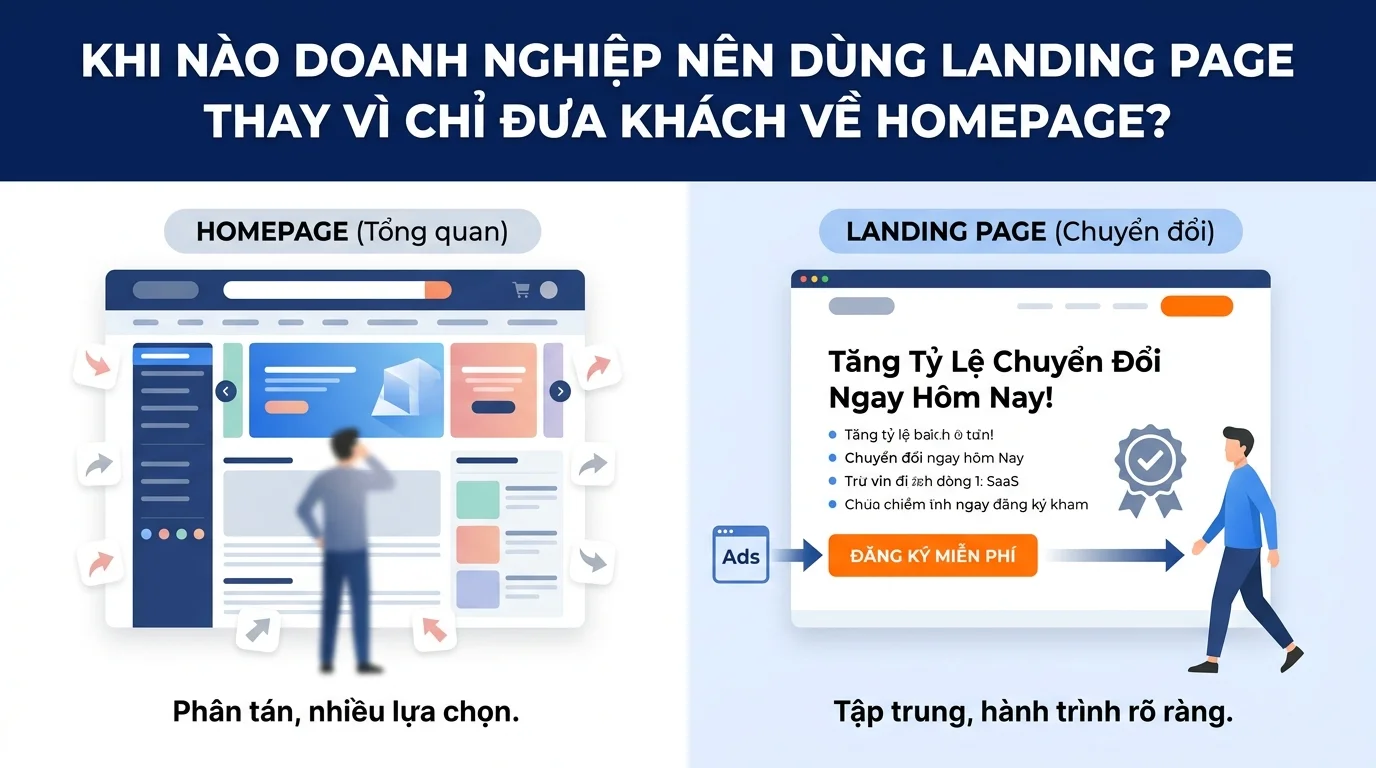
A homepage is a page with an overview. It serves many different user groups simultaneously. Some come to learn about the brand, some want to see services, some want to read more articles, and some are just browsing for reference. Therefore, a homepage often has many directions, much content, and many choices.
A landing page is different. It is a page created to serve one specific objective. It usually ties into a campaign, a customer segment, a service, an offer, or a clear call to action.
In short:
| Page | Main Role |
|---|---|
| Homepage | Provide an overview of the business and navigate users |
| Landing Page | Guide customers to a specific action within a specific campaign |
Due to the difference in roles, if used incorrectly, conversion effectiveness will be clearly affected.
Why do many businesses use their homepage when they should be using a landing page?
The biggest reason is that the homepage is already there. When needing to run ads or launch a new campaign, businesses often choose the quickest way: using the homepage link directly. This saves time in the initial stage but can reduce the effectiveness of the entire campaign later on.
The problem is that the homepage is often too broad. Meanwhile, customers from ads or specific campaigns need a very clear destination. They just clicked on a piece of content, an offer, or a specific promise. If they are then taken to a page with too much irrelevant information, there's a high chance they will lose focus.
Landing pages are not meant to replace homepages. Landing pages exist to handle situations where the homepage lacks focus.
5 situations where businesses should use a separate landing page instead of just sending customers to the homepage
1. When running ads for a specific service or product
This is a very common situation.
For example, a business runs ads for tax consulting services, website design packages, short-term courses, or a featured product line. If customers click on an ad but are then taken to a homepage with many different content categories, they will have to find what they were interested in themselves.
This reduces the continuity of the journey.
A landing page in this situation helps businesses better maintain customer attention. Instead of letting customers filter information themselves, the landing page takes them directly to:
- the problem they are interested in
- the solution the business is offering
- key benefits
- credible evidence
- a clear form or CTA
When a campaign has a specific objective, a landing page is almost always more suitable than a homepage.
2. When the business is running a short-term offer or promotion
Homepages are usually built for stability and long-term use. But promotional programs are time-sensitive. If customers are only sent to the homepage, the offer may not be prominent enough or may not be presented in a convincing journey.
A separate landing page allows businesses to focus all content on a specific program, such as:
- seasonal offers
- limited-time discounts
- free gifts
- early bird registration
- offers for a specific customer group
In such campaigns, a landing page will make the message clearer and increase the likelihood of action, especially with added sections like a countdown timer, registration form, or prominent CTA.
3. When the business needs to capture leads rather than just providing information
This is a very important point. If the objective of the campaign is to collect customer information, a separate landing page is usually much more effective than a homepage.
The reason is that homepages are typically not built around lead generation. They may have a contact button or form somewhere, but it's usually not prominent enough and not placed within a focused flow. In contrast, a landing page can be designed from the ground up to serve this purpose.
A good lead-capture landing page typically clarifies:
- what problem the customer is facing
- how the business can help
- why they should leave their information now
- what the customer will receive after filling out the form
When a business needs forms, CTA clicks, and wants to optimize registration behavior, a landing page is a more suitable choice.
4. When the business wants to speak to a very specific customer segment
A homepage has to serve many audiences at once. But in marketing, many campaigns target only a very specific customer segment.
For example:
- a business wants to run a separate campaign for online shop owners
- a service provider wants to speak specifically to manufacturing businesses
- a software company wants to create a dedicated page for small businesses with small sales teams
If a homepage is used, the message will often be generic because it has to cover many segments. A landing page, however, can be written in the right language, address the right pain points, and have the right CTA for each customer segment.
This is where a landing page clearly shows its advantage: it allows businesses to personalize the experience for each campaign without needing to change the entire main website.
5. When the business needs to measure campaign effectiveness more clearly
If all traffic is directed to the homepage, it will be very difficult for the business to differentiate the effectiveness of each campaign. It's hard to know which ad brought the customer in, which content kept them engaged longer, which CTA performed better, and which page is generating leads most effectively.
Separate landing pages help businesses see campaign effectiveness more clearly because each page is linked to a specific objective. This is crucial if businesses want to optimize marketing based on data rather than intuition.
In other words, landing pages not only increase conversions. They also help businesses measure and learn from campaigns better.
Common mistakes when using a homepage instead of a landing page
Many businesses don't intentionally make mistakes. They just haven't clearly seen when the homepage is becoming a bottleneck. Here are some common mistakes:
1. Thinking that more information is more persuasive
In reality, for a specific campaign, too much information can easily distract customers. Customers don't need to know everything about the business on the first interaction. They need to know exactly what is relevant to their current needs.
2. Using one destination for all campaigns
When running multiple different campaigns but directing them all to the same homepage, businesses are missing the opportunity to build a suitable experience for each customer segment.
3. Having a CTA, but it's not clear enough
A homepage often has many different buttons. But many buttons do not equate to clarity. In a campaign, customers need to see one main direction for action, not too many equal choices.
4. Letting customers search for information themselves
Every time a customer has to figure out what to look at next, the business is increasing friction in the conversion journey. Landing pages exist to reduce that friction.
So when is a homepage still suitable?
The homepage is still very important. This is not an article to deny the role of the homepage.
A homepage is suitable when a business needs to:
- provide an overall brand introduction
- serve as the main navigation hub of the website
- help customers find various types of information
- build a long-term online presence
In other words, the homepage is the general foundation. The landing page is the page that serves the campaign.
Businesses should not choose one over the other. It is more reasonable to know when to use the homepage and when to create a separate landing page.
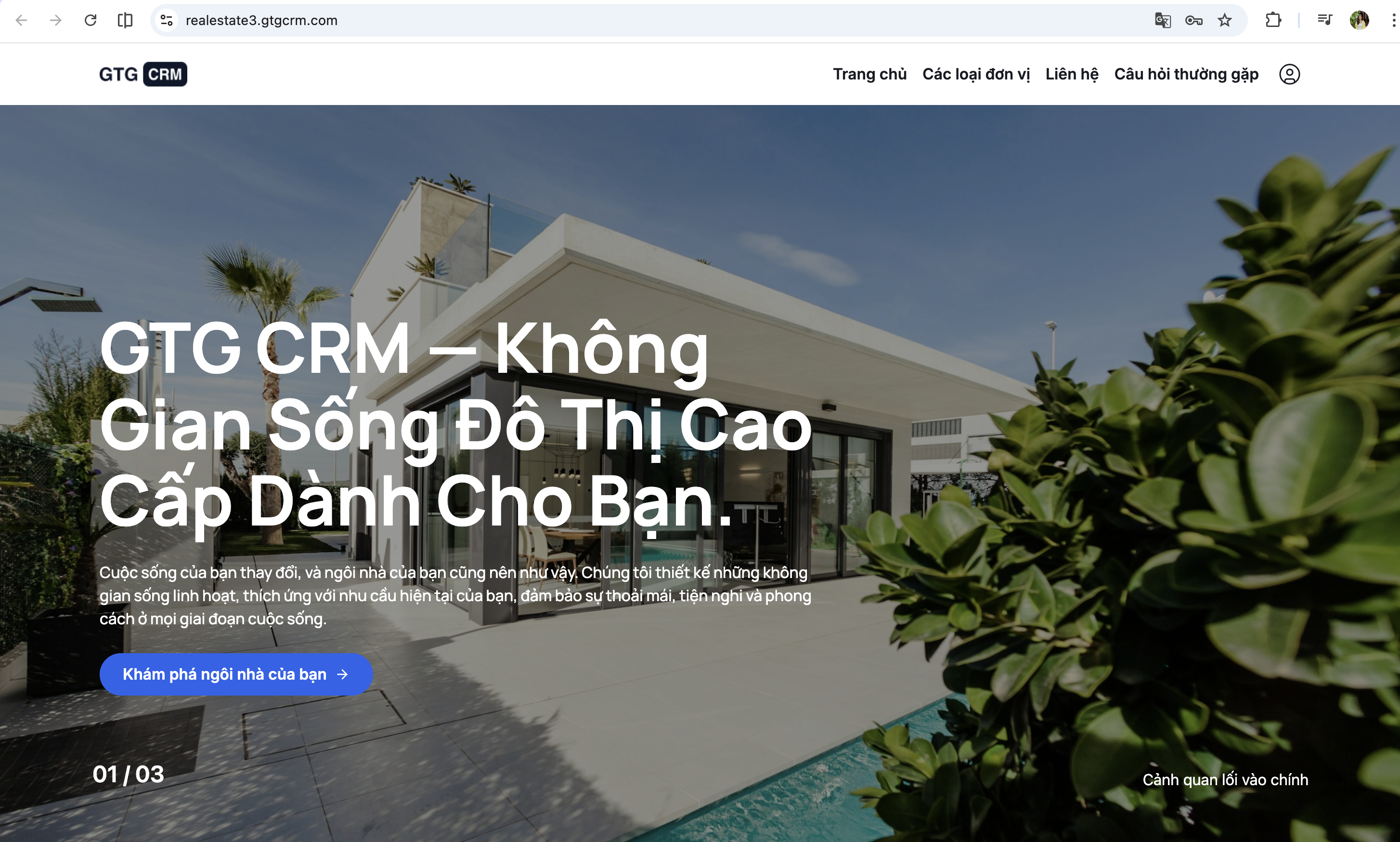
How does GTG CRM support businesses in creating campaign landing pages?
For small and medium-sized businesses implementing specific campaigns, GTG CRM makes creating landing pages more streamlined and practical.
Instead of sending all traffic to the homepage, businesses can create separate landing pages for each campaign, service, or customer segment. This makes the destination after the click clearer, the content more focused, and the CTAs easier to optimize.
GTG CRM supports the creation of landing pages to serve objectives such as lead generation, service introduction, running promotions, or implementing short-term campaigns. When content needs to be changed with each marketing wave, businesses will also be more flexible instead of having to modify the structure of the entire main website.
The important thing is that businesses no longer have to use the homepage for every purpose. Each campaign can have a more suitable landing page with the right message and the desired behavior.
Conclusion
The homepage is not always the best destination for customers.
When a business is running a specific campaign, needs to capture leads, needs to close an offer, needs to speak to a specific customer segment, or needs to measure results more clearly, a landing page is almost always the more reasonable choice.
Homepages help businesses have a presence.
Landing pages help campaigns convert better.
For small and medium-sized businesses, understanding this difference correctly will help avoid a very common mistake: having a campaign but not having a focused enough landing page to keep customers engaged and guide them to the final action.
If businesses are implementing marketing on a campaign-by-campaign basis, now is the time to think more seriously about creating separate landing pages instead of just sending all traffic to the homepage.
CTA: Create a campaign landing page
Turn what you just read into real results — apply now with GTG CRM, for free.
Apply Now