Generative AI is creating an unprecedented productivity revolution in marketing, with the ability to improve creative (right-brain) performance by up to 40% according to research by Boston Consulting Group. However, this poses a dangerous paradox: as AI helps marketers create more content, it can also lead to "content homogenization" - where every brand becomes the same, losing its unique identity.
In the AI era, modern marketers face a strategic choice: develop the "AI left brain" (optimization, prediction, analysis) or protect the "creative right brain" (emotion, differentiation, brand identity). Understanding how this model works is key for businesses to not only leverage AI but also maintain a sustainable competitive advantage.
How the "AI Left Brain" Model Works
The Two Brains of Modern Marketing
Right Brain - Traditional Creativity:
- Tap into consumers' emotional needs
- Create perfect products and innovations
- Build messages that reach customers at the right time
- The traditional strength of marketers for the past 50 years
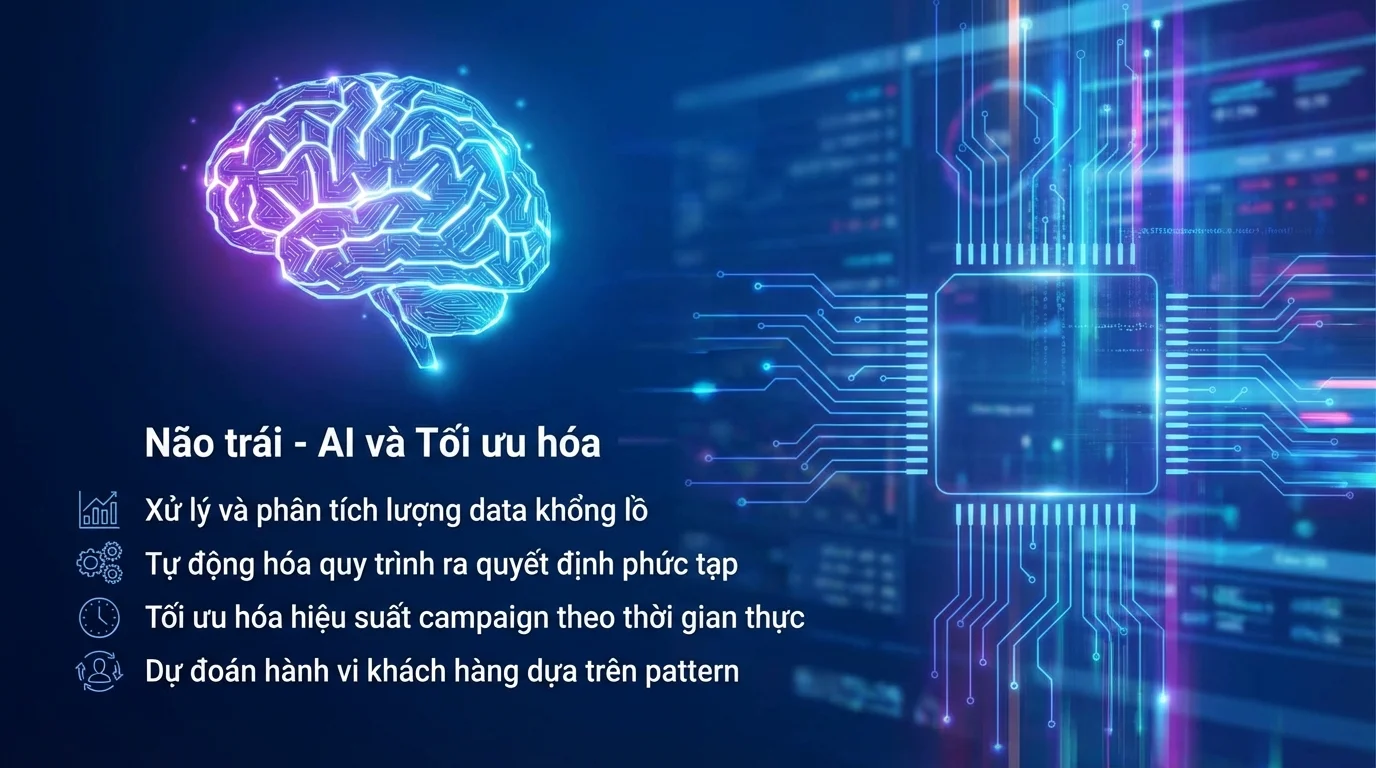
Left Brain - AI and Optimization:
- Process and analyze vast amounts of data
- Automate complex decision-making processes
- Optimize campaign performance in real-time
- Predict customer behavior based on patterns
The Productivity Effect of AI
Boston Consulting Group × Harvard research shows:
- Current ChatGPT has improved marketers' right-brain performance by 40%
- Marketing productivity can increase by up to 50% thanks to Generative AI
- The problem: Marketers are not using the saved time to rest, but to create more content and ideas
Real-World Scenarios: Opportunities and Risks
✅ Opportunity - Supercharged Personalization
The Future of Marketing Content:
- Emails 100% personalized for each individual
- Images that match your age, ethnicity, and style
- Product recommendations that only show what's meaningful to you
- Even the opening lines are written uniquely for each person
Real-world example: Instead of a generic email sent to 100,000 people, a brand can create 100,000 different email versions – each perfectly tailored to the individual customer's preferences, purchase history, and personal context.
Risk - "Content Homogenization"
Serious Problem:
How many people have felt "attacked" by generic content on social media? Imagine:
- The amount of content you encounter daily increases tenfold
- But all that content is the same
- Because every brand uses the same AI model
- AI is trained on the same existing data and content sources
Root Cause:
- Generative AI is trained on existing content and data
- It reduces variance and creates "averaged" content
- Result: Every brand has similar content
- Brands lose their unique identity
Strategy: Choose Your Brain to Specialize
Two Parallel Paths
Businesses and marketers need to make a strategic choice about their development direction:
1. The "AI Left Brain" Path - Optimization Expert
- Develop prompt engineering skills and working with AI
- Master Marketing Technology tools
- Focus on data analytics and predictive marketing
- Optimize performance and ROI through automation
2. The "Creative Right Brain" Path - Differentiated Superpower
- Invest in unique storytelling and a distinct brand voice
- Develop deep insights into customer emotions and psychology
- Create breakthrough ideas that AI cannot replicate
- Build a strong and distinctive brand identity
Strategy to Protect the Right Brain
Even while developing the "AI left brain" strongly, businesses still need to protect creative talent:
- Don't let AI completely replace creativity - Use AI as a support tool, not a replacement. Keep humans in the final decision loop for creative direction.
- Invest in a unique brand voice - Develop a distinct tone & manner that AI cannot copy. Create storytelling tied to corporate values and culture.
- Balance scale and differentiation - Use AI to scale basic content. Allocate creative resources for important campaigns.
- Train AI with proprietary data - Build your own datasets from customer insights. Fine-tune models to reflect brand personality.
Benefits of Understanding the "AI Left Brain" Model
- ✅ Clear career development direction - Marketers know which skillsets to invest in to avoid being replaced
- ✅ Protect competitive advantage - Businesses avoid "content homogenization" and loss of brand identity
- ✅ Optimize AI ROI - Know when to use AI and when human input is needed to maximize effectiveness
- ✅ Prepare for the future - Understand trends to proactively adapt rather than passively react
- ✅ Create superior customer experiences - Balance personalization (thanks to AI) with authenticity (thanks to humans)
Important Notes
- ⚠️ This is not an "either/or" choice - Businesses need both brains, but must know where to focus resources
- ⚠️ The pace of change is rapid - AI marketing tools evolve monthly; continuous learning is essential
- ⚠️ Legal and ethical risks - Using AI-generated content requires attention to copyright, transparency, and ethics
- ⚠️ Humans remain central - AI is a tool; final strategic decisions still require marketer's judgment and experience
In the AI era, victory will belong to businesses that know how to combine the power of the "AI left brain" with the uniqueness of the "creative right brain" – ensuring neither fully replaces the other.
Turn what you've just read into real results — apply it now with GTG CRM, for free.
Apply Now