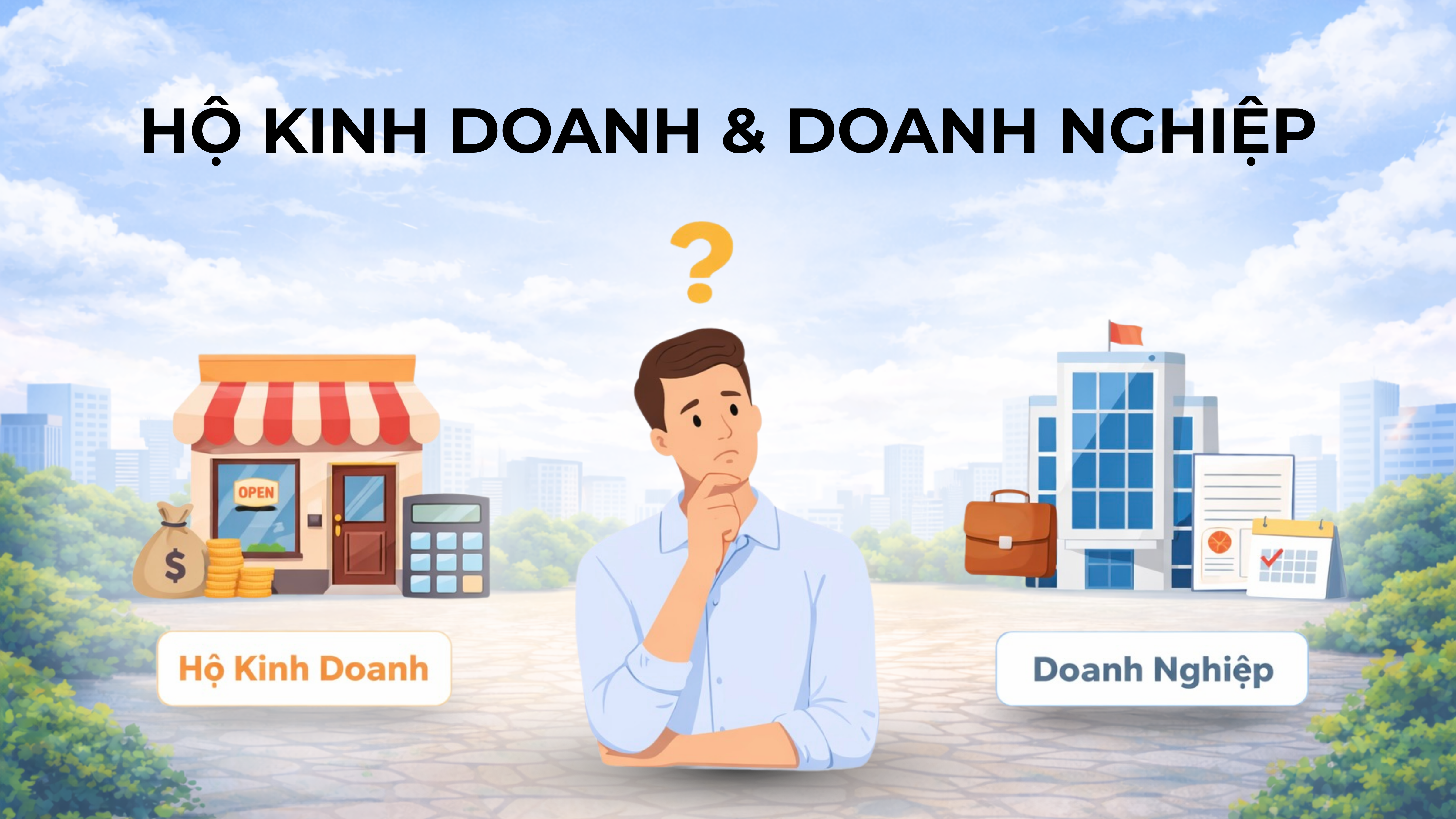
When starting a business, choosing a legal structure is a decision that directly impacts operations, tax obligations, legal risks, and future scalability. In reality, most small and medium-sized sellers are torn between the two most popular options: sole proprietorships and enterprises.
Both models are legal and recognized by Vietnamese law, but they differ fundamentally, not just in terms of "size." Understanding the differences correctly will help businesses choose the right path from the start, avoiding hasty transitions or costly legal risks.
How do sole proprietorships and enterprises differ?
What is a sole proprietorship?
A sole proprietorship is a business form registered by an individual or family members, who are responsible with their entire assets for the business activities. If multiple members participate, one person must be authorized to act as the household head.
Simply put, a sole proprietorship is a business model tightly linked to the individual, with no separation between business assets and the owner's personal assets. This is why this model is often chosen when starting a small-scale business.
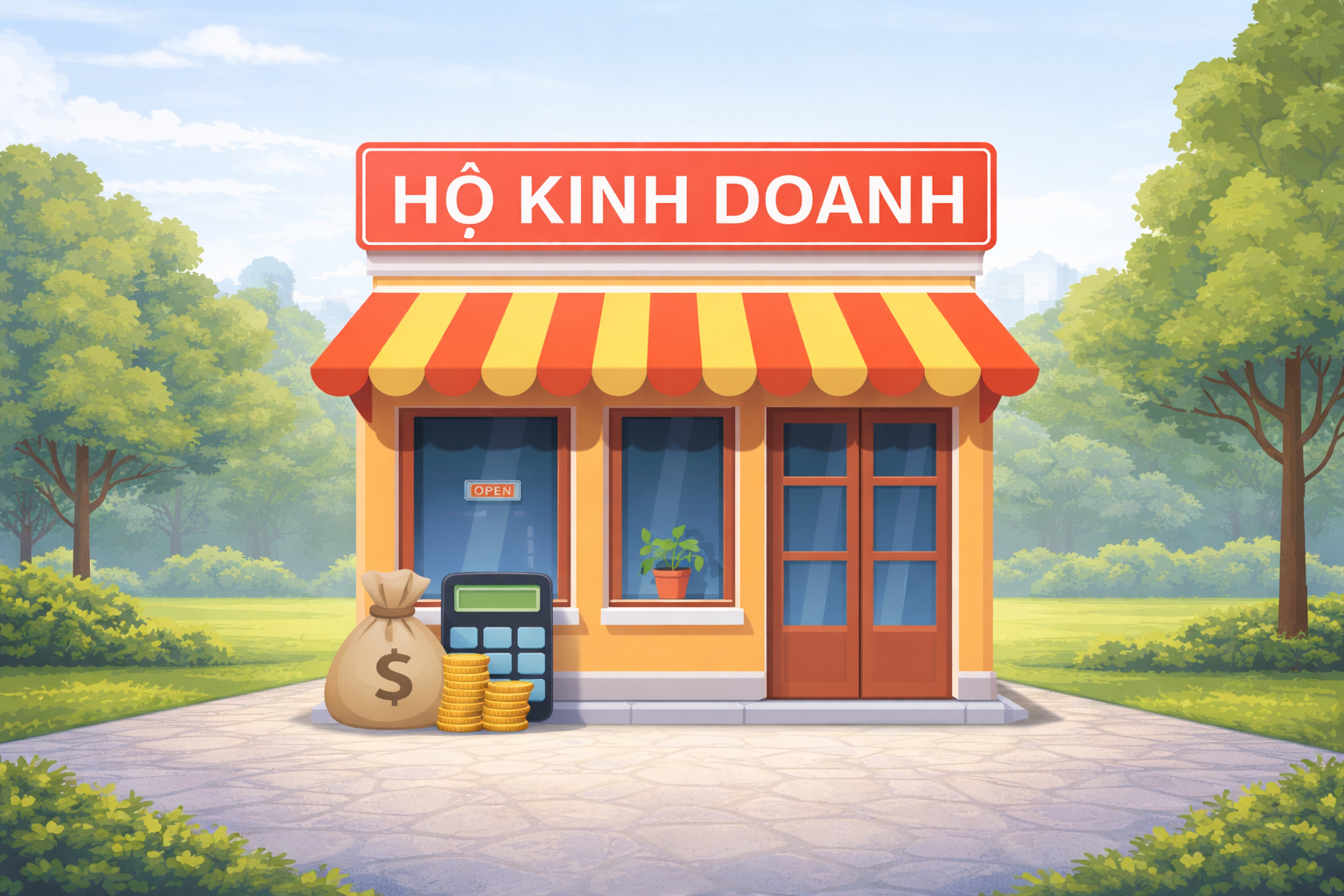
A sole proprietorship is a business model tied to individuals.
What is an enterprise?
An enterprise is an economic organization with legal status, its own name, assets, a registered place of business, and is established in accordance with the law for business purposes.
An enterprise exists independently of the individuals contributing capital. Depending on the type, owners or members are only liable within the scope of their capital contribution, except in special cases such as general partnerships.
The core of an enterprise lies in the legal separation between individuals and business activities.
Depending on the type, owners or members are only liable within the scope of their capital contribution.
Comparing sole proprietorships and enterprises based on core criteria
For easier understanding, the table below summarizes the most important differences, focusing on points that directly affect businesses in practice.
| Comparison Criteria | Sole Proprietorship | Enterprise |
|---|---|---|
| Named party | An individual, group of individuals within a household | Individual or organization, can have multiple capital contributors |
| Legal status | Does not form an independent legal entity | Is a legal entity (except for sole proprietorships) |
| Scope of operation | Usually tied to a specific business location | Can be flexibly expanded through branches, offices, business locations |
| Financial liability | The owner is liable with all personal assets | Liability is limited to the contributed capital |
| Accounting and invoices | Simple accounting, usually applies lump-sum or direct taxation | Must apply full accounting regimes, electronic invoices, financial statements |
| Tax obligations | License tax, VAT, personal income tax (depending on type) | License tax, VAT, corporate income tax, personal income tax, periodic reporting |
| Capital mobilization ability | Limited, mainly from individuals or households | Easy to mobilize capital, can raise capital, issue shares, or borrow from credit institutions |
| Establishment and dissolution procedures | Simple | More complex, requires tax reporting and settlement upon dissolution |
Looking at the table, the biggest difference is not about "paying more or less tax," but about legal liability and scalability.
Read more: Everything About Electronic Invoices: When to Issue, How to Handle Errors
When should you choose a sole proprietorship?
A sole proprietorship is suitable for the initial phase, when operations are small, the scope of risk is low, and the business owner wants to simplify procedures. This model is usually chosen when there is no need to raise capital, no need to expand the scale, or no need to build a corporate brand.
However, the unlimited liability is also a point that puts many people at risk when revenue increases rapidly, especially in areas like online sales, e-commerce, or services involving complaints and disputes.
Read more: Guide to Registering a Sole Proprietorship: Process, Documents, and What You Need to Know
When is an enterprise a more suitable choice?
An enterprise is a suitable choice when the business owner has a long-term vision, wants to expand the scale, build a brand, and minimize personal legal risks. This is also a necessary model if operating in fields requiring strict legal compliance, working with large partners, or participating in formal supply chains.
In practice, many cases start as sole proprietorships but convert to enterprises when they reach a certain threshold in revenue, staff, or risk level.
A practical perspective for online sellers
In reality, many people start as sole proprietors to test the market, then convert to enterprises as revenue and risks increase. This is a perfectly reasonable progression if adequately prepared in accounting, invoicing, and business data from the start.
Choosing the right model from the beginning not only saves costs but also avoids difficult legal issues later on, especially as tax authorities increasingly rely on data and cash flow for management.
Read more: What Happens If You Sell Online Without Issuing Invoices?
Conclusion
No single model is "absolutely best" for all situations. Sole proprietorships and enterprises are designed to serve different stages and goals of the business process.
If chosen correctly from the start, businesses can optimize costs, manage effectively, and limit legal risks. Conversely, if the wrong model is chosen compared to the actual operations, the costs of adjustment and subsequent risks are often much greater than the initial establishment costs.
Therefore, before registering, business owners should carefully assess their scale, development orientation, management capacity, and risk tolerance, and then choose the most suitable model for them.
Turn what you've read into real results — apply it now with GTG CRM, for free.
Apply Now