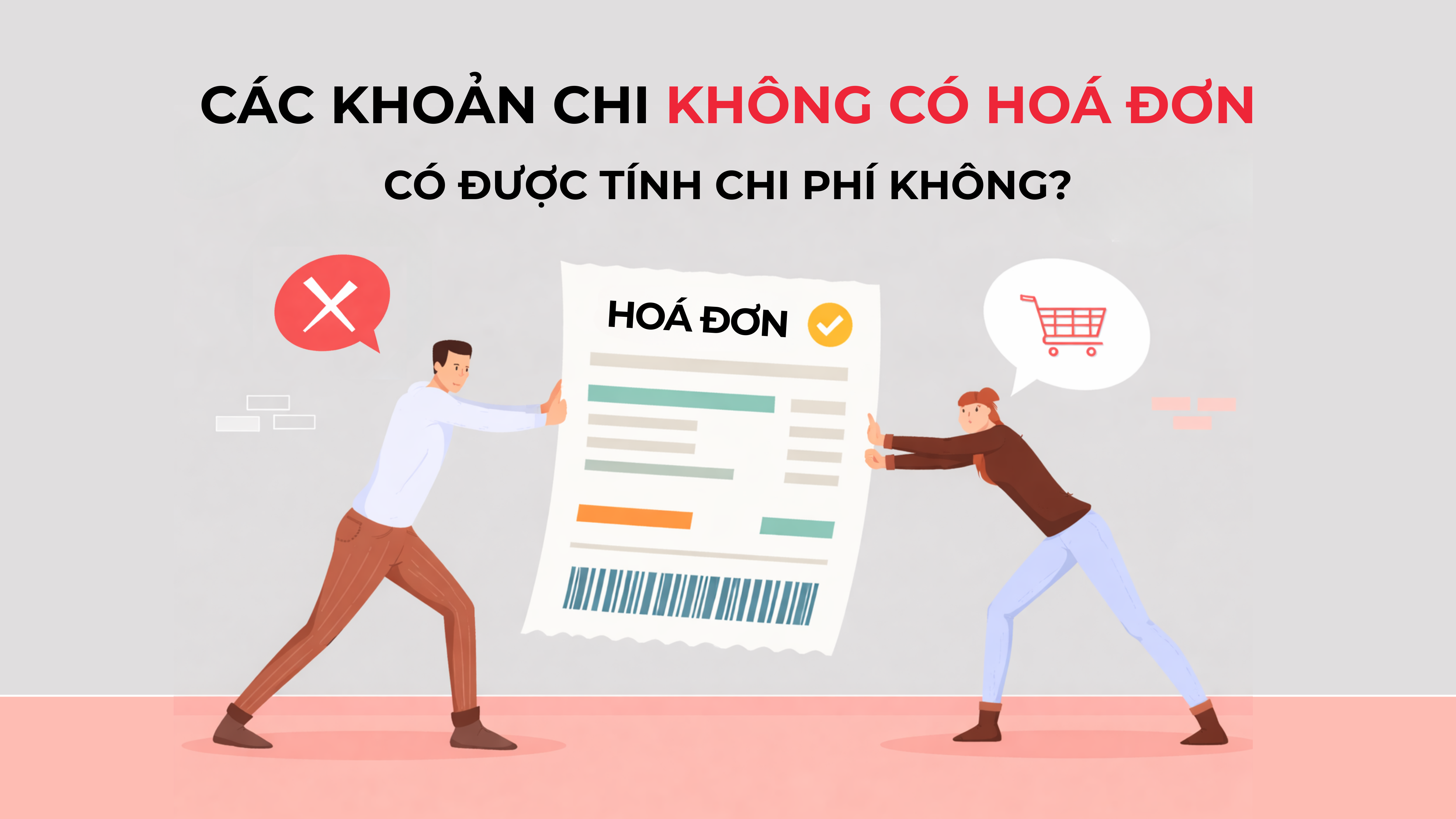
During operations, businesses very frequently incur expenses without invoices, especially when transacting with individuals. Without a proper understanding of the legal nature of these transactions, businesses are highly likely to have these expenses disallowed during tax settlement, leading to increased corporate income tax payable and risks of retroactive tax collection and penalties.
So, can expenses without invoices be considered deductible expenses, and in which cases?
What is a Reasonable Expense according to Tax Regulations?
Reasonable expenses (deductible expenses) are expenditures that can be included in the cost when determining taxable corporate income, provided they fully meet legal conditions.
According to current regulations, an expense is considered reasonable when:
- It is genuinely incurred and directly related to production and business activities.
- It is supported by sufficient legal documents and evidence for each specific case.
- It is not among the expenses prohibited or capped by tax law.
Important Note: Some expenses do not require an invoice but can still be considered reasonable expenses if proper substitute documentation is provided.
Cases Where Expenses Without Invoices Are Still Deductible
Purchasing Goods and Services from Individuals Not Engaged in Business
Businesses are permitted to not have invoices when purchasing:
- Assets from individuals not engaged in business.
- Services from individuals not registered for business.
- Goods produced, harvested, or caught directly by residents and sold directly.
In these cases, the business must prepare a list of purchases without invoices (Form 01/TNDN) and is responsible for its accuracy.
Practical Note: If the purchase price on the list exceeds the market price, tax authorities have the right to adjust the expense to the market price.
Purchasing Goods and Services from Business Households or Individuals with Annual Revenue Below 100 Million VND
In cases where business households or individuals are exempt from issuing invoices, businesses can still deduct expenses if they have:
- List 01/TNDN.
- Sufficient evidence of actual transactions.
- Proof of the source and nature of the expenditure.
In this case:
- No personal income tax is incurred for the seller.
- Businesses are not required to make non-cash payments, even for transactions over 20 million VND.
Purchasing Goods and Services from Individuals or Business Households with Annual Revenue Exceeding 100 Million VND
This is a crucial legal boundary.
If the seller:
- Is an individual or business household.
- Has an annual revenue exceeding 100 million VND.
They are REQUIRED to issue an invoice.
In this case:
- The individual or business household must obtain an invoice from the tax authority.
- Businesses cannot use List 01/TNDN to substitute for an invoice.
Without an invoice, the entire expense will be disallowed during corporate income tax settlement.
Hiring Seasonal Labor, Outsourcing Short-Term Tasks
Businesses can deduct expenses when:
- Hiring individuals for seasonal work or contracted tasks.
- The work is short-term and not regular.
Tax obligations:
- Businesses must deduct 10% personal income tax before payment.
- This deducted tax amount is considered a reasonable expense.
Renting Assets from Individuals (Houses, Vehicles, Warehouses...)
Rental expenses do not require an invoice, but tax may need to be paid on behalf of the individual in certain cases.
Distinguish clearly:
- Contracts below 100 million VND/year: no VAT, personal income tax, or license fees are incurred.
- Contracts above 100 million VND/year:
- VAT: 5%
- Personal Income Tax: 5%
Businesses can pay these taxes on behalf of the individual if agreed upon in the contract.
Calculating Corporate Income Tax and Personal Income Tax for Expenses Without Invoices
Each type of expense has a different tax treatment; a single formula cannot be applied universally.
Principle to remember:
- Deductible expenses for corporate income tax depend on the documentation and the nature of the transaction.
- Personal income tax is only incurred when the individual is liable for tax according to regulations.
Example:
- Purchasing goods produced by residents: no personal income tax.
- Hiring services from individuals not engaged in business: 10% personal income tax is deducted.
- Renting assets from individuals with high revenue: 5% personal income tax + 5% VAT.
Common Mistakes Leading to Disallowance of Expenses Without Invoices
During tax audits, the most common errors include:
- Using List 01/TNDN for incorrect parties.
- Failure to prove that individuals are not engaged in business.
- Lack of handover minutes or contracts.
- Recording purchase prices that are unusually high compared to the market.
- Failure to deduct personal income tax as required.
Even a small error can lead to the disallowance of the entire expense.
Read more: Which Expenses Are Tax-Deductible for Businesses?
Conclusion
An expense without an invoice does not automatically mean it will be disallowed for tax purposes. Current tax laws allow businesses to record many types of expenses without invoices, provided that the business correctly determines the nature of the transaction, the party incurring the expense, and prepares sufficient substitute documentation as required.
In practice, the risk lies not in the absence of an invoice, but in misapplying the regulations, using lists for incorrect parties, failing to deduct personal income tax when necessary, or not proving the reality of the transaction. In such cases, even if the expense was genuinely incurred, the business may still have the expense disallowed and be subject to retroactive corporate income tax collection.
Therefore, to protect their tax interests, businesses must clearly understand each category of expenses, grasp the corresponding legal conditions, and organize and maintain complete and consistent records from the moment the transaction occurs. Doing it right from the start not only helps optimize legal expenses but also serves as an important foundation for businesses to operate transparently, safely, and sustainably in the long term.
Turn what you've just read into real results — apply it with GTG CRM, free.
Apply Now