In the context of a strong digital transformation, choosing the right sales software not only helps businesses optimize their business processes but also creates a solid foundation for sustainable growth. However, with hundreds of solutions on the market, finding a platform that truly meets practical needs is a significant challenge.
An effective sales software needs to meet multiple requirements simultaneously: accurate order management, real-time inventory control, clear customer debt tracking, and timely management reporting. Furthermore, scalability and integration with other systems are also crucial factors as businesses grow. In this article, let's explore the Top 5 best sales software solutions for 2026 to find the best fit for your business.
Why Businesses Need Professional Sales Software
Manual sales management or using spreadsheets is increasingly revealing limitations as business scales expand. These traditional methods are not only time-consuming but also carry many risks regarding accuracy and operational efficiency.
First, Data is Fragmented Across Departments
When using multiple separate Excel files for sales, inventory, and accounting, synchronizing information becomes extremely complex. A new order might require data entry 3-4 times in different departments, leading to potential data discrepancies and significant time spent on reconciliation.
Second, Difficulty in Real-Time Inventory and Debt Control
With manual methods, managers often only grasp the business situation after daily or weekly summaries. This causes businesses to react slowly to issues like stockouts, overselling inventory, or overdue debts.
Third, Lack of Analysis and Forecasting Tools
Manual reports often focus solely on past data without providing analytical insights into sales trends, employee performance, or potential customer segments. This limits the business's strategic decision-making capabilities.
Fourth, Difficulty in Scaling
As businesses grow with multiple sales channels, branches, or agents, managing with Excel becomes overwhelming. The need for a centralized, scalable system with permission controls becomes urgent.
These limitations have driven the trend towards professional sales software – a solution that helps businesses automate processes, reduce errors, and enhance overall management efficiency.

Criteria for Evaluating Effective Sales Software
Order and Sales Process Management Capabilities
The software should support the entire cycle from quote generation, order confirmation, delivery, to payment. Real-time order status tracking allows businesses to proactively handle emerging situations and enhance customer experience.
Inventory Management Integration
The link between sales and inventory is a key factor. Each sales transaction needs to automatically update inventory levels, preventing overselling or stagnant stock. Good software should provide alerts when goods are running low or have been in stock for a long time.
Debt and Cash Flow Management
The ability to track debts by customer, contract, and payment term helps businesses effectively manage cash flow. The system should alert for overdue debts and facilitate quick debt reconciliation.
Reporting and Business Analytics
The software needs to provide multidimensional reports on revenue, profit, employee performance, and customer trends. Intuitive and easy-to-understand reports help managers grasp the business situation and make timely decisions.
Scalability and Customization
The software should be scalable to business growth, support multiple branches, sales channels, and integrate with other systems such as accounting, CRM, or e-commerce.
Top 5 Best Sales Software of 2026
1. GTG CRM – Comprehensive Sales Platform from Orders to Operations
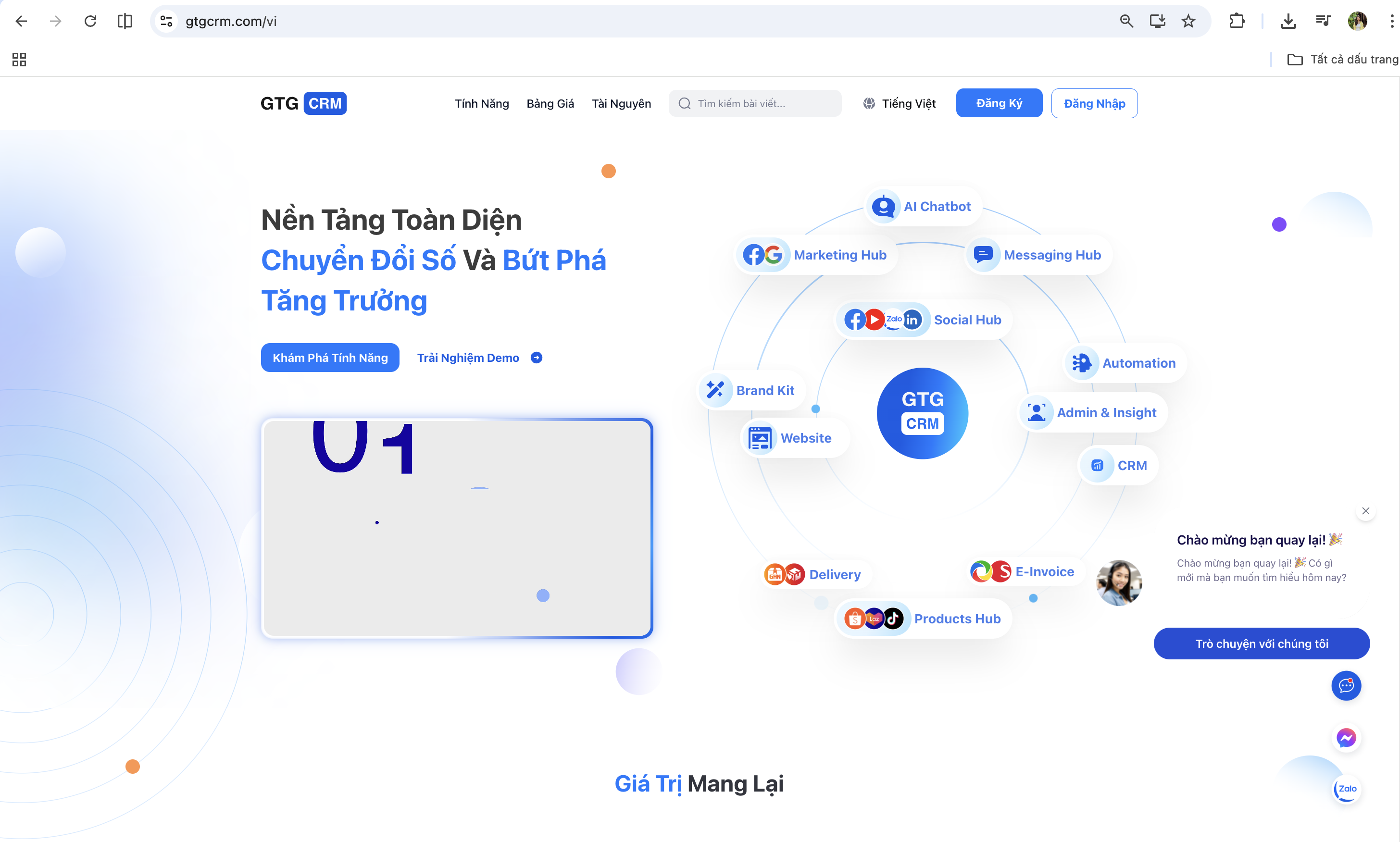
GTG CRM is an integrated platform that combines many sales tools into a single system, helping businesses manage the entire process from order creation, inventory management, shipping to invoice issuance and profit analysis.
Unlike many software solutions that focus on a single aspect, GTG CRM is designed to serve the entire online sales lifecycle.
Advantages
- Centralized Multi-channel Sales Management: Supports sales on Facebook, Website, Zalo and synchronizes products – orders with Shopee, Lazada, TikTok Shop.
- Real-time Inventory Management: Inventory is continuously updated across all sales channels, helping to minimize overselling or data discrepancies.
- Closed-loop Order Processing Workflow: From order placement → packing → shipping label creation → delivery, all managed within one system.
- Shipping Integration: Directly integrates with GHN and Viettel Post, enabling quick shipping label creation without needing to operate on multiple platforms.
- Comprehensive Invoice Management: Outgoing invoices: Create and manage sales invoices. Incoming invoices: Store and manage purchase invoices.
- Detailed Revenue and Profit Reporting: Track revenue, costs, and profits by product or over time.
- AI Sales Assistant:
- AI assists in replying to customer messages.
- AI can help create orders from conversation content.
- AI supports marketing and advertising:
Sellers can also create advertising content and deploy marketing campaigns with AI support.
Disadvantages
New platform, not yet widely popular
Suitable for: Small and medium-sized businesses in Vietnam in wholesale, distribution, retail, and manufacturing sectors that need a comprehensive sales management solution at a reasonable cost.
Try for free at: https://gtgcrm.com
Salesforce Sales Cloud
Salesforce Sales Cloud is one of the leading CRM and sales management platforms globally, trusted by thousands of large enterprises.
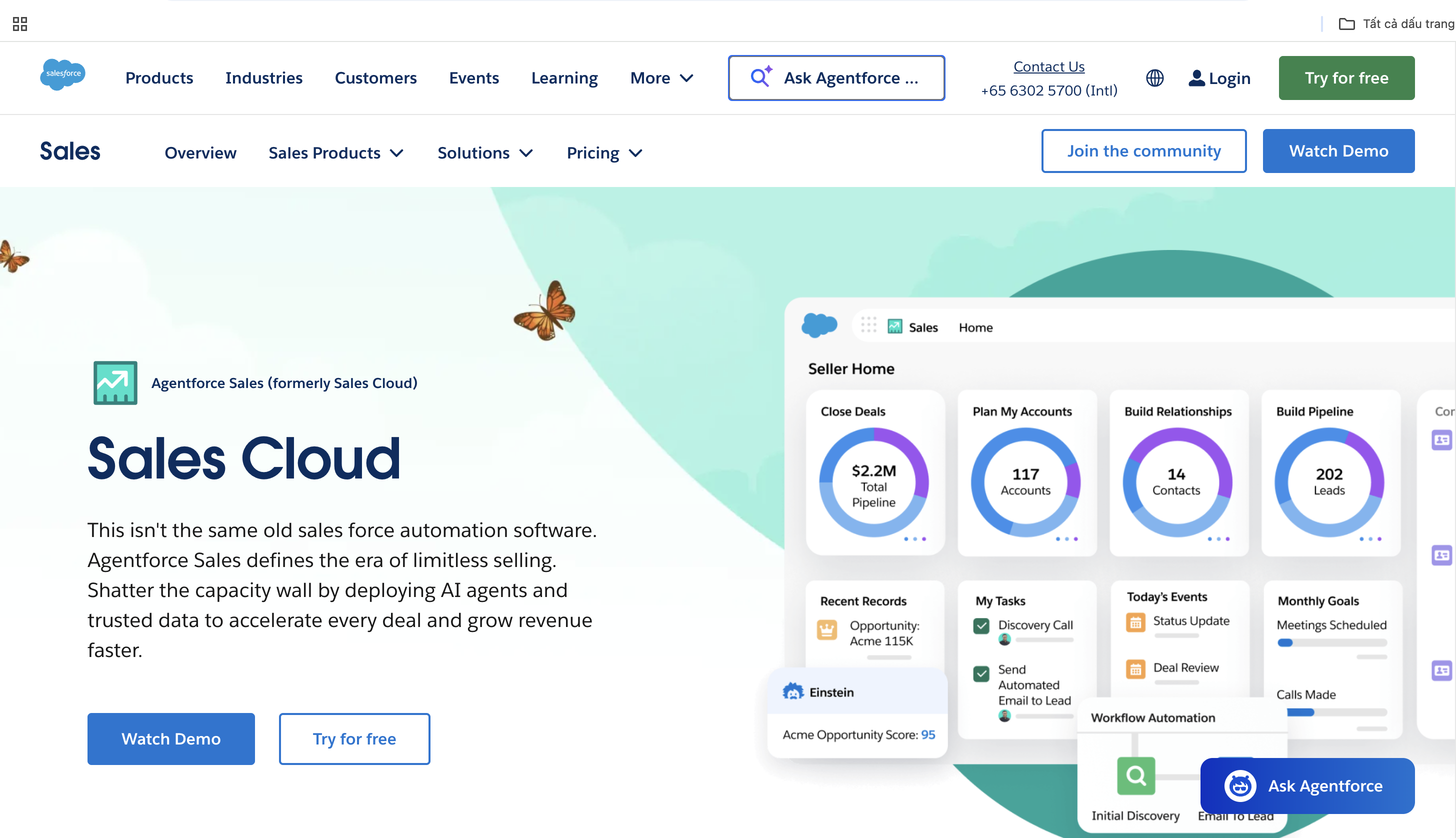
Advantages: - Powerful CRM features with detailed lead and sales opportunity management capabilities - In-depth sales data reporting and analysis system - Good integration with many other applications and platforms - Supports sales and marketing process automation
Disadvantages: - High implementation and maintenance costs, not suitable for small and medium-sized businesses - Complex interface, requiring staff training time - Limited inventory and accounting management features, requiring integration of more modules - Not optimized for the Vietnamese market (language, accounting processes, taxes)
Suitable for: Large enterprises, multinational corporations with high investment budgets.
HubSpot Sales Hub
HubSpot Sales Hub stands out with its sales automation capabilities and tight integration with HubSpot's marketing ecosystem.
Advantages: - User-friendly interface, easy to use even for beginners - Strong integration with marketing automation tools - Offers a free version with basic features - Detailed tracking of emails and customer activities
Disadvantages: - Weak inventory and debt management features - Costs increase rapidly when upgrading to higher tiers - Does not fully support Vietnamese accounting processes - Limited customization capabilities for specific business operations
Suitable for: B2B businesses focused on marketing and nurturing potential customers.
Zoho CRM
Zoho CRM is a CRM and sales solution from India with competitive pricing and diverse features.
Advantages: - More affordable pricing compared to Salesforce - Diverse features from CRM, sales to customer support - High customization capability with many additional modules - Supports multi-channel sales
Disadvantages: - Interface is not very intuitive, difficult for new users to use - Integration with accounting and inventory management is not smooth - Limited Vietnamese language support - Processing speed can sometimes be slow with large data volumes
Suitable for: Small and medium-sized businesses needing a low-cost CRM solution.
Microsoft Dynamics 365 Sales
Microsoft Dynamics 365 Sales is Microsoft's enterprise sales platform, deeply integrated with the Office 365 ecosystem.
Advantages: - Seamless integration with Microsoft products (Outlook, Excel, Teams) - Powerful data analysis capabilities with Power BI - Suitable for businesses that have already invested in the Microsoft ecosystem - High security and compliance
Disadvantages: - High and complex license costs - Implementation and configuration require technical expertise - Inventory and accounting management require separate, high-cost modules - Not optimized for the specific needs of Vietnamese businesses
Suitable for: Large enterprises that have invested in the Microsoft ecosystem.
Conclusion
In the context of a strong digital transformation, choosing the right sales software is a key factor determining a business's operational efficiency and competitiveness. Each solution in the TOP 5 has its own strengths, suitable for different customer segments.
For small and medium-sized businesses in Vietnam, especially in wholesale, distribution, and retail, GTG CRM stands out as an optimal choice due to its comprehensive integration of sales – inventory – invoicing, designed to suit the specific characteristics of the Vietnamese market and its competitive pricing. The system not only helps businesses efficiently manage their sales processes but also provides accurate, transparent data management tools to support strategic decision-making.
Turn what you've read into real results — apply now with GTG CRM, free.
Apply Now