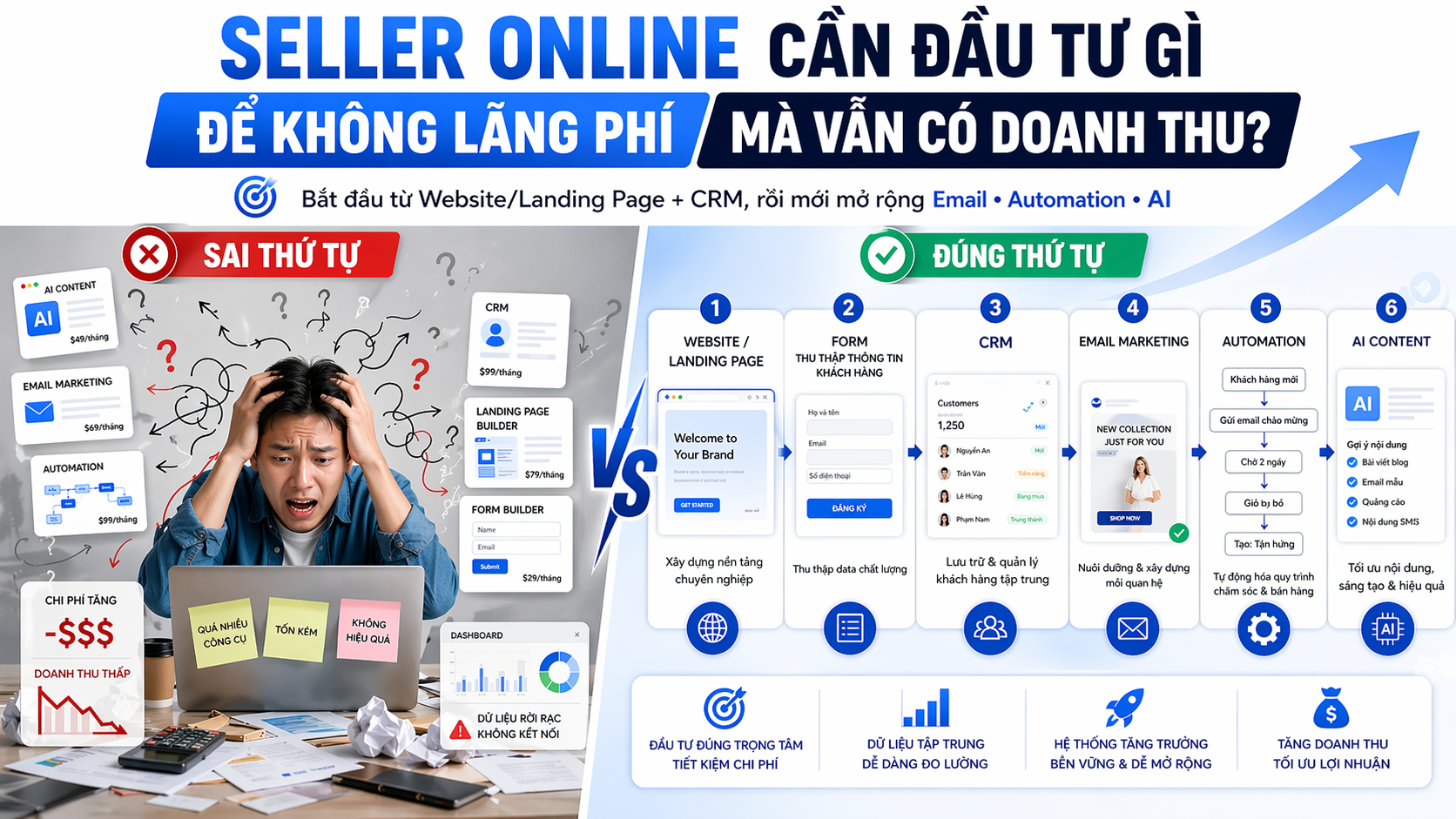
Κατά την έναρξη των online πωλήσεων, πολλοί πωλητές πέφτουν στην παγίδα της αγοράς υπερβολικά πολλών εργαλείων ταυτόχρονα ή επενδύουν σε προηγμένες λειτουργίες ενώ τους λείπει το βασικό σύστημα. Στην πραγματικότητα, οι online πωλητές πρέπει να διακρίνουν σαφώς τα "must have" - τις απαραίτητες πλατφόρμες για να πωλούν και να διατηρούν δεδομένα πελατών - από τα "nice to have" - τα εργαλεία που υποστηρίζουν τη βελτιστοποίηση και την επέκταση, όταν η βασική πλατφόρμα λειτουργεί σταθερά.

Αυτό το άρθρο θα σας βοηθήσει να δημιουργήσετε ένα πλαίσιο ανάπτυξης ανά στάδιο, ώστε να γνωρίζετε πού να δώσετε προτεραιότητα στις επενδύσεις σας για να έχετε ένα ευέλικτο, αποτελεσματικό και εύκολα επεκτάσιμο σύστημα online πωλήσεων στο μέλλον.
Γιατί Πολλοί Πωλητές Αγοράζουν Εργαλεία Με Εμπειρία Και Δυσκολεύουν το Σύστημά τους
Όταν ξεκινούν online επιχειρήσεις, οι πωλητές λαμβάνουν συχνά πολλές συμβουλές από διάφορες πηγές. Σήμερα κάποιος λέει ότι χρειάζεστε αυτοματοποίηση, αύριο κάποιος λέει ότι το περιεχόμενο AI είναι πολύ σημαντικό, και μετά κάποιος συμβουλεύει να επενδύσετε σε email marketing από την αρχή. Όλα είναι σωστά, αλλά αν εφαρμοστούν ταυτόχρονα χωρίς την κατάλληλη βασική πλατφόρμα, οι πωλητές θα υπερφορτωθούν γρήγορα.
Το πρόβλημα δεν είναι η ποιότητα των εργαλείων, αλλά η σειρά υλοποίησής τους. Όταν ένας πωλητής δεν έχει ακόμη έναν ξεκάθαρο ιστότοπο πωλήσεων ή μια landing page, δεν έχει πού να υποδεχτεί πελάτες και να ολοκληρώσει παραγγελίες, η επένδυση σε αυτοματοποίηση ή AI δεν θα αποφέρει την πραγματική της αξία. Ομοίως, όταν ένας πωλητής δεν έχει ένα CRM για να αποθηκεύει πληροφορίες πελατών, η εκτέλεση καμπανιών email marketing για online πωλητές είναι δύσκολο να αποφέρει βιώσιμα αποτελέσματα, καθώς δεν υπάρχουν δεδομένα για μακροχρόνια φροντίδα.
Επιπλέον, πολλά προηγμένα εργαλεία συνοδεύονται από υψηλότερο κόστος και απαιτούν πιο περίπλοκο χρόνο υλοποίησης. Αγοράζοντας πολλά πράγματα πολύ νωρίς, οι πωλητές όχι μόνο ξοδεύουν χρήματα, αλλά σπαταλούν και χρόνο μαθαίνοντας να χρησιμοποιούν λειτουργίες που δεν χρειάζονται πραγματικά. Το αποτέλεσμα είναι ένα δυσλειτουργικό, δύσκολο στη διαχείριση σύστημα, που είναι πολύ δύσκολο να βελτιστοποιηθεί αργότερα.
Πλαίσιο Ανάπτυξης Σύμφωνα Με Κάθε Στάδιο Εξέλιξης Online Πωλητών
Για να αποφύγετε την απλοϊκή επένδυση και την απώλεια ελέγχου, οι πωλητές θα πρέπει να δημιουργούν συστήματα σύμφωνα με ένα σαφές πλαίσιο, βασισμένο στο πραγματικό τους στάδιο ανάπτυξης. Αυτό το πλαίσιο σας βοηθά να γνωρίζετε ακριβώς πού βρίσκεστε και σε τι πρέπει να εστιάσετε στη συνέχεια.
Στάδιο 1: Πώληση
Αυτό είναι το αρχικό στάδιο, όταν οι πωλητές χρειάζονται έναν χώρο για να παρουσιάσουν τα προϊόντα τους, να προσεγγίσουν πελάτες και να πραγματοποιήσουν συναλλαγές. Χωρίς αυτήν τη βάση, οποιοδήποτε άλλο εργαλείο γίνεται ανούσιο.
Σε αυτό το στάδιο, η κορυφαία προτεραιότητα είναι να έχετε έναν ιστότοπο πωλήσεων ή μια landing page, ανάλογα με τον συγκεκριμένο στόχο σας. Αν έχετε πολλά προϊόντα, θέλετε να παρουσιάσετε την επωνυμία σας και να χτίσετε μακροπρόθεσμη αξιοπιστία, ένας ιστότοπος πολλαπλών σελίδων είναι μια λογική επιλογή. Αν εστιάζετε σε ένα μόνο προϊόν ή μια συγκεκριμένη καμπάνια, μια landing page θα σας βοηθήσει να εστιάσετε το μήνυμά σας και να αυξήσετε γρήγορα το ποσοστό μετατροπής.
Επιπλέον, χρειάζεστε μια φόρμα συλλογής πληροφοριών πελατών στον ιστότοπό σας ή στη landing page. Η φόρμα όχι μόνο σας βοηθά να μάθετε ποιος ενδιαφέρεται για το προϊόν, αλλά είναι και η γέφυρα για να προχωρήσετε στο επόμενο στάδιο.
Στάδιο 2: Διατήρηση Δεδομένων
Όταν έχετε πλέον έναν χώρο πωλήσεων και αρχίζετε να λαμβάνετε επισκέπτες, ενέργειες ή πληροφορίες, το επόμενο σημαντικό βήμα είναι η συστηματική αποθήκευση των δεδομένων των πελατών. Χωρίς ένα σύστημα διαχείρισης, είναι εύκολο να χάσετε πληροφορίες, να ξεχάσετε παλιούς πελάτες ή να μην ξέρετε ποιος αγόρασε, ποιος ενδιαφέρεται και ποιος χρειάζεται επιπλέον φροντίδα.
Αυτή είναι η στιγμή που ένα CRM γίνεται ένα must-have εργαλείο. Το CRM σας βοηθά να αποθηκεύετε όλες τις πληροφορίες επικοινωνίας από φόρμες, να κατηγοριοποιείτε τους πελάτες με βάση τη συμπεριφορά τους και να παρακολουθείτε ολόκληρο το ταξίδι τους από την πρώτη επαφή μέχρι την ολοκλήρωση της παραγγελίας. Με ένα CRM, όχι μόνο διατηρείτε τα δεδομένα, αλλά μπορείτε επίσης να διαχειρίζεστε την πωλητική διαδικασία πολύ πιο αποτελεσματικά.
Στάδιο 3: Επανεκπώληση
Αφού έχετε τα δεδομένα των πελατών, το επόμενο βήμα είναι η φροντίδα και η επαναπώληση σε παλιούς πελάτες. Αυτή είναι η στιγμή που εργαλεία όπως το email marketing για online πωλητές αρχίζουν να δείχνουν την αξία τους.
Το email marketing σας βοηθά να διατηρήσετε σχέσεις με τους πελάτες, να στείλετε πληροφορίες για νέα προϊόντα, ειδικές προσφορές ή χρήσιμο περιεχόμενο για να τους κρατήσετε. Όταν έχετε δεδομένα στο CRM, μπορείτε να ομαδοποιήσετε τους πελάτες ανάλογα με τη συμπεριφορά αγοράς και να στείλετε email που ταιριάζουν σε κάθε ομάδα, αντί να στέλνετε μαζικά και άστοχα.
Σε αυτό το στάδιο, η αυτοματοποίηση για online πωλήσεις αρχίζει επίσης να γίνεται χρήσιμη. Αντί να στέλνετε χειροκίνητα email καλωσορίσματος, υπενθυμίσεις για εγκαταλελειμμένα καλάθια ή ευχαριστήρια μετά από αγορά, μπορείτε να ρυθμίσετε αυτοματοποιημένες ροές εργασίας για να εκτελεί το σύστημα αυτές τις ενέργειες χωρίς συνεχή παρέμβαση.
Στάδιο 4: Επέκταση
Όταν το βασικό σύστημα λειτουργεί σταθερά, έχετε σταθερό πελατολόγιο και σαφείς διαδικασίες, μπορείτε να αρχίσετε να επεκτείνετε την κλίμακα και να αυξήσετε την ταχύτητα λειτουργίας. Αυτή είναι η στιγμή που προηγμένα εργαλεία όπως το AI content για ιστοσελίδες πωλήσεων γίνονται μια αξιόλογη "nice to have" προσθήκη.
Το AI content σας βοηθά να γράφετε περιεχόμενο για την ιστοσελίδα, τις landing pages ή τα email πιο γρήγορα, ειδικά όταν χρειάζεται να παράγετε συνεχώς πολλά άρθρα περιγραφής προϊόντων, περιεχόμενο blog ή email campaigns. Ωστόσο, το AI είναι πραγματικά χρήσιμο μόνο όταν έχετε ήδη μια σαφή στρατηγική περιεχομένου και ξέρετε τι θέλετε να γράψετε. Αν δεν έχετε συγκεκριμένη κατεύθυνση, το AI δεν μπορεί να αντικαταστήσει την επιχειρηματική σκέψη και την κατανόηση των πελατών σας.
"Απαραίτητα" Στο Αρχικό Στάδιο: Η Θεμελιώδης Βάση
Όταν ξεκινάτε τις online πωλήσεις, τα "must have" για τους online πωλητές δεν αφορούν τον αριθμό των λειτουργιών, αλλά το αν υπάρχει η απαραίτητη υποδομή για να λειτουργήσει το σύστημα. Εάν λείπει ένα από αυτά τα στοιχεία, οι πωλητές θα αντιμετωπίσουν δυσκολίες από τα πρώτα κιόλας βήματα.
Μια ιστοσελίδα ή Landing Page είναι το σημείο εκκίνησης. Εκεί οι πελάτες μαθαίνουν για τα προϊόντα, διαβάζουν πληροφορίες και αποφασίζουν αν θα αγοράσουν. Χωρίς ιστοσελίδα ή landing page, δεν έχετε πού να υποδεχτείτε τους πελάτες, πού να ολοκληρώσετε παραγγελίες και πού να συλλέξετε πληροφορίες. Όσο καλά κι αν διαφημίζετε, αν δεν έχετε μια σαφή σελίδα προορισμού, οι πελάτες θα φύγουν αμέσως.
Μια φόρμα συλλογής πληροφοριών είναι επίσης απαραίτητη από την αρχή. Η φόρμα σας βοηθά να γνωρίζετε ποιοι ενδιαφέρονται, ποιος άφησε email ή αριθμό τηλεφώνου, και έτσι έχετε δεδομένα για να επικοινωνήσετε ξανά. Χωρίς φόρμα, όλες οι επισκέψεις είναι απλώς αόρατα στατιστικά που δεν μπορείτε να αξιοποιήσετε.
Το CRM γίνεται "must have" μόλις αρχίσετε να έχετε δεδομένα πελατών. Αν αποθηκεύετε πληροφορίες πελατών μόνο σε αρχεία Excel ή σε χαρτί, είναι πολύ εύκολο να χάσετε δεδομένα ή να ξεχάσετε παλιούς πελάτες. Το CRM σας βοηθά να οργανώσετε τις πληροφορίες συστηματικά, να παρακολουθείτε κάθε πελάτη σε κάθε στάδιο και να μην χάνετε ευκαιρίες πωλήσεων.
Εάν λείπει οποιοδήποτε από τα τρία παραπάνω στοιχεία, το σύστημα πωλήσεών σας δεν θα λειτουργεί ομαλά. Αυτός είναι ο λόγος που ονομάζονται "must have", επειδή δημιουργούν τη βασική υποδομή για να μπορείτε να πουλάτε και να διατηρείτε πελάτες.
"Χρειάζεται να Υπάρχει" Στο Επόμενο Στάδιο: Βελτιστοποίηση και Επέκταση
Όταν η βασική υποδομή είναι έτοιμη, εργαλεία όπως το email marketing, η αυτοματοποίηση και το AI content γίνονται "πρέπει να υπάρχουν" για τους online πωλητές στο επόμενο στάδιο ανάπτυξης. Δεν είναι κάτι που χρειάζεστε αμέσως, αλλά αξίζει να επενδύσετε όταν έχετε ήδη δεδομένα και βασικές διαδικασίες που λειτουργούν.
Το Email marketing σας βοηθά να φροντίζετε τους παλιούς πελάτες και να επαναπωλείτε χωρίς να ξοδεύετε πολλά χρήματα σε διαφήμιση. Όταν έχετε ήδη μια λίστα πελατών στο CRM, το email είναι ο πιο αποτελεσματικός τρόπος να διατηρείτε σχέσεις, να στέλνετε προσφορές ή να παρουσιάζετε νέα προϊόντα. Ωστόσο, εάν δεν έχετε ακόμα δεδομένα πελατών ή σαφή διαδικασία πωλήσεων, η επένδυση στο email marketing δεν θα φέρει τα αναμενόμενα αποτελέσματα.
Η αυτοματοποίηση εξοικονομεί χρόνο και αυξάνει τη συνέπεια στις διαδικασίες εξυπηρέτησης πελατών. Αντί να υπενθυμίζετε τον εαυτό σας να στέλνει ένα email καλωσορίσματος σε κάθε νέο πελάτη, μπορείτε να ρυθμίσετε μια αυτοματοποιημένη ροή εργασιών που το σύστημα θα στέλνει αμέσως μόλις εγγραφεί ένας πελάτης. Ωστόσο, η αυτοματοποίηση γίνεται πραγματικά αποτελεσματική μόνο όταν έχετε δεδομένα, έχετε μια διαδικασία και γνωρίζετε ακριβώς ποιες ενέργειες θέλετε να αυτοματοποιήσετε. Εάν δεν έχετε αυτά, η αυτοματοποίηση γίνεται βάρος αντί για εργαλείο υποστήριξης.
Το περιεχόμενο AI σάς βοηθά να παράγετε περιεχόμενο πιο γρήγορα, ειδικά όταν χρειάζεται να γράψετε πολλές περιγραφές προϊόντων, περιεχόμενο blog ή email. Το AI δεν αντικαθιστά πλήρως τους ανθρώπους, αλλά μπορεί να σας βοηθήσει να δημιουργήσετε αρχικά προσχέδια ή να βελτιώσετε υπάρχον περιεχόμενο. Ωστόσο, εάν δεν έχετε μια στρατηγική περιεχομένου ή δεν κατανοείτε πλήρως τους πελάτες σας, το AI δεν θα μπορεί να δημιουργήσει πραγματικά αποτελεσματικό περιεχόμενο.
Το κοινό σημείο αυτών των εργαλείων είναι ότι όλα απαιτούν μια προηγούμενη προετοιμασία πριν από την υλοποίησή τους. Χωρίς ιστοσελίδα, landing page ή CRM, η επένδυση σε email, αυτοματοποίηση ή AI δεν θα αξιοποιηθεί πλήρως.
Πίνακας Διαχωρισμού Must Have και Nice To Have ανά Φάση
Για να γίνετε πιο κατανοητοί, ας εξετάσουμε τη διαφορά μεταξύ must have και nice to have βάσει του ρόλου τους σε κάθε στάδιο ανάπτυξης.
Must Have είναι τα στοιχεία που αποτελούν τη βάση για να λειτουργήσει το σύστημα. Μια ιστοσελίδα πωλήσεων ή ένα landing page για πωλητές είναι ο χώρος όπου οι πελάτες πηγαίνουν, ενημερώνονται και αποφασίζουν να αγοράσουν. Χωρίς αυτόν τον χώρο, δεν μπορείτε να πουλήσετε. Το CRM είναι ο χώρος αποθήκευσης των δεδομένων πελατών, που σας βοηθά να μην χάνετε πληροφορίες και να μπορείτε να παρακολουθείτε κάθε πελάτη σε κάθε στάδιο. Χωρίς CRM, θα δυσκολευτείτε να διαχειριστείτε καθώς ο αριθμός των πελατών αυξάνεται.
Nice To Have είναι εργαλεία που σας βοηθούν να βελτιστοποιήσετε διαδικασίες, να επιταχύνετε τη λειτουργία και να κλιμακώσετε όταν η πλατφόρμα είναι έτοιμη. Το email marketing για online πωλητές σας βοηθά να φροντίζετε παλιούς πελάτες χωρίς να ξοδεύετε πολλά χρήματα σε νέες διαφημίσεις. Η αυτοματοποίηση για online πωλήσεις σάς εξοικονομεί χρόνο αυτοματοποιώντας επαναλαμβανόμενα βήματα. Το περιεχόμενο AI για ιστοσελίδες πωλήσεων σάς βοηθά να παράγετε περιεχόμενο πιο γρήγορα όταν χρειάζεται να κλιμακώσετε.
Η κύρια διαφορά έγκειται στον χρόνο υλοποίησης. Τα must have πρέπει να υπάρχουν από την αρχή για να λειτουργήσει το σύστημα. Τα nice to have πρέπει να υλοποιηθούν αφού τα must have λειτουργούν σταθερά, όταν έχετε ήδη δεδομένα και σαφείς διαδικασίες.
Use Case: Το Ταξίδι Ανάπτυξης ενός Online Πωλητή
Για να κατανοήσετε καλύτερα πώς να εφαρμόσετε αυτό το πλαίσιο, ας δούμε το ταξίδι ενός πωλητή που πουλάει χειροποίητα αντικείμενα στα μέσα κοινωνικής δικτύωσης.
Αρχικά, ο πωλητής αυτός έτρεχε διαφημίσεις στο Facebook και λάμβανε μηνύματα από πελάτες μέσω Messenger. Όλα πήγαιναν σχετικά καλά μέχρι που ο όγκος των μηνυμάτων αυξήθηκε και ο πωλητής άρχισε να ξεχνάει να απαντά σε κάποιους πελάτες, χάνοντας ακόμη και πληροφορίες για ορισμένες παραγγελίες. Συνειδητοποιώντας το πρόβλημα, ο πωλητής αποφάσισε να ψάξει για εργαλεία υποστήριξης.
Κατά τη διάρκεια της έρευνάς του, ο πωλητής άκουσε πολλές συμβουλές για email marketing, αυτοματοποίηση και AI. Νιώθοντας ενθουσιασμένος, ο πωλητής άρχισε αμέσως να ψάχνει να αγοράσει αυτά τα εργαλεία. Ωστόσο, αφού τα αγόρασε, ο πωλητής συνειδητοποίησε ότι δεν ήξερε τι να τα κάνει, αφού δεν είχε μια σαφή ιστοσελίδα για να κατευθύνει τους πελάτες, ούτε φόρμα για τη συλλογή email, ούτε CRM για την αποθήκευση δεδομένων πελατών.
Μετά από λίγο αμηχανία, ο πωλητής αποφάσισε να επιστρέψει στην αρχή και να επαναπροσδιορίσει τις προτεραιότητες. Το πρώτο βήμα ήταν η δημιουργία ενός landing page για τον πωλητή, για την παρουσίαση προϊόντων και έναν χώρο για να κατευθύνει τους πελάτες αντί να συνομιλεί μόνο μέσω Messenger. Στο landing page, ο πωλητής έβαλε μια φόρμα συλλογής πληροφοριών, ώστε οι πελάτες να μπορούν να εγγραφούν για να λαμβάνουν πληροφορίες για νέα προϊόντα ή να αφήσουν ένα αίτημα για συμβουλές.
Όταν πλέον υπήρχε landing page και φόρμα, ο πωλητής άρχισε να χρησιμοποιεί CRM για την αποθήκευση των πληροφοριών των πελατών από τη φόρμα και από προηγούμενα μηνύματα. Αυτή τη φορά, όλες οι πληροφορίες ήταν σαφώς οργανωμένες, ο πωλητής ήξερε ποιος είχε αγοράσει, ποιος ενδιαφέρεται και ποιος χρειάζεται επιπλέον φροντίδα.
Αφού το βασικό σύστημα λειτούργησε ομαλά για μερικούς μήνες, ο πωλητής άρχισε να εφαρμόζει το email marketing για να στέλνει νέες πληροφορίες προϊόντων σε παλιούς πελάτες. Εφόσον υπήρχαν ήδη δεδομένα στο CRM, ο πωλητής μπορούσε να ομαδοποιήσει τους πελάτες και να στείλει σχετικά email, με αποτέλεσμα το ποσοστό ανοίγματος email και το ποσοστό επαναγοράς να αυξηθούν αισθητά.
Τέλος, αφού εξοικειώθηκε με τη διαδικασία, ο πωλητής άρχισε να χρησιμοποιεί την αυτοματοποίηση για να στέλνει αυτόματα email καλωσορίσματος όταν εγγράφονταν νέοι πελάτες και να χρησιμοποιεί περιεχόμενο AI για να γράφει γρήγορα περιγραφές προϊόντων στις landing pages. Εκείνη τη στιγμή, αυτά τα εργαλεία απέδωσαν πραγματικά την αξία τους, καθώς η πλατφόρμα ήταν έτοιμη.
Αυτό το ταξίδι δείχνει ότι η σειρά προτεραιότητας είναι πιο σημαντική από τον αριθμό των εργαλείων. Εάν ο πωλητής επενδύσει στη σωστή σειρά, το σύστημα θα είναι τακτοποιημένο, εύκολο στη διαχείριση και εύκολο στην επέκταση αργότερα.
Γιατί η Σειρά Προτεραιότητας Είναι Πιο Σημαντική από τον Αριθμό των Εργαλείων
Πολλοί πωλητές τείνουν να πιστεύουν ότι όσο περισσότερα εργαλεία, τόσο πιο ισχυρό το σύστημα. Ωστόσο, η πραγματικότητα δείχνει ότι ένα σύστημα με λιγότερα εργαλεία αλλά σωστή διάταξη θα είναι πολύ πιο αποτελεσματικό από ένα σύστημα με όλα τα εργαλεία αλλά χωρίς μια στέρεα βάση.
Όταν αγοράζετε πάρα πολλά εργαλεία ταυτόχρονα, θα αντιμετωπίσετε τα ακόλουθα προβλήματα. Πρώτον, το κόστος αυξάνεται χωρίς αντίστοιχη αποτελεσματικότητα. Τα προηγμένα εργαλεία συνήθως κοστίζουν περισσότερο, και αν δεν χρησιμοποιήσετε όλες τις δυνατότητες, αυτά τα χρήματα γίνονται σπατάλη. Δεύτερον, ο χρόνος εκμάθησης και υλοποίησης παρατείνεται. Κάθε εργαλείο χρειάζεται χρόνο για να εξοικειωθείτε, να το ρυθμίσετε και να το βελτιστοποιήσετε. Αν πρέπει να μάθετε πολλά πράγματα ταυτόχρονα, δεν θα μπορείτε να συγκεντρωθείτε στην πραγματική πώληση. Τρίτον, το σύστημα γίνεται χαοτικό και δύσκολο στη διαχείριση. Όταν υπάρχουν πάρα πολλά εργαλεία χωρίς σαφή διαδικασία, δεν θα γνωρίζετε ποιο εργαλείο να χρησιμοποιήσετε για ποιον σκοπό, οδηγώντας σε σπατάλη χρόνου και προσπάθειας.
Αντίθετα, όταν επενδύετε με λογική σειρά, θα διαπιστώσετε ότι κάθε εργαλείο αξιοποιεί πλήρως την αξία του. Η ιστοσελίδα ή η landing page σας παρέχει έναν σαφή τόπο πώλησης. Το CRM σας βοηθά να διατηρείτε τα δεδομένα των πελατών. Το email marketing σας βοηθά να φροντίζετε αποτελεσματικά τους παλιούς πελάτες. Η αυτοματοποίηση σας βοηθά να εξοικονομήσετε χρόνο. Το περιεχόμενο AI σας βοηθά να επιταχύνετε την παραγωγή περιεχομένου. Κάθε εργαλείο έχει τον δικό του ρόλο και συμπληρώνει τα άλλα όταν υλοποιείται την κατάλληλη στιγμή.
Επιπλέον, επενδύοντας βήμα προς βήμα, έχετε χρόνο να κατανοήσετε τις πραγματικές σας ανάγκες. Μπορεί να συνειδητοποιήσετε ότι δεν χρειάζεστε περίπλοκη αυτοματοποίηση, αλλά μόνο μερικές απλές ροές εργασίας. Ή μπορεί να συνειδητοποιήσετε ότι το περιεχόμενο AI δεν ταιριάζει με το ύφος γραφής της επωνυμίας σας και ότι προτιμάτε να γράφετε εσείς. Αυτές οι αναγνωρίσεις μπορούν να εμφανιστούν μόνο αφού έχετε πραγματικά λειτουργήσει το σύστημα για κάποιο χρονικό διάστημα.
GTG CRM: Η Λύση που Βοηθά τους Πωλητές να Ακολουθήσουν μια Πιο Συνοπτική Πορεία
Αφού κατανοήσετε καλά το πλαίσιο και τη σειρά προτεραιότητας, το επόμενο ερώτημα είναι πώς να υλοποιήσετε αυτά τα στοιχεία αποτελεσματικά χωρίς να αγοράσετε πάρα πολλά ξεχωριστά εργαλεία από διαφορετικούς παρόχους.
Το GTG CRM είναι μια λύση σχεδιασμένη για να βοηθήσει τους online πωλητές να υλοποιήσουν κάθε στάδιο με συνοχή μέσα στο ίδιο οικοσύστημα. Αντί να αναζητούν και να ενσωματώνουν πολλά διαφορετικά εργαλεία, οι πωλητές μπορούν να ξεκινήσουν με τα απαραίτητα στοιχεία, στη συνέχεια να επεκταθούν σε δυνατότητες "nice to have" όταν είναι έτοιμοι.
Στο αρχικό στάδιο, το GTG CRM παρέχει τη δυνατότητα δημιουργίας ιστοσελίδας πολλών σελίδων ή landing page ανάλογα με τους στόχους του πωλητή. Μπορείτε να δημιουργήσετε μια σελίδα παρουσίασης προϊόντων, μια σελίδα πώλησης ή μια σελίδα συλλογής πληροφοριών πελατών χωρίς να χρειάζεστε περίπλοκες τεχνικές γνώσεις. Σε αυτές τις σελίδες, μπορείτε να τοποθετήσετε φόρμες για τη συλλογή πληροφοριών πελατών, και όλα τα δεδομένα από τις φόρμες θα μεταφερθούν αυτόματα στο CRM.
Όταν έχετε πλέον τα δεδομένα των πελατών στο CRM, μπορείτε να διαχειρίζεστε τις πληροφορίες επικοινωνίας, να ταξινομείτε τους πελάτες ανά συμπεριφορά και να παρακολουθείτε κάθε στάδιο της διαδικασίας πωλήσεων. Σε αυτό το σημείο, έχετε μια βασική βάση για να πουλήσετε και να διατηρήσετε τα δεδομένα.
Στο επόμενο στάδιο, όταν θέλετε να φροντίσετε παλιούς πελάτες και να κάνετε επαναπωλήσεις, το GTG CRM προσφέρει λειτουργία email marketing με drag-and-drop builder, που σας βοηθά να δημιουργείτε email εύκολα, να στέλνετε καμπάνιες και να παρακολουθείτε βασικούς δείκτες όπως το ποσοστό ανοίγματος email, το ποσοστό κλικ. Μπορείτε επίσης να ρυθμίσετε αυτοματοποιημένες ροές εργασίας για να στέλνετε αυτόματα email καλωσορίσματος, υπενθυμίσεις ή φροντίδα πελατών με βάση συγκεκριμένες ενέργειες.
Όταν το σύστημα λειτουργεί σταθερά και θέλετε να επιταχύνετε την παραγωγή περιεχομένου, το GTG CRM διαθέτει AI για υποστήριξη στη συγγραφή ή βελτίωση περιεχομένου στο οικοσύστημα, εξοικονομώντας σας χρόνο όταν χρειάζεται να γράψετε πολλές περιγραφές προϊόντων, περιεχόμενο landing page ή email.
Το δυνατό σημείο του GTG CRM είναι ότι όλα αυτά τα στοιχεία συνδέονται μεταξύ τους στην ίδια πλατφόρμα. Δεν χρειάζεται να ανησυχείτε για την ενσωμάτωση μεταξύ website, CRM, email και αυτοματισμού, καθώς έχουν σχεδιαστεί για να λειτουργούν απρόσκοπτα. Αυτό βοηθά τους πωλητές να εξοικονομούν χρόνο υλοποίησης, να μειώνουν το κόστος και να διαχειρίζονται το σύστημα πολύ πιο εύκολα.
Το πιο σημαντικό, το GTG CRM σας επιτρέπει να ξεκινήσετε με τα απαραίτητα στοιχεία (must-have) και να επεκταθείτε σταδιακά όταν είστε έτοιμοι, αντί να αγοράζετε όλες τις λειτουργίες από την αρχή. Αυτό σας βοηθά να επενδύετε με τη σωστή σειρά, σύμφωνα με το πραγματικό στάδιο ανάπτυξής σας.
Αυτοαξιολογηθείτε σε Ποιο Στάδιο Βρίσκεστε
Για να γνωρίζετε πού πρέπει να δώσετε προτεραιότητα στις επενδύσεις σας, αυτοαξιολογηθείτε σε ποιο στάδιο βρίσκεστε στο ταξίδι ανάπτυξής σας.
Αν δεν έχετε ακόμη ένα σαφές website ή landing page, ένα μέρος για να κατευθύνετε τους πελάτες όταν τρέχετε διαφημίσεις ή μοιράζεστε συνδέσμους, τότε βρίσκεστε στο στάδιο που χρειάζεται να πουλήσετε. Σε αυτήν την περίπτωση, η πρώτη προτεραιότητα είναι να δημιουργήσετε έναν χώρο για να παρουσιάσετε προϊόντα και να κλείσετε παραγγελίες. Δεν χρειάζεται να βιάζεστε να σκεφτείτε email, αυτοματισμό ή AI.
Αν έχετε ήδη ένα μέρος για να πουλήσετε, αλλά τα στοιχεία των πελατών σας είναι διάσπαρτα σε πολλά μέρη, ή συχνά ξεχνάτε τους παλιούς πελάτες, τότε βρίσκεστε στο στάδιο που χρειάζεται να διατηρήσετε δεδομένα. Σε αυτήν την περίπτωση, η επένδυση σε CRM θα σας βοηθήσει να οργανώσετε καλύτερα τα δεδομένα σας και να μην χάσετε ευκαιρίες πωλήσεων.
Αν έχετε ήδη δεδομένα πελατών στο CRM, αλλά δεν έχετε έναν οργανωμένο τρόπο φροντίδας παλιών πελατών, τότε βρίσκεστε στο στάδιο που χρειάζεται να επαναπωλήσετε. Σε αυτήν την περίπτωση, το email marketing θα είναι ένα χρήσιμο εργαλείο για τη διατήρηση σχέσεων και την αύξηση εσόδων από παλιούς πελάτες.
Αν έχετε μια σαφή διαδικασία, έχετε δεδομένα πελατών και στέλνετε email τακτικά, αλλά νιώθετε ότι αφιερώνετε πολύ χρόνο σε επαναλαμβανόμενες εργασίες, τότε βρίσκεστε στο στάδιο που χρειάζεται να επεκταθείτε (scale). Σε αυτήν την περίπτωση, ο αυτοματισμός και το AI content θα σας βοηθήσουν να εξοικονομήσετε χρόνο και να επιταχύνετε τη λειτουργία.
Αυτή η αυτοαξιολόγηση σας βοηθά να μην παρασυρθείτε από γενικές συμβουλές, αλλά να εστιάσετε σε ό,τι είναι πραγματικά απαραίτητο για το τρέχον στάδιο σας.
Συμπέρασμα
Οι online πωλητές δεν χρειάζονται τα πάντα ταυτόχρονα. Το πιο σημαντικό είναι να γνωρίζουν σε ποιο στάδιο βρίσκονται και πού πρέπει να επενδύσουν για να λειτουργεί σταθερά το σύστημα πριν επεκταθούν περαιτέρω.
Τα "Must have" είναι οι απαραίτητες βάσεις για να μπορείτε να πουλάτε και να διατηρείτε δεδομένα πελατών, συμπεριλαμβανομένων website ή landing page, φόρμα συλλογής πληροφοριών και CRM. Τα "Nice to have" είναι τα εργαλεία που βοηθούν στη βελτιστοποίηση και την επέκταση όταν η βάση είναι έτοιμη, συμπεριλαμβανομένων email marketing, αυτοματισμού και AI content.
Η σειρά προτεραιότητας είναι πιο σημαντική από τον αριθμό των εργαλείων. Όταν επενδύετε με τη σωστή σειρά, ανάλογα με το στάδιο ανάπτυξης, το σύστημα θα είναι τακτοποιημένο, αποτελεσματικό και εύκολο να επεκταθεί αργότερα.
Αν αναζητάτε μια λύση που θα σας βοηθήσει να υλοποιήσετε βήμα-βήμα με συνέπεια, δείτε τη λύση για πωλητές με το GTG CRM για να μάθετε πώς να χτίσετε ένα λιτό σύστημα online πωλήσεων από τη βάση έως την επέκταση.
Συχνές Ερωτήσεις
Τι είναι τα must-have για τους online πωλητές;
Τα must-have για τους online πωλητές είναι τα θεμελιώδη στοιχεία που είναι απαραίτητα για τη λειτουργία ενός συστήματος πωλήσεων, συμπεριλαμβανομένων website ή landing page για την παρουσίαση προϊόντων και το κλείσιμο παραγγελιών, φόρμα για τη συλλογή πληροφοριών πελατών, και CRM για την αποθήκευση και διαχείριση δεδομένων πελατών. Χωρίς αυτά τα στοιχεία, οι πωλητές θα δυσκολευτούν να πουλήσουν ή θα χάσουν εύκολα πληροφορίες πελατών.
Το "Nice to have" σημαίνει ότι δεν είναι σημαντικό;
Το "Nice to have" δεν σημαίνει ότι κάτι δεν είναι σημαντικό, αλλά ότι δεν είναι απαραίτητο να υλοποιηθεί άμεσα στην αρχική φάση. Εργαλεία όπως το email marketing, η αυτοματοποίηση και το AI content είναι πολύ χρήσιμα για τη βελτιστοποίηση διαδικασιών και την επιτάχυνση της λειτουργίας, αλλά αποδίδουν πραγματική αξία μόνο όταν ο πωλητής έχει ήδη μια βασική υποδομή όπως ιστοσελίδα, landing page και CRM. Η επένδυση σε "nice to have" πολύ νωρίς μπορεί να οδηγήσει σε σπατάλη χρόνου και κόστους.
Γιατί χρειάζεται CRM όταν ξεκινάς τις online πωλήσεις;
Το CRM βοηθά τον πωλητή να αποθηκεύει τις πληροφορίες των πελατών μεθοδικά από την αρχή, αποφεύγοντας την απώλεια δεδομένων ή την ξεχασιμότητα παλιών πελατών. Με ένα CRM, μπορείς να παρακολουθείς κάθε πελάτη σε κάθε στάδιο, γνωρίζοντας ποιος αγόρασε, ποιος ενδιαφέρεται και ποιος χρειάζεται περαιτέρω φροντίδα. Χωρίς CRM, η διαχείριση πελατών γίνεται χαοτική καθώς ο αριθμός τους αυξάνεται.
Πότε πρέπει να αρχίσεις να χρησιμοποιείς email marketing;
Πρέπει να αρχίσεις να χρησιμοποιείς email marketing όταν έχεις ήδη δεδομένα πελατών στο CRM και θέλεις να φροντίσεις παλιούς πελάτες ή να κάνεις επαναπώληση. Αν δεν έχεις δεδομένα ή μια σαφή διαδικασία πωλήσεων, το email marketing δεν θα αποδώσει. Το email marketing είναι πιο κατάλληλο για τη φάση επαναπώλησης, όταν θέλεις να διατηρήσεις τη σχέση με τους παλιούς πελάτες και να αυξήσεις τα έσοδα από αυτή την ομάδα.
Είναι απαραίτητη η αυτοματοποίηση από την αρχή;
Η αυτοματοποίηση δεν είναι απαραίτητη από την αρχή, γιατί στην αρχική φάση, οι πωλητές συνήθως δεν έχουν αρκετά δεδομένα και σαφείς διαδικασίες για να αυτοματοποιήσουν. Η αυτοματοποίηση γίνεται πραγματικά χρήσιμη όταν έχεις μια σταθερή διαδικασία πωλήσεων, δεδομένα πελατών και ξέρεις ακριβώς ποια βήματα θέλεις να αυτοματοποιήσεις. Αν εφαρμοστεί πολύ νωρίς, η αυτοματοποίηση μπορεί να γίνει βάρος αντί για εργαλείο υποστήριξης.
Το GTG CRM είναι κατάλληλο για νέους πωλητές;
Το GTG CRM είναι κατάλληλο για νέους πωλητές, επειδή σου επιτρέπει να υλοποιείς βήμα-βήμα, ανάλογα με την πραγματική ανάπτυξη. Μπορείς να ξεκινήσεις με ιστοσελίδα ή landing page και CRM για να έχεις μια βασική υποδομή, και στη συνέχεια να επεκταθείς σε email marketing, αυτοματοποίηση και AI content όταν είσαι έτοιμος. Όλα αυτά τα στοιχεία συνδέονται στην ίδια πλατφόρμα, εξοικονομώντας σου χρόνο ενσωμάτωσης και διευκολύνοντας τη διαχείριση.
Μετέτρεψε όσα διάβασες σε πραγματικά αποτελέσματα — εφάρμοσε το τώρα με το GTG CRM, δωρεάν.
Εφάρμοσε τώρα