When starting an online business, many sellers easily fall into the trap of buying too many tools at once or investing in advanced features while the basic system is still lacking. In reality, online sellers need to clearly distinguish between "must-have" tools—essential platforms for selling and retaining customer data—and "nice-to-have" tools—tools that optimize and expand once the basic platform is running smoothly.

This article will help you build a framework in stages, so you know where to prioritize your investment first to create a streamlined, efficient, and easily scalable online sales system.
Why Do Many Sellers Buy Tools on Impulsiveness and Get Confused About the System?
When starting an online business, sellers often receive a lot of advice from different sources. Today someone might say automation is essential, tomorrow someone else might say AI content is crucial, and then another might advise investing in email marketing right from the start. All of this is true, but applying everything at once without a solid foundation can quickly overwhelm the seller.
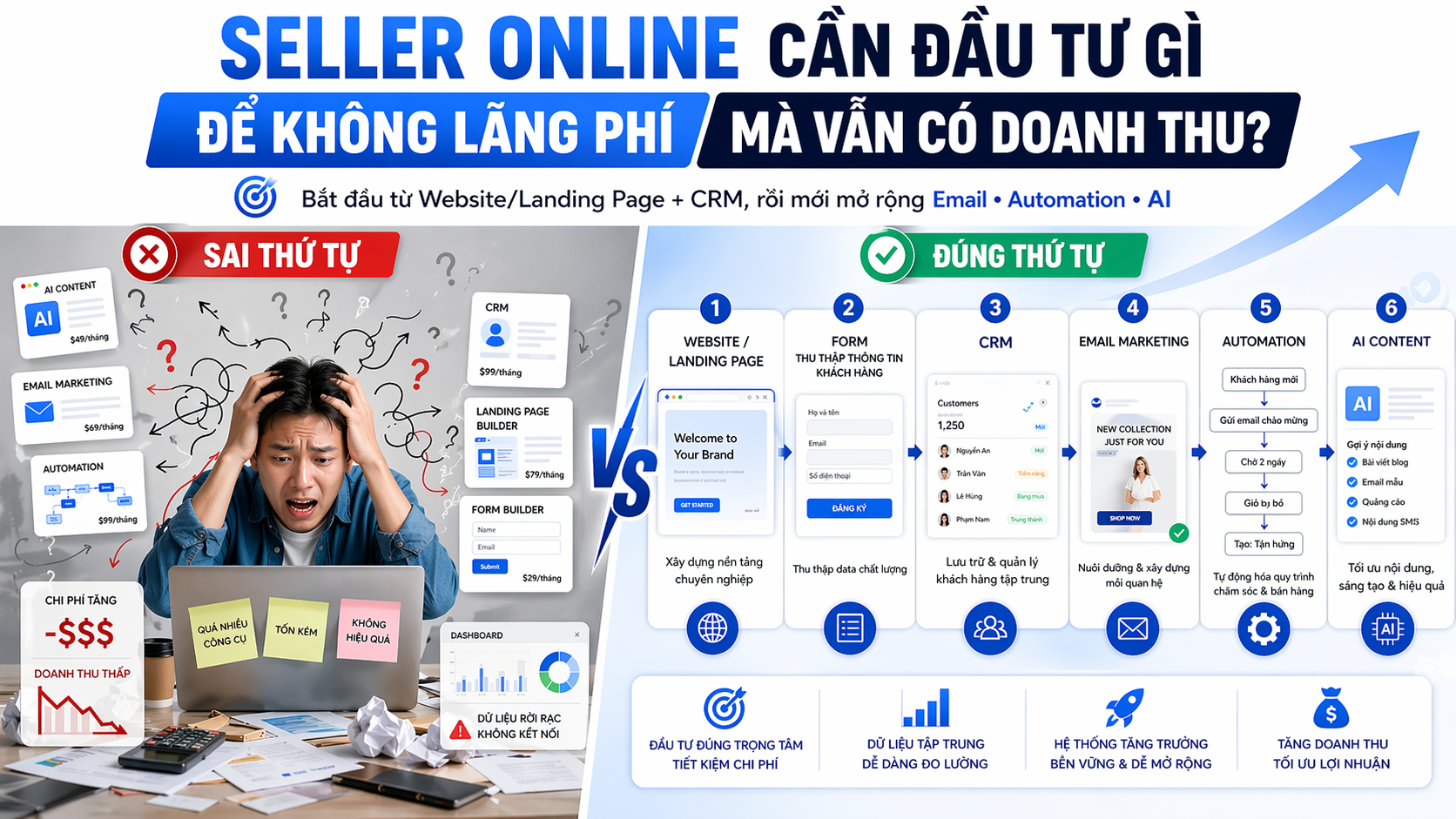
The problem isn't the quality of the tools, but the order in which they're implemented. If a seller doesn't have a website or a clear landing page, a place to attract customers and close deals, investing in automation or AI won't yield real value. Similarly, if a seller doesn't have a CRM to store customer information, running email marketing campaigns online will be difficult to sustain because there's no data for long-term customer care.
Furthermore, many advanced tools often come with higher costs and require more complex implementation time. By purchasing too many things too early, sellers not only incur financial costs but also waste time learning how to use features they don't actually need. As a result, the operating system becomes cluttered, difficult to manage, and very difficult to optimize later.
Framework for the Stages of Online Seller Development
To avoid scattered and uncontrolled investments, sellers should build their system using a clear framework based on their actual development stage. This framework helps you know exactly where you are and what you need to focus on next.
Phase 1: Sold
This is the initial stage, where sellers need a place to showcase their products, reach customers, and complete transactions. Without this platform, all other tools become meaningless.
At this stage, the top priority is having a sales website or a seller landing page, depending on your specific goals. If you have many products, need to introduce your brand, and build long-term trust, a multi-page website is a sensible choice. If you focus on only one product or a specific campaign, a landing page will help you concentrate your message and increase conversion rates quickly.
Additionally, you need a customer information collection form directly on your website or landing page. This form not only helps you identify who is interested in your product but also serves as a bridge to the next stage.
Phase 2: Data Retention
Once you have a sales page and start getting visitors, actions, or information, the next crucial step is to systematically store customer data. Without a management system, you can easily lose information, forget old customers, or not know who has made a purchase, who is interested, and who needs further attention.
This is where CRM for sellers becomes a must-have tool. CRM helps you store all contact information from forms, categorize customers by behavior, and track their entire journey from initial contact to closing the sale. With CRM, you not only keep your data secure but can also manage your sales process much more effectively.
Phase 3: Resale
After collecting customer data, the next stage is nurturing relationships and reselling to existing customers. This is where tools like email marketing for online sellers begin to show their true value.
Email marketing helps you maintain relationships with customers, sending information about new products, special offers, or useful content to retain them. Once you have data in your CRM, you can segment customers by purchasing behavior and send targeted emails to each group, instead of sending mass emails without a goal.
At this stage, automation for online sales also begins to become useful. Instead of manually sending welcome emails, reminders for forgotten carts, or thank-you messages after purchases, you can set up an automated workflow for the system to run these actions without constant intervention.
Phase 4: Scale
Once the basic system is running smoothly, with a stable customer base and clear processes, you can begin to scale up and increase operational speed. This is when advanced tools like AI content creation for e-commerce websites become valuable and worthwhile.
AI content helps you write website content, landing pages, or emails faster, especially when you need to produce a large number of product descriptions, blog posts, or email campaigns continuously. However, AI is only truly useful when you have a clear content strategy and know what you need to write. Without a specific direction, AI cannot replace your business thinking and understanding of your customers.
"Essential" in the Early Stage: An Indispensable Foundation
When starting to sell online, the must-have for online sellers isn't about the number of features, but about having a solid foundation for the system to run. Without any of these components, sellers will face difficulties right from the start.
A website or landing page is the starting point. This is where customers learn about the product, read information, and decide whether or not to buy. Without a website or landing page, you have no place to welcome customers, no place to close deals, and no place to collect information. No matter how good your advertising is, without a clear landing page, customers will leave immediately.
Information collection forms are an essential part of the process right from the start. They help you identify interested individuals, those who leave their email addresses or phone numbers, and provide you with the data to contact them. Without forms, all website visits are just intangible data that you can't leverage.
CRM becomes a must-have as soon as you start collecting customer data. If you only store customer information in Excel files or on paper notes, it's easy to lose data or forget old customers. CRM helps you organize information systematically, track each customer through each stage, and not miss any sales opportunities.
Without any of these three elements, your sales system will not be able to function smoothly. This is why they are called must-haves, because they form the most fundamental foundation for you to sell and retain customers.
"Necessary" for the Next Stage: Optimization and Scaling
Once the basic foundation is in place, tools like email marketing, automation, and AI content will become essential for online sellers in the next stage of development. They're not something you need immediately, but they're well worth investing in once you have the data and underlying processes running smoothly.
Email marketing helps you nurture existing customers and resell without spending excessive amounts on advertising. Once you have a customer list in your CRM, email is the most effective way to maintain relationships, send offers, or introduce new products. However, if you don't have customer data or a clear sales process, investing in email marketing may not yield the expected results.
Automation saves time and increases consistency in customer service processes. Instead of remembering to send welcome emails to each new customer, you can set up an automated workflow so the system sends them as soon as a customer registers. However, automation is only truly effective when you have data, established processes, and know exactly which steps you want to automate. Without these, automation will become a burden rather than a helpful tool.
AI content helps you produce content faster, especially when you need to write many product descriptions, blog posts, or emails. AI won't completely replace humans, but it can assist you in creating initial drafts or improving existing content. However, if you don't have a content strategy or a thorough understanding of your customers, AI won't be able to create truly effective content.
The common thread among these tools is that they all require a foundation before deployment. Without a website, landing page, or CRM, investing in email, automation, or AI will not yield its true value.
Table Differentiating Must Have and Nice To Have by Stage
To make it easier to understand, consider the difference between "must have" and "nice to have" based on their roles in each stage of development.
Must-Have components are the foundation upon which a system can operate. A sales website or landing page is where customers come, learn about products, and decide to buy. Without this, you can't sell anything. A CRM (Customer Relationship Management) storees customer data, preventing information loss and allowing you to track each customer through different stages. Without a CRM, managing a growing customer base is difficult.
Nice To Have tools help you optimize processes, speed up operations, and scale up once your platform is ready. Email marketing for online sellers helps you nurture existing customers without spending a lot on new advertising. Online sales automation saves you time by automating repetitive steps. AI content for e-commerce websites helps you produce content faster when you need to scale up.
The main difference lies in the timing of deployment. Must-have systems need to be in place from the start for the system to run. Nice-to-have systems should be deployed after the must-have system is stable, when you have clear data and processes in place.
Use Case: The Development Journey of an Online Seller
To better understand how to apply this framework, consider the journey of a seller of handmade goods on social media.
Initially, this seller ran ads on Facebook and received messages from customers via Messenger. Everything went quite well until the volume of messages increased and the seller started forgetting to reply to some customers, even losing information on some orders. Realizing the problem, the seller decided to look into support tools.
During their research, the seller heard a lot of advice about email marketing, automation, and AI. Intrigued, the seller immediately started looking to buy these tools. However, after purchasing them, the seller realized they didn't know what to do with them because they lacked a clear website to attract customers, a form to collect emails, and a CRM to store customer data.
After a period of uncertainty, the seller decided to start over and re-prioritize. The first step was to create a landing page to showcase products and provide a place for customers to connect, instead of just messaging via Messenger. On the landing page, the seller placed a form to collect information so customers could sign up for new product updates or leave a request for consultation.
Once the landing page and form are ready, the seller begins using a CRM to store customer information from the form and previous messages. This time, all the information is clearly organized, and the seller knows who has made a purchase, who is interested, and who needs further follow-up.
After the basic system has been running smoothly for a few months, the seller begins implementing email marketing to send information about new products to existing customers. Because they already have data in the CRM, the seller can segment customers and send relevant emails, resulting in a significant increase in email open rates and repurchase rates.
Finally, once familiar with the process, sellers begin using automation to automatically send welcome emails when new customers sign up and use AI content to quickly write product descriptions on landing pages. At this point, these tools truly prove their value because the foundation is already in place.
This journey demonstrates that prioritization is more important than the number of tools. If sellers invest in the right order, the system will be streamlined, easy to manage, and easy to expand later.
Why is Prioritization More Important Than the Number of Tools?
Many sellers tend to think that the more tools a system has, the more powerful it is. However, the reality is that a system with fewer tools but arranged in the right order is far more effective than a system with many tools but no foundation.
When you buy too many tools at once, you'll encounter the following problems. First, costs increase without a corresponding increase in effectiveness. Advanced tools are often more expensive, and if you don't use all the features, that money becomes wasted. Second, learning and deployment time is prolonged. Each tool requires time to get acquainted with, set up, and optimize. If you have to learn too many things at once, you won't be able to focus on actual sales. Third, the system becomes cluttered and difficult to manage. With too many tools and no clear process, you won't know which tool to use for what purpose, leading to wasted time and effort.
Conversely, when you invest in the right order, you'll find that each tool delivers its full value. A website or landing page provides a clear sales channel. CRM helps you maintain customer data. Email marketing helps you effectively nurture existing customers. Automation saves you time. AI content helps you speed up content production. Each tool has its own role and complements the others when implemented at the right time.
Furthermore, when you invest gradually, you have time to truly understand your needs. You might realize that you don't need complex automation, but just a few simple workflows. Or you might realize that AI content doesn't suit your brand's writing style, and you still want to write it yourself. These realizations only emerge after you've actually been running the system for a while.
GTG CRM: A Solution to Help Sellers Follow a Shorter Journey
Once you understand the framework and its priorities, the next question is how to implement these components effectively without having to purchase too many separate tools from different vendors.
GTG CRM is a solution designed to help online sellers seamlessly implement each stage within a single ecosystem. Instead of searching for and integrating many different tools, sellers can start with the must-have components first, then expand to nicer features when ready.
In its initial stages, GTG CRM offers the ability to create multi-page websites or landing pages depending on the seller's goals. You can build product introduction pages, sales pages, or customer information capture pages without needing complex technical knowledge. On these pages, you can place forms to collect customer information, and all data from the forms will be automatically transferred to the CRM.
Once you have customer data in your CRM, you can manage contact information, categorize customers by behavior, and track each stage of the sales process. At this point, you have a basic foundation for selling and retaining data.
In the next stage, when you want to nurture existing customers and resell, GTG CRM offers email marketing features with a drag-and-drop builder, allowing you to easily create emails, send campaigns, and track key metrics such as email open rates and click-through rates. You can also set up automation workflows to automatically send welcome emails, reminders, or customer care emails based on specific actions.
Once the system is running smoothly and you want to speed up content production, GTG CRM has AI support for writing or improving content within the ecosystem, saving you time when you need to write multiple product descriptions, landing page content, or emails.
GTG CRM's strength lies in the fact that all these components are connected within a single platform. You don't need to worry about integration between your website, CRM, email, and automation because they are designed to work seamlessly. This saves sellers deployment time, reduces costs, and makes system management much easier.
More importantly, GTG CRM allows you to start with the must-have components and gradually expand as you're ready, instead of having to buy all features at once. This helps you invest in the right order, matching your actual development stage.
Self-Assess: What Stage Are You Currently In?
To know where you should prioritize your investments, assess where you are in your development journey.
If you don't yet have a clear website or landing page, or a place to direct customers when running ads or sharing links, then you're in the sales phase. At this point, the top priority is creating a place to showcase your product and close deals. There's no need to rush into email marketing, automation, or AI.
If you already have a physical store but your customer information is scattered across multiple locations, or you frequently forget about old customers, then you're at a stage where data retention is crucial. Investing in a CRM system will help you organize your data better and avoid missing sales opportunities.
If you already have customer data in your CRM but lack a systematic way to nurture existing customers, then you're at the stage where reselling is necessary. At this point, email marketing will be a useful tool to maintain relationships and increase revenue from existing customers.
If you have a clear process, customer data, and are sending emails regularly but feel you're wasting a lot of time on repetitive tasks, then you're at a stage where scaling is necessary. At this point, automation and AI content will help you save time and speed up operations.
This self-assessment helps you avoid being swayed by generic advice and focus on what is truly necessary for your current stage.
Conclude
Online sellers don't need everything at once. It's more important to know where you are and where to invest to ensure your system runs smoothly before expanding further.
Must-haves are essential platforms for selling and retaining customer data, including websites or landing pages, information collection forms, and CRM. Nice-to-have tools help optimize and scale once the platform is ready, including email marketing, automation, and AI content.
Prioritization is more important than the number of tools. When you invest in the right order according to the development stage, the system will be streamlined, efficient, and easier to scale later.
If you're looking for a solution that helps you implement a step-by-step process in a coherent manner, check out GTG CRM's seller-specific solution suite to learn how to build a streamlined online sales system from the ground up to the scalable level.
Frequently Asked Questions
What are essentials for online sellers?
Essential components for online sellers to have a functioning sales system include a website or landing page to showcase products and close sales, forms to collect customer information, and a CRM to store and manage customer data. Without these components, sellers will find it difficult to sell or risk losing customer information.
"Nice to have" means "not important," right?
"Nice to have" doesn't mean unimportant, but rather that it doesn't need to be implemented immediately in the early stages. Tools like email marketing, automation, and AI content are very useful for optimizing processes and speeding up operations, but they only truly prove valuable when sellers already have a basic foundation like a website, landing page, and CRM. Investing in "nice to have" too early can be a waste of time and money.
Why do you need a CRM when starting an online business?
CRM helps sellers store customer information systematically from the start, preventing data loss or forgetting old customers. With CRM, you can track each customer through each stage, knowing who has purchased, who is interested, and who needs further attention. Without CRM, customer management becomes chaotic as the number of customers increases.
When should you start using email marketing?
Email marketing should only be used when you have customer data in your CRM and want to nurture existing customers or resell to them. If you don't have data or a clear sales process, email marketing won't be effective. Email marketing is most suitable for the resale stage, when you want to maintain relationships with existing customers and increase revenue from this customer group.
Is automation necessary from the start?
Automation isn't necessary from the start because, in the early stages, sellers often don't have enough data and clear processes to automate. Automation is only truly useful when you have a stable sales process, customer data, and know exactly which steps you want to automate. If implemented too early, automation can become a burden instead of a helpful tool.
Is GTG CRM suitable for beginner sellers?
GTG CRM is suitable for beginner sellers because it allows you to implement it step-by-step according to your actual development stage. You can start with a website or landing page and CRM for a basic foundation, then expand to email marketing, automation, and AI content when you're ready. All these components are connected within the same platform, saving you integration time and making it easier to manage.
Turn what you've just read into tangible results — apply it now with GTG CRM, free.
Apply now