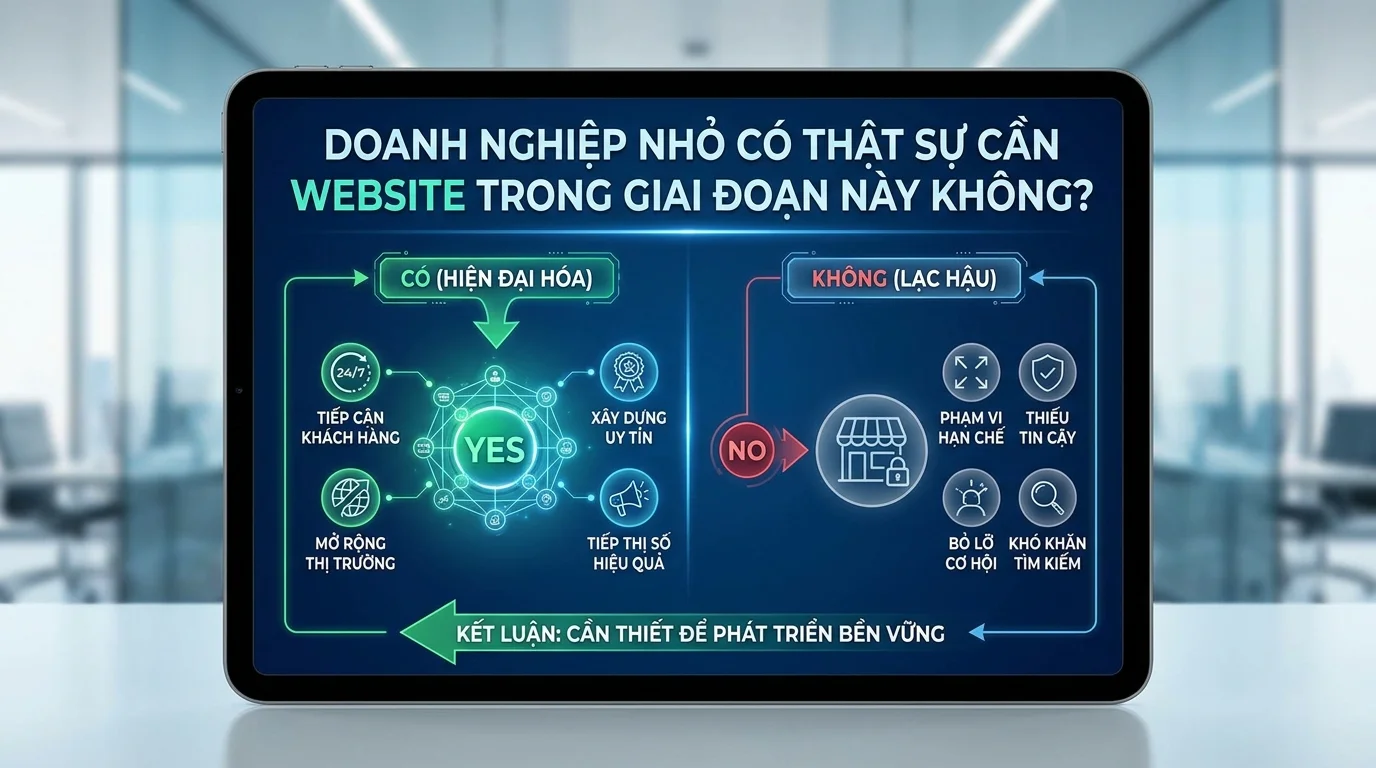
Many small business owners are already doing well with Facebook, Zalo, or e-commerce platforms, and often wonder if they really need to invest in a website. The answer isn't always "yes immediately," but when a business starts needing to build trust with new customers, requires a central, official information hub, or wants to run more effective advertising campaigns, a website becomes an indispensable platform for a serious and professional online presence.

This article will help you better understand the question of whether small businesses need a website , in what situations it is truly necessary, and why a website is important for the development stage of a business.
Why haven't many small businesses created websites?
In reality, many small and medium-sized enterprises (SMEs) are operating entirely based on channels such as Facebook, Zalo, e-commerce platforms, or word-of-mouth referrals. These channels yield initially good results, with quick customer interaction, low costs, and ease of management.
Therefore, many business owners believe that creating a website is unnecessary, or can be postponed. Some common reasons for website deployment delays include:
- Initial costs : Concerns about the cost of designing, programming, and maintaining a website.
- Lack of technical knowledge : Feeling that website management is too complicated and requires a specialist.
- No clear demand yet : Because business is still growing well through existing channels.
- Not knowing where to start : Unsure of what's needed, what the content should be like, or how to design it.
These concerns are entirely valid. However, as businesses grow and need to reach new customers or expand their markets, relying solely on fragmented channels will reveal many limitations.
When do small businesses really need a website?
A website for an SMB isn't always the top priority. However, there are specific stages and situations where a website becomes essential for the sustainable growth of the business.
1. When you need to create a professional and trustworthy image.
Today's customers, especially business customers or individual customers with high order values, often want to do thorough research before making a purchase decision. They will search for information about the company on Google, and if they only find a personal Facebook page or nothing at all, their trust level will decrease significantly.
A well-designed website for a small business demonstrates that the business is serious and provides clear information about its products, services, team, and contact details.
2. When there is a lot of information that needs to be presented in full.
Facebook and Zalo are good channels for quick interaction, but it's difficult to organize information logically and comprehensively. When businesses need to introduce multiple services, price lists, work processes, case studies, or warranty policies, a clearly structured website will make it much easier for customers to access the information.
3. When running ads and needing a primary source of traffic.
If your business is running ads on Google Ads, Facebook Ads, or TikTok Ads, directing customers to a Facebook page or Zalo inbox often seems unprofessional and can easily raise suspicion. A landing page for small businesses or a website with relevant content will help increase conversion rates and make better use of your advertising budget.
4. When you want an official channel to encourage customers to return.
Unlike social media posts, which can easily get lost or be difficult to find again, a website is a fixed place that customers can return to at any time to find information, review products, or contact the business. It is a long-term digital asset for the company.
5. When systematic customer information collection is required.
If a business wants to build a database of potential customers, a website with a contact or registration form is a very useful tool. Information from the website can be integrated into a CRM system to manage and nurture customers more effectively.
Signs that your business lacks a website.
Sometimes, the realization that you need a website doesn't come from planning, but from practical problems in the operational process. Below are common signs that your business is struggling because it doesn't have a proper website.
Customers ask many questions, but it's difficult to send them a summary of the information.
When new customers contact you via Zalo or Messenger, they often ask about prices, services, procedures, and policies. If you have to send back long messages, PDF files, or disjointed links every time a customer asks, it's a clear sign that your business needs a centralized information hub.
Information is scattered across many channels.
Some businesses post prices on Facebook, but advertise their services on Zalo, while actual product images are on Instagram. Customers have to search through multiple places to get a full understanding, which can easily tire them out and make them give up.
New customers may find it difficult to verify credibility.
When customers search for a business name on Google and find nothing but a few Facebook posts, or nothing at all, they will question its credibility. A company website with complete information, business licenses, address, and phone number will build online credibility for the business from the very first interaction.
Missed opportunity because customers couldn't find the information quickly enough.
Many customers don't have time to chat back and forth or wait for responses. They want to quickly find out more before deciding to contact you. Without a website, businesses may be losing these potential customers without even realizing it.
The sales team must repeatedly answer basic questions.
If sales staff have to repeatedly explain products, services, processes, or policies to each new customer, it's a sign that an online presence is needed so customers can learn about the product or service themselves, saving time for both parties.
The practical business benefits of a website for small businesses.
Many business owners still think of a website as just "a page to have for the sake of having it," but in reality, when implemented correctly, a website delivers very concrete business value.
Create official and trusted touchpoints.
A website is like a virtual office, a place customers can visit anytime to learn about your business. It's the only place where you have complete control over the content, images, and messaging you convey, without being dependent on social media algorithms or e-commerce platform policies.
Increase your ability to reach new customers.
With a website that is optimized for basic SEO, businesses have a better chance of appearing in Google search results. This helps reach customers who are actively searching for your products and services, rather than just waiting for them to stumble upon your social media posts.
It serves as a foundation for marketing campaigns.
All marketing activities, such as running ads, sending emails, and sharing on social media, need a clear destination. A website acts as the center of the marketing ecosystem, concentrating traffic from all channels and converting it into potential customers.
Collect customer data systematically.
With contact forms, consultation registration forms, or email collection popups, websites help businesses build a systematic database of potential customers. This data can then be integrated into a CRM system for more effective customer care and conversion.
Reduce consulting and customer service costs.
When information about products, services, processes, and policies is clearly presented on the website, customers can research it themselves beforehand. This reduces the number of basic questions the sales team has to handle, allowing them to focus on customers with genuine high demand.
Creating long-term digital assets for businesses.
Unlike paid advertising or short-lived social media posts, a website is a long-term digital asset. Once built and optimized well, a website will continue to deliver value to a business for many years.
The real story: When a business lacks a website, it misses opportunities.
A small business specializing in interior design consulting services did quite well in its first two years thanks to referrals from regular customers and a few Facebook posts. The business owner believed that a fan page was sufficient, as customers usually contacted them directly via Messenger.
However, when they started running Facebook Ads to expand their customer base, the conversion rate was very low. After analysis, they realized that many potential customers, after clicking on the ads and visiting the fan page, couldn't find complete information about the services, work process, price list, or completed projects. They had to inbox to ask individual questions, but not everyone had the patience to wait for a response.
Some customers even search for the business name on Google to verify its credibility before deciding to contact it, but find nothing except a fan page. They begin to have doubts and start researching other competitors with more professional websites.
After realizing the problem, the company decided to build a simple website with pages introducing services, project portfolios, workflows, and a contact form. As a result, the conversion rate from advertising increased significantly, and the number of customers leaving their information through the form also increased. More importantly, they no longer had to waste time answering basic questions.
Websites are not a replacement for social media, but rather the official platform.
A common misconception is that having a website eliminates the need for social media, or vice versa. In reality, both are important and play different roles within a business's marketing ecosystem.
The role of social media
Facebook, Zalo, Instagram, and TikTok are great channels for:
- Interact directly and quickly with customers.
- Building community and fostering connections.
- Run ads at a reasonable cost.
- Share short, engaging, and easily shareable content.
However, these channels have major limitations: you don't control the algorithms, you don't fully own customer data, and content can easily get lost or disappear over time.
The role of websites
A website, on the other hand, is a platform that you have complete control over. This is where:
- Focus on providing complete and organized information.
- Demonstrate professionalism and credibility.
- Receive traffic from all marketing channels.
- Collecting and managing customer data
- Optimizing SEO to appear on Google.
The ideal combination is to use social media to reach and engage with customers, then direct them to the website for further information and conversion into actual customers. For example, a Facebook post might attract attention, but when customers want to learn more, they will click on the website link to view details, pricing, procedures, and leave their contact information.
Small businesses don't need a complicated website to get started.
A major barrier preventing many small businesses from creating a website is the belief that they need a very large, beautiful, and expensive website. In reality, to get started, you only need a website that is clear, trustworthy, and functional enough.
What does a basic website need to have?
A simple e-commerce website or company website for a small business usually only needs:
- Homepage : Overview of the business, main products/services
- About Us Page : Story, Core Values, Team
- Product/Service Page : Provides a detailed description of each product or service.
- Contact page : Contact information, map, form for guests to leave their information.
- Blog page (optional): Share knowledge, case studies, news
There's no need for overly complicated effects or fancy features. What's important is that the information is clear, easy to find, easy to read, and easy to relate to.
It can be gradually expanded as needed.
You can start with a simple website, then gradually add new pages and features as your business grows. For example, initially you might just need an about us page and a contact form, then you could add a blog to share knowledge, or a landing page for small businesses for specific advertising campaigns.
GTG CRM Solution: Professional Website for Small Businesses
For small businesses looking for a solution to start building a website without requiring complex technical knowledge or a large budget, GTG CRM provides a website creation tool integrated into its business management ecosystem.
What GTG CRM supports
GTG CRM helps small businesses build professional websites with the following features:
- Create multi-page websites : Easily build pages such as homepage, about us, products, services, and contact.
- Menu and navigation management : Organizing information logically to help customers easily find what they're looking for.
- Create a custom landing page : Tailored to each specific advertising campaign or objective.
- Basic SEO support : Customize the title, description, and slug for each page to easily appear on Google.
- Custom domain : Use your business's own domain name to increase professionalism.
- Information collection form : Customer data from the form can be directly imported into the CRM system for management and customer care.
Benefits of using GTG CRM
Instead of hiring a separate website design company or learning how to use complex platforms, GTG CRM allows you to create and manage your website within the same system, alongside other sales, customer service, and marketing tools.
This helps small businesses save time and costs, and most importantly, creates a unified data ecosystem: from the moment a customer visits the website and leaves their information, to when they are nurtured and converted into a real customer.
Conclude
The question of whether small businesses need a website does n't have a one-size-fits-all answer. However, when a business starts needing to build trust with new customers, requires a central, official information hub, or wants to effectively leverage advertising campaigns, a website becomes an indispensable tool.
A website doesn't necessarily have to be large or complex, but it needs to be clear enough for customers to understand who the business is, what it does, why they should trust it, and how to contact it. This isn't a pointless expense; it's a long-term digital asset that helps businesses increase professionalism, reduce potential customer loss, and create a solid foundation for future marketing and sales activities.
If you're at the stage where you need a professional small business website to start building a more serious online presence, consider the signs and benefits shared in this article. And if you need a simple, easy-to-implement solution that still meets your needs, creating a business website with GTG CRM could be the right starting point for you.
Frequently Asked Questions
1. Do small businesses that only sell on Facebook need a website?
If you're only selling to regular customers or a small group, Facebook might be sufficient. But when you want to expand, build trust with new customers, or run effective advertising campaigns, a website helps create an official destination and increase conversion rates.
2. How many pages should a small business website have?
To begin, just 3-5 pages are sufficient: homepage, about us, products/services, and contact. You can then gradually expand as needed, adding a blog, pricing page, or a separate landing page for your campaign.
3. Does creating a website cost a lot of money?
The cost depends on how you implement it. Hiring a private designer can cost anywhere from a few million to tens of millions of Vietnamese dong. However, there are now many platforms that help small businesses create websites themselves at a low cost or integrate them into existing management systems like GTG CRM.
4. Can a website help a business increase revenue?
A website doesn't automatically increase revenue, but it provides a platform for businesses to reach new customers, enhance professionalism, gather customer information, and support more effective marketing campaigns.
5. Do small businesses need SEO for their websites?
Basic SEO is essential for your website to appear on Google when customers search. You don't need complex SEO from the start, but you should ensure each page has a clear title, description, and quality content.
6. What is the difference between a landing page and a website?
A landing page is typically a single page focused on a specific goal, such as registration, document download, or purchase. A website, on the other hand, is a collection of pages with the overall purpose of introducing a business and providing more comprehensive information.
7. I don't know anything about technology, can I create a website myself?
Nowadays, there are many tools that help businesses create websites without needing programming knowledge, such as drag-and-drop platforms or systems integrated into enterprise management software. GTG CRM is one example that helps small businesses easily build their own websites.
8. How often should website content be updated?
Depending on the nature of your business, you should update your information when there are new products, service changes, or contact details. If you have a blog, you should post regularly to increase credibility and support SEO.
Turn what you've just read into tangible results — apply it now with GTG CRM, free.
Apply now