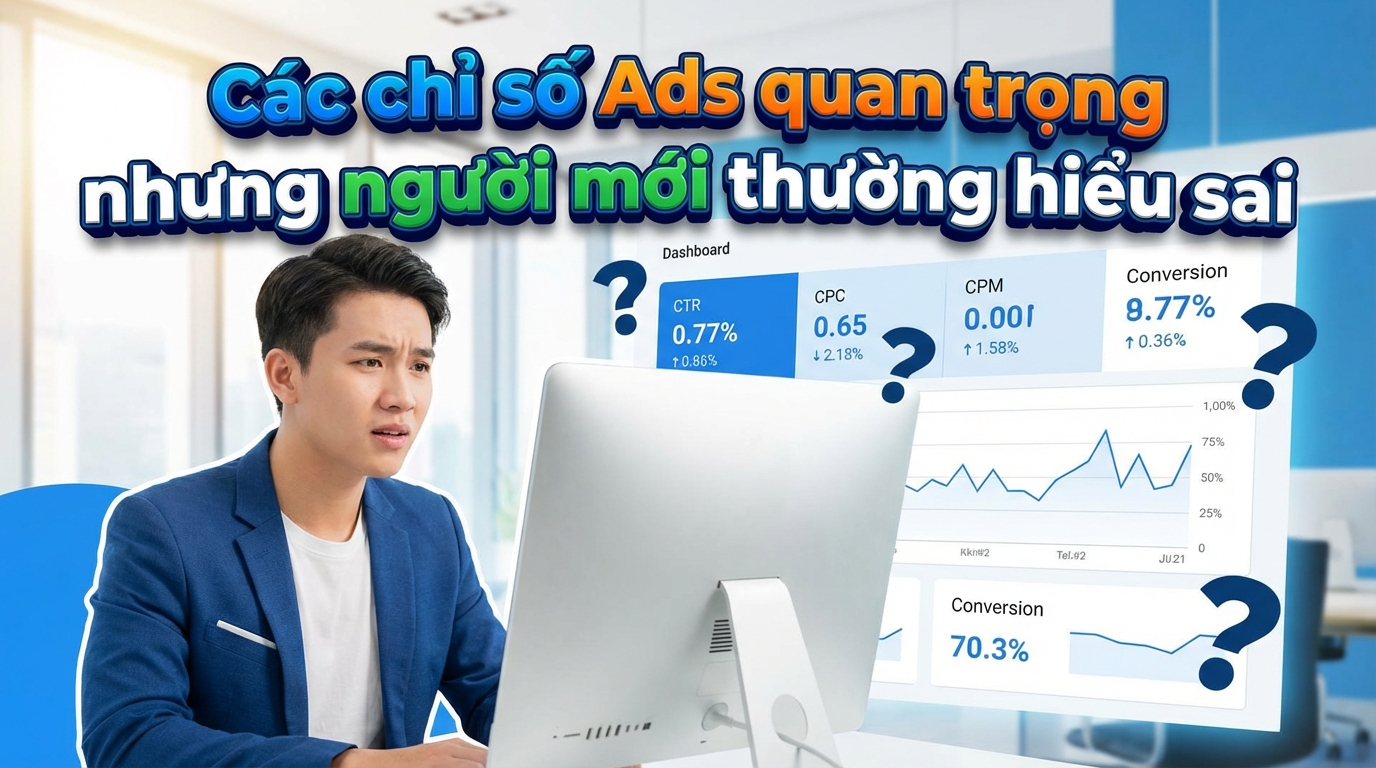
When starting to run ads, many beginners fall into a state of "looking at numbers without understanding them." Ads reports are full of metrics like CTR, CPC, CPM, Conversion, but the more you look, the more confused you get, and the more you optimize, the fewer orders you get.
The reason is not that these metrics are useless, but because beginners often misunderstand their meaning, leading to incorrect optimization from the start.
High CTR does not mean effective advertising
CTR is one of the most concerned metrics for beginners. When they see a high CTR, many people believe their ads are performing very well. But in reality, CTR reflects only one thing: whether the ad makes viewers click.
An ad might have a high CTR due to a captivating headline, an eye-catching image, or controversial content. However, if customers don't take the next action after clicking, a high CTR has little business value.
Beginners often make the mistake of stopping or doubling their budget based on CTR, instead of looking at post-click behavior.
Cheap CPC doesn't necessarily mean good advertising
Low CPC is often seen as a positive sign because the cost per click is cheap. However, a cheap CPC only indicates that the ad is attracting clicks at a low cost, and it says nothing about the quality of those clicks.
There are many cases where CPC is very cheap, but customers click, immediately leave, don't leave their information, and don't buy. In such cases, a cheap CPC simply means you are buying many unqualified clicks.
For beginners, focusing on optimizing CPC without considering subsequent customer behavior often leads to the feeling of "it's cheap, but still no orders."
High CPM isn't necessarily bad
A high CPM often worries beginners, making them think their ads are "expensive." But CPM reflects the cost to reach 1,000 impressions, and this metric is heavily influenced by the target audience, timing, and competition.
In many cases, a high CPM that reaches the right audience with genuine needs can bring better conversions than a low CPM with too broad an audience. If you only look at CPM to evaluate effectiveness, it's easy to mistakenly discard potentially valuable campaigns.
The important thing is that CPM needs to be considered in relation to customer quality, not in isolation.
Conversion is more than just "orders"
Another common misconception is equating conversion solely with purchases. In reality, a conversion is any important action you want a customer to take, such as leaving information, sending a message, or filling out a form.
Beginners often obsess over the number of orders, ignoring intermediate conversions. This leads to a skewed evaluation of ad effectiveness, especially in industries that require consultation or longer customer nurturing.
If the appropriate conversion is not clearly defined for the business model, it's very difficult to optimize Ads effectively.
Running Ads for too short a period leads to misinterpretation of data
Many beginners evaluate their ads after only 1-2 days of running. If they don't see orders immediately, they rush to turn off the ads or change them constantly. This prevents the algorithm from having enough data for stable distribution, and the metrics become distorted.
Ads need time to collect data and accurately reflect customer behavior. Reading metrics too early often leads to emotional decisions, not based on sufficient data.
Not linking Ads metrics to actual business results
A core mistake is viewing Ads metrics in isolation from business operations. Beginners often only look at the ad dashboard without cross-referencing actual orders, revenue, and costs.
Without knowing which campaign generated an order, how much advertising cost contributes to total revenue, optimizing Ads has almost no long-term meaning. Pretty metrics on Ads, but ineffective business is still a failure.
Ads metrics are only valuable when placed within a system
The essence of advertising metrics is not in the numbers themselves, but in how they reflect the customer journey. CTR, CPC, or CPM are just initial signals. The true value lies in understanding what customers do after interacting with the ads.
Beginners often struggle not because of a lack of Ads knowledge, but because of a lack of a system to connect advertising data with sales data.
How GTG CRM helps you see Ads metrics for what they truly are
GTG CRM helps businesses link advertising data with customer data, orders, and revenue within a single platform. Instead of just looking at individual metrics on the ad manager, businesses can track the entire journey from the moment a customer interacts with an ad to when an order is placed.
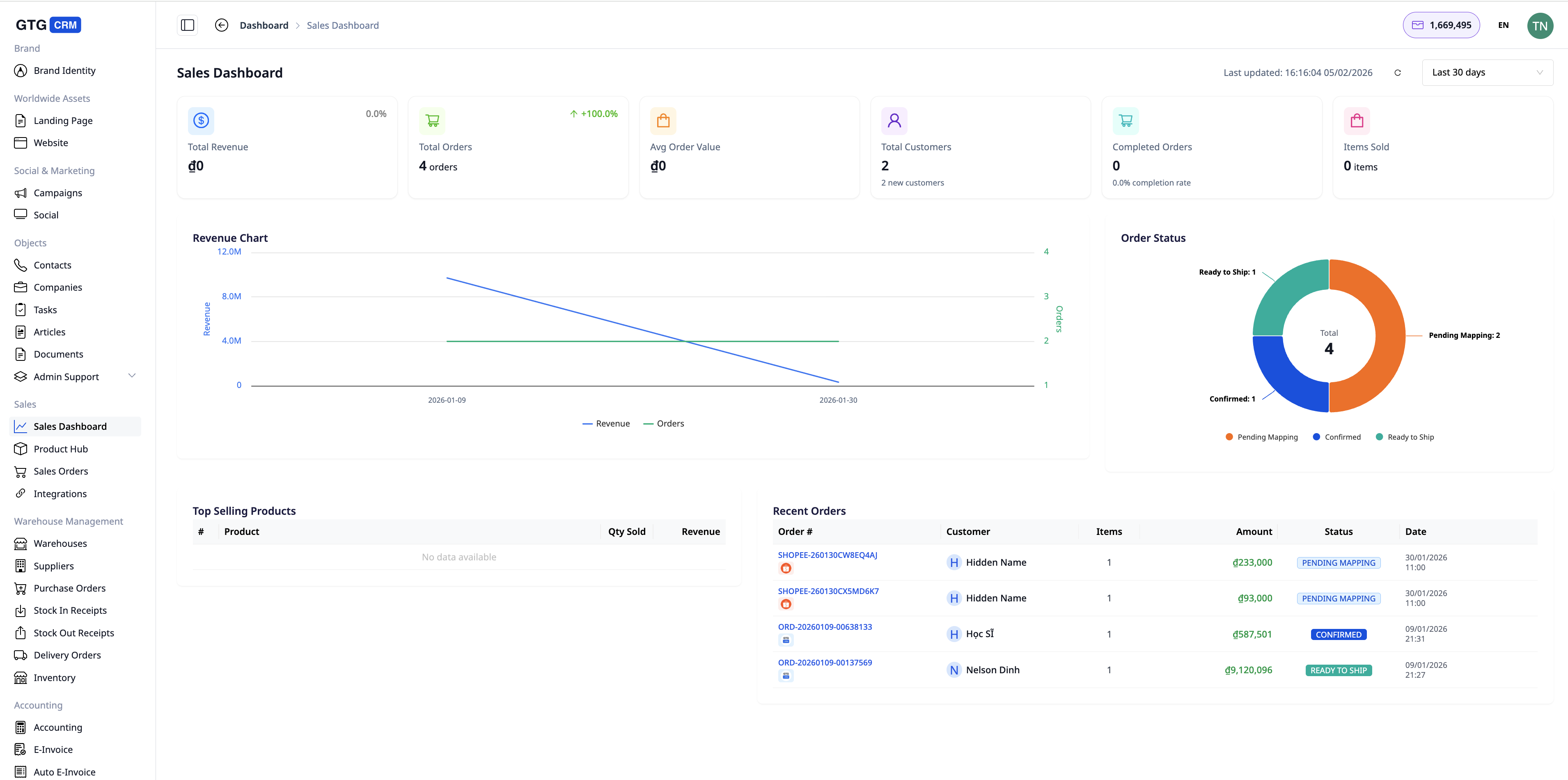
The GTG CRM dashboard system allows you to get an overview of sales activities, from the number of customers reached, conversion rates, to the actual revenue generated by each campaign.
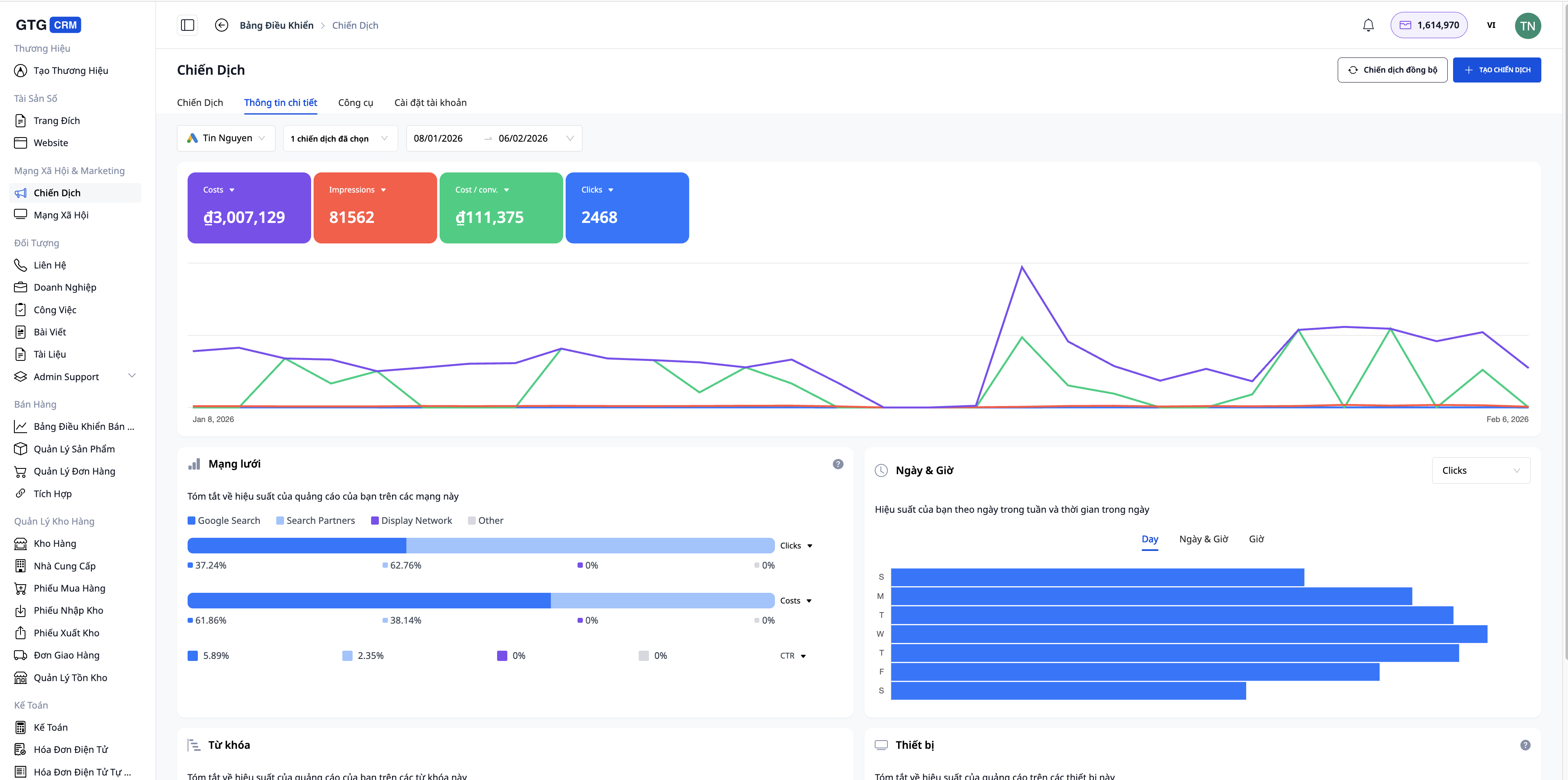
When data is centralized, Ads metrics are no longer misunderstood or subjectively evaluated. Business owners can clearly see which campaigns bring in quality customers, how advertising costs affect profits, and where optimization is needed in the sales process.
GTG CRM makes Ads a part of the business system, not an isolated data table.
Conclusion
Ads metrics are not inherently complex, but they are easily misinterpreted when viewed in isolation. New advertisers need to learn how to read data in relation to customer behavior and actual business results.
Understanding metrics correctly is the first step to optimizing effectively. And effective optimization only happens when there is a clear system behind it.
Turn what you've just read into real results — apply it now with GTG CRM, for free.
Apply now