What is a landing page?
Before learning how to create a landing page, you need to understand the basic concept. A landing page is a standalone webpage, usually designed to serve a specific goal: selling products, collecting customer information (leads), or calling for action (CTA).
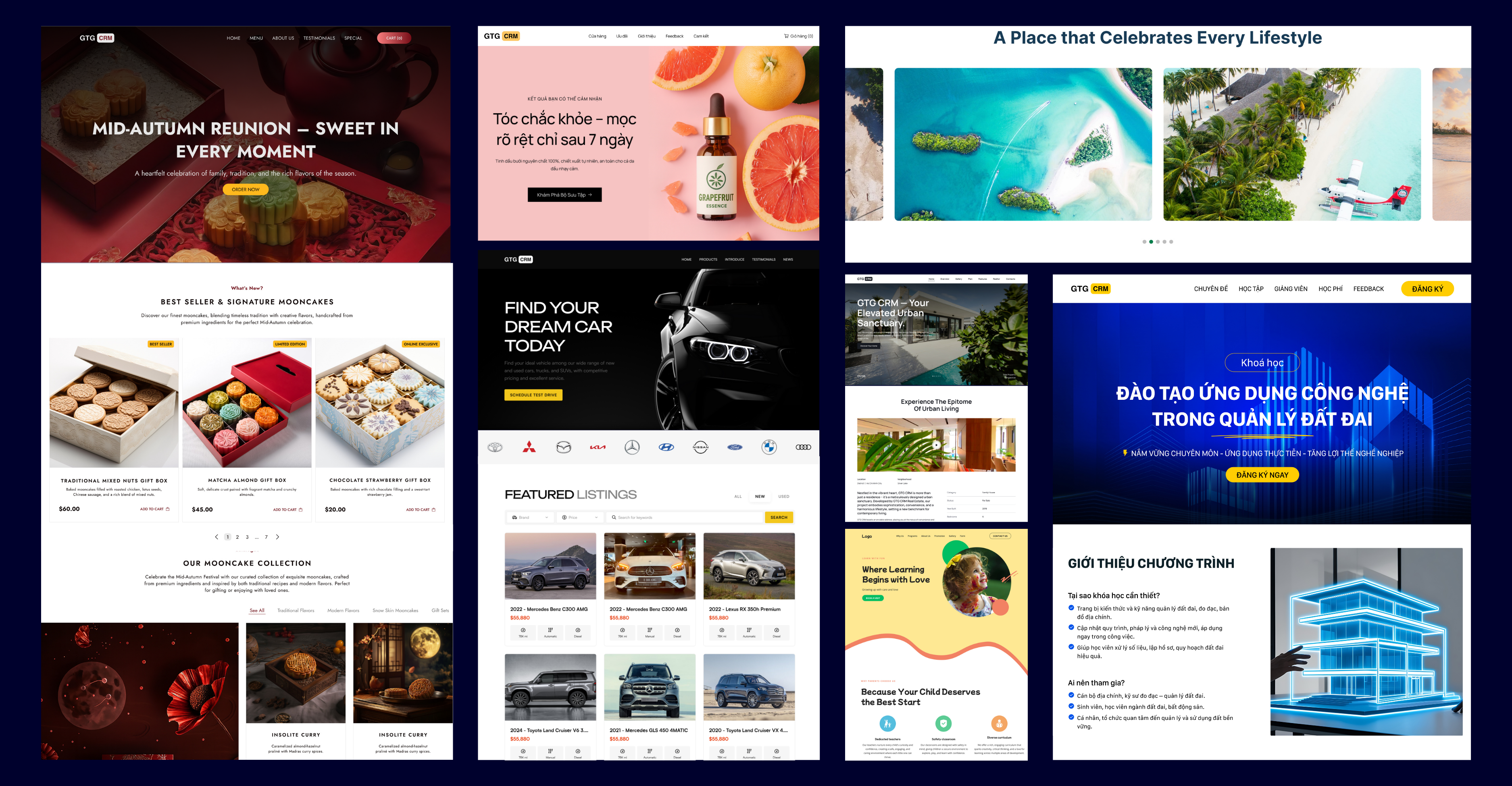
GTG CRM Landing Page Templates
Unlike a typical website with multiple sections, a landing page focuses on a single objective. For example, a fashion shop might create a separate landing page for its men's shirt collection, instead of directing customers to a homepage with too many products that can be distracting.
Why do online shop owners and SMEs need landing pages?
At this stage, many small shop owners often wonder: "I already have a fan page, do I need a landing page?" The answer is yes. A landing page is the clearest "place to close deals," where you control the entire message, images, and customer journey.
Unlike fan pages or e-commerce platforms, a landing page is entirely yours. You can run ads, add lead generation forms, set up live chat, and analyze customer behavior all on one platform. This is an essential tool if you want to increase conversion rates and optimize your marketing costs.
How to create SEO-optimized landing pages for online shop owners and SMEs.
To help you visualize this more clearly, here is a detailed guide on how to create a landing page that suits your business goals.
Step 1: Define the Landing Page Objectives
Before learning how to create a landing page, you need to be clear: What do you want the page to do? If the goal is to generate leads, you need a prominent registration form. If you want to create a sales landing page, the "Buy Now" CTA must be strategically placed. If you're running an event campaign, you need a countdown timer to generate FOMO (fear of missing out).
A clear objective will determine the structure, content, and features you need on your landing page.
Step 2: Design the Landing Page
If you lack design expertise, you can hire a landing page design company to create a landing page tailored to your needs. The price for a complete landing page can range from 11 million VND to 15 million VND.
If you find hiring a designer too expensive, and designing it yourself too time-consuming, then it's time to look for landing page creation tools with industry-specific templates.
With GTG CRM, you simply choose a suitable template (cosmetics, fashion, F&B, real estate, etc.), then drag and drop to edit the content and images. No coding knowledge is required; in just 10 minutes you'll have a complete sales landing page. If you still haven't found a landing page template you like, you can submit a request for GTG CRM to create a completely new template for you.
Step 3: Write SEO-optimized content using AI.
Most online shops struggle with writing headlines, meta descriptions, or calls to action (CTA). The content is often lengthy, unengaging, and lacks keywords. This is why advertising is ineffective.
To get your landing page to the top of search results, you must pay attention to the following four things:
1. Headline (H1) - The first headline that appears on your landing page.
- This is the deciding factor in whether guests stay or leave.
- Principle: Be concise (6-12 words), include the main keyword, and highlight the direct benefits of the product/service.
For example: Instead of writing "Premium men's leather shoes," write "Premium men's leather shoes – Lasts over 2 years, 30% off today."
2. Meta Description - The description displayed on Google
- 140-160 characters long , includes the main keyword, and highlights the benefits + CTA
- Formula: [Product/Service] + [Key Benefit] + [Call to Action]
Example: “SEO-optimized sales landing pages help online shops double their orders. Try GTG CRM for free today!”
3. On-page content - Break down and optimize keywords
- Opening paragraph: Briefly explain the customer's problem (pain point), then offer the solution (your product/service).
- Subsequent sections: use H2/H3 headings containing secondary keywords (e.g., Benefits of creating a Landing Page, How to collect customers from a Landing Page, How is a Landing Page different from a Website?)
- Clear CTAs: Place "Sign Up Now," "Try Free," and "Get a Consultation" buttons in multiple locations, at least at the top, middle, and bottom of the page.
Here's a specific example:
- H2: Why do online shops need landing pages to sell products?
- Paragraph: Explain the reason + insert a CTA → “Create a Landing Page with GTG CRM in just 10 minutes”
Step 4: Find illustrative images
A landing page lacking professional-looking images will struggle to retain customers. First, you need to determine the size of the images you need to use; typically, a landing page will include the following types of images:
- Hero image (large image at the top of the page): Used to convey core benefits/values, recommended width is 1600-1920px.
- Product/service photos: Optimize for a 45° angle and a clean background; if it's a service, use photos simulating the process or "before-and-after" shots.
- Contextual images (lifestyle/use-case): Show the product being used in a real-world context → increases credibility.
- Testimonial/case evidence: Customer portrait + short quote
- Icons illustrating benefits: 3-6 simple icons, consistent with brand colors.
Note:
- Image file name: No accents, includes primary/secondary keywords (e.g., landing-page-ban-hang-my-pham.webp)
- Alt text (8–12 words): Describe the image + cleverly insert keywords, avoid keyword stuffing (e.g., “Vitamin C brightening serum on a wooden background – cosmetics landing page”)
- Format: WebP is preferred for illustrations; PNG for logos (transparent background).
- Size & File: Ensure image fits the display frame; size < 300KB (hero < 500KB)
- Consistency: a consistent visual style (lighting, color tone) to enhance the sense of professionalism.
Step 5: Add the registration form and collect customer data.
To optimize conversions, you should place the form right in the hero section or near important CTAs. The form should be concise, only collecting essential information such as name, email, and phone number. Personalize the form title (e.g., "Sign up now to get a 20% discount") and use a clear CTA button.
Step 6: Activate Live Chat and various messaging channels.
To allow visitors not only to read information but also to interact directly, you need to integrate Live Chat or familiar messaging channels. This serves as a bridge, enabling businesses to respond instantly and create a professional impression for customers.
- Choose a Live Chat tool: You can use popular platforms like Tawk.to (free), Crisp, or LiveChat. They allow you to create a chat widget in just a few minutes.
- Insert into Landing Page: After registering, you will receive a code snippet. Insert this code into the <head> section or before the </body> tag of your landing page. If using a pre-made landing page builder, simply paste the code into the “Custom Script” or “Chat Plugin” field.
- Outsource if needed : If you're not familiar with the technical aspects, you can hire freelancers on Fiverr, Upwork, or small agencies to help with the integration. The cost usually ranges from a few hundred thousand to a few million VND, depending on your needs.
In addition to Live Chat, don't forget to add the Messenger Chat Plugin (Facebook provides it for free) or the Zalo OA button so customers can choose the channel they are most familiar with.
Step 7: Test and optimize before running.
Before launching your landing page, you need to thoroughly test everything to ensure it's working smoothly and creating a seamless experience for your customers.
- Test display across multiple devices: View the landing page on desktop, tablet, and mobile to ensure the layout is not broken.
- Check page load speed: Use Google PageSpeed Insights or GTmetrix to check and optimize images and scripts so that the page loads in under 3 seconds.
- Test registration form: Enter a test email/phone number to ensure the information is sent and you receive a response (email, SMS).
- Check the links and CTA buttons: Ensure all buttons (Buy Now, Register, Contact Us, etc.) are working correctly.
- Ask friends/colleagues to test it out: Send the link to a few people so they can give feedback on their experience, helping you identify any minor bugs.
Suggested tools for creating landing pages.
1. GTG CRM: Allows customers to drag and drop to design, choose industry-specific templates, use AI to write SEO-optimized content, and create images instantly. Every landing page integrates live chat, lead generation forms, and data synchronization with the CRM. You can also integrate Messenger and Zalo to chat directly with customers, converting visitors into orders on the spot.
2. Ladipage.vn: Strengths include many beautiful, drag-and-drop templates. However, it lacks integrated CRM customer management features.
3. Haravan.com: Strong in e-commerce, but focuses more on online sales than personalized content marketing.
4. GetResponse: An international, multi-functional tool, but it's expensive and complex for SMEs.
Conclude
Creating an effective landing page isn't just about building a website; it's about creating a "sales conversion machine" for online shops and SMEs. With a SEO-optimized landing page, brand alignment, integrated live chat, and CRM, you'll save costs and significantly increase your conversion rate. If you want to experience the difference, try GTG CRM for FREE – a platform that lets you create a landing page in 10 minutes without any technical or design expertise.
Turn what you've just read into tangible results — apply it now with GTG CRM, free.
Apply now