In an era where customers demand fast, personalized, and 24/7 service, businesses not only need good products but also intelligent operational solutions. Especially in the financial sector, the pressure to serve tens of millions of customers daily forces many corporations to turn to technology for relief. Bank of America (BoA) is one of the pioneering organizations to apply AI assistant in customer service, achieving outstanding results thanks to its virtual assistant, Erica.
The Importance of AI Assistants in Customer Service
AI is not just an automation tool; it is becoming a "second brain" for businesses. For large corporations like BoA, investing in an AI assistant addresses a series of challenges: reducing pressure on customer care centers, optimizing operational costs, and simultaneously improving user experience for tens of millions of customers.
In a context where customers are increasingly accustomed to finding instant answers, traditional solutions like hotlines or emails are no longer sufficient. AI assistants emerge as a flexible support channel, operating 24/7 and capable of handling massive interaction volumes without requiring staff expansion.
Erica - The Virtual Assistant Changing How BoA Serves Customers
Bank of America (BoA) is one of the largest banks in the United States and among the top financial groups worldwide. With tens of millions of individual customers, hundreds of thousands of businesses, and a global branch network, BoA must constantly handle a huge volume of transaction requests and customer support daily.
Erica, an acronym for e-RICA (Electronic Robotic Intelligent Conversational Agent), is directly integrated into BoA's mobile application. It is not just an automated chatbot but an intelligent AI assistant capable of "understanding" and "acting" based on each customer's financial data.
Erica's unique feature is its ability to provide comprehensive solutions for personal financial management needs. When users need to check balances, find transactions, or reset passwords, Erica can respond instantly. Beyond answering questions, Erica also proactively sends smart alerts, such as reminding customers when they exceed normal spending limits or when their account is at risk of going negative.
Another highlight is Erica's ability to offer suggestions and guidance: from budgeting and opening savings accounts to assisting with urgent situations like freezing a lost card. Notably, customers can perform simple transactions like money transfers or bill payments using just their voice or text – a convenient and user-friendly experience.
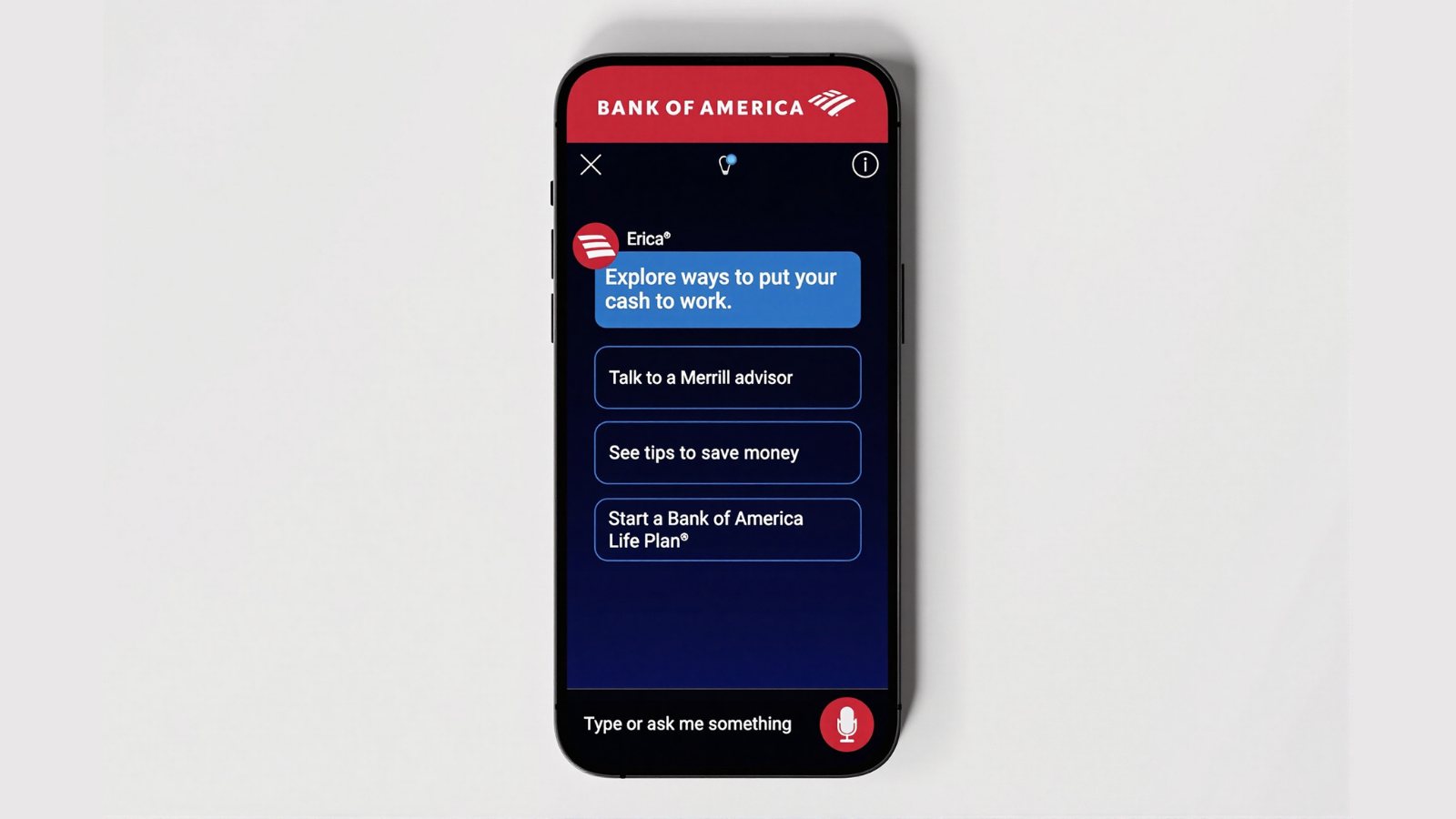
Bank of America's Erica AI Interface
Source: Financial Brand
The Success Achieved by Bank of America
Just a few years after its deployment, Erica has become one of the most AI assistant s in the financial industry. Millions of requests are processed automatically each month, saving the bank enormous operational costs previously allocated to customer care centers.
Beyond cost savings, Erica quickly reached over 30 million users, handling hundreds of millions of requests. This demonstrates that customers are entirely willing to trust and use AI for their personal financial matters – a field previously considered sensitive and requiring absolute accuracy.
Most importantly, Erica helps BoA enhance customer experience. Instead of waiting, customers receive instant, personalized responses based on real data. Satisfaction increases, loyalty is strengthened, and the bank gains a sustainable competitive advantage in the market.
Lessons for SMEs in Applying AI
BoA's case study shows that AI is not just for large corporations. Vietnamese SMEs, with their limited resources and competitive pressures, can fully apply AI to optimize operations. While Erica directly serves end customers by answering and processing requests automatically, GTG CRM is designed to support business owners in managing more effectively through data analysis and strategic suggestions.
For example, SMEs often spend time answering repetitive customer questions, such as product prices, inventory status, or return policies. GTG CRM can suggest appropriate answers for business owners or staff to use, saving time and ensuring consistency in communication. Furthermore, GTG CRM analyzes data from sales platforms like Shopee or Lazada, providing detailed information and suggesting actions to increase business efficiency.
GTG CRM - Bringing AI Assistants Closer to SMEs
Unlike Erica, which is designed to interact directly with end customers, GTG CRM's AI Assistant operates like a "ChatGPT for businesses," assisting business owners in managing and developing their companies. As one of GTG CRM's prominent features, this virtual assistant allows users to ask questions about business performance in natural language, for example:
- "What is the revenue this week?"
- "Report on the effectiveness of last week's Facebook advertising campaign"
- "How many new customers were acquired this month?"
- "Which customer segments need further nurturing?"
The AI Assistant not only provides instant answers based on business data but also analyzes them to offer specific actionable suggestions. For instance, if an advertising campaign is underperforming, the AI might suggest budget adjustments or focusing on potential customer segments. If it identifies a promising customer group, the AI will propose a suitable nurturing strategy.
The GTG CRM platform also integrates AI content generation, including creating content for social posts, ad copy, Google Ads, Landing Pages, ... and even suggesting suitable illustrations, customer responses, ...
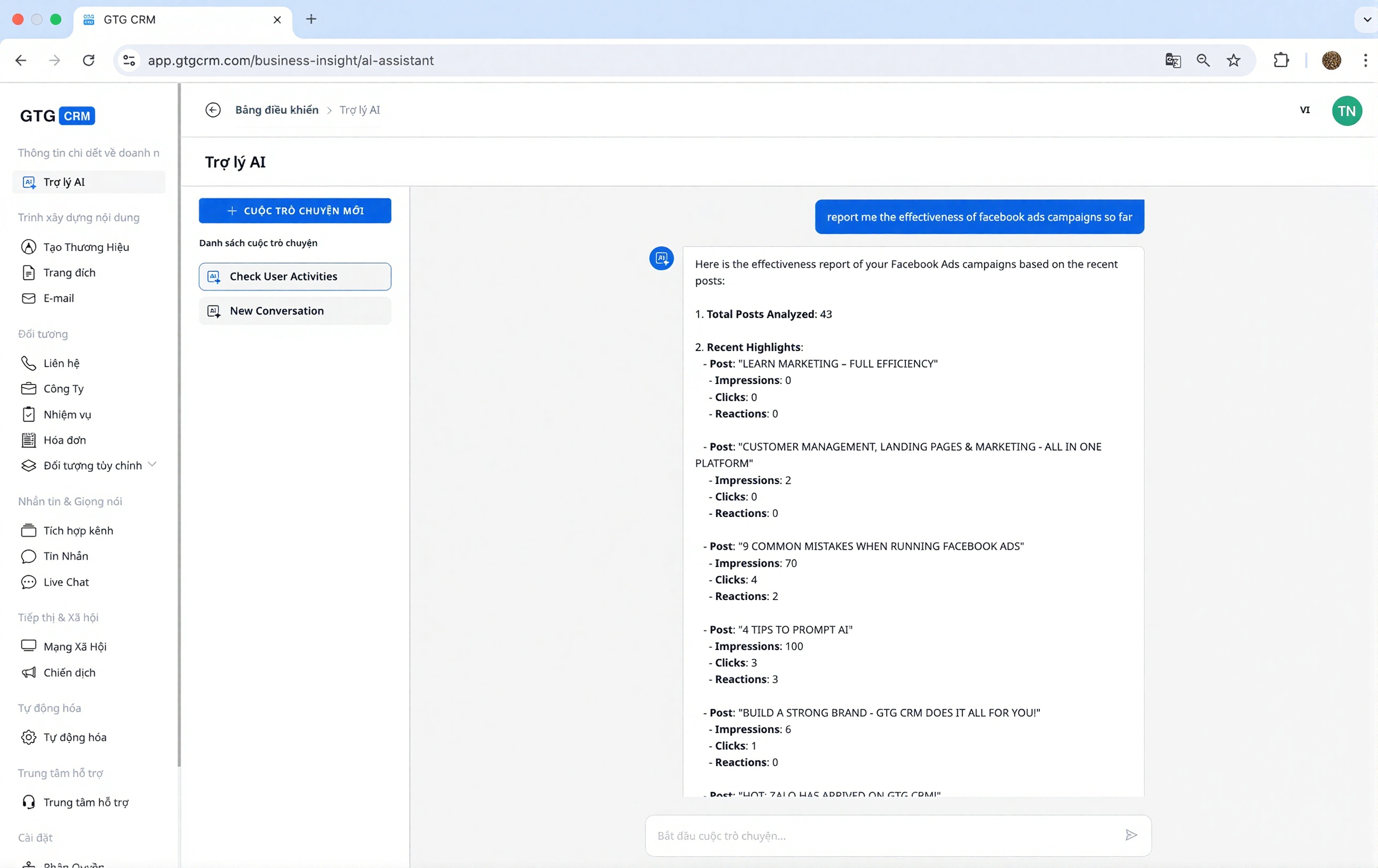
GTG CRM's AI Assistant helps business owners report advertising effectiveness
Conclusion
Bank of America's case study with Erica demonstrates that AI assistants are strategic leverage, helping businesses save costs and improve efficiency. Erica assists end customers with personal financial management, while GTG CRM empowers Vietnamese business owners with detailed insights and data-driven strategic suggestions. Although they serve different audiences, both leverage AI for automation, analysis, and optimization, delivering superior value. For Vietnamese SMEs, GTG CRM is an opportunity to transform AI into a true competitive advantage, enabling more effective business management in an increasingly fierce market. Start with GTG CRM to optimize operations and drive growth today!
Your business can achieve similar results — get started for free.
Start your journey