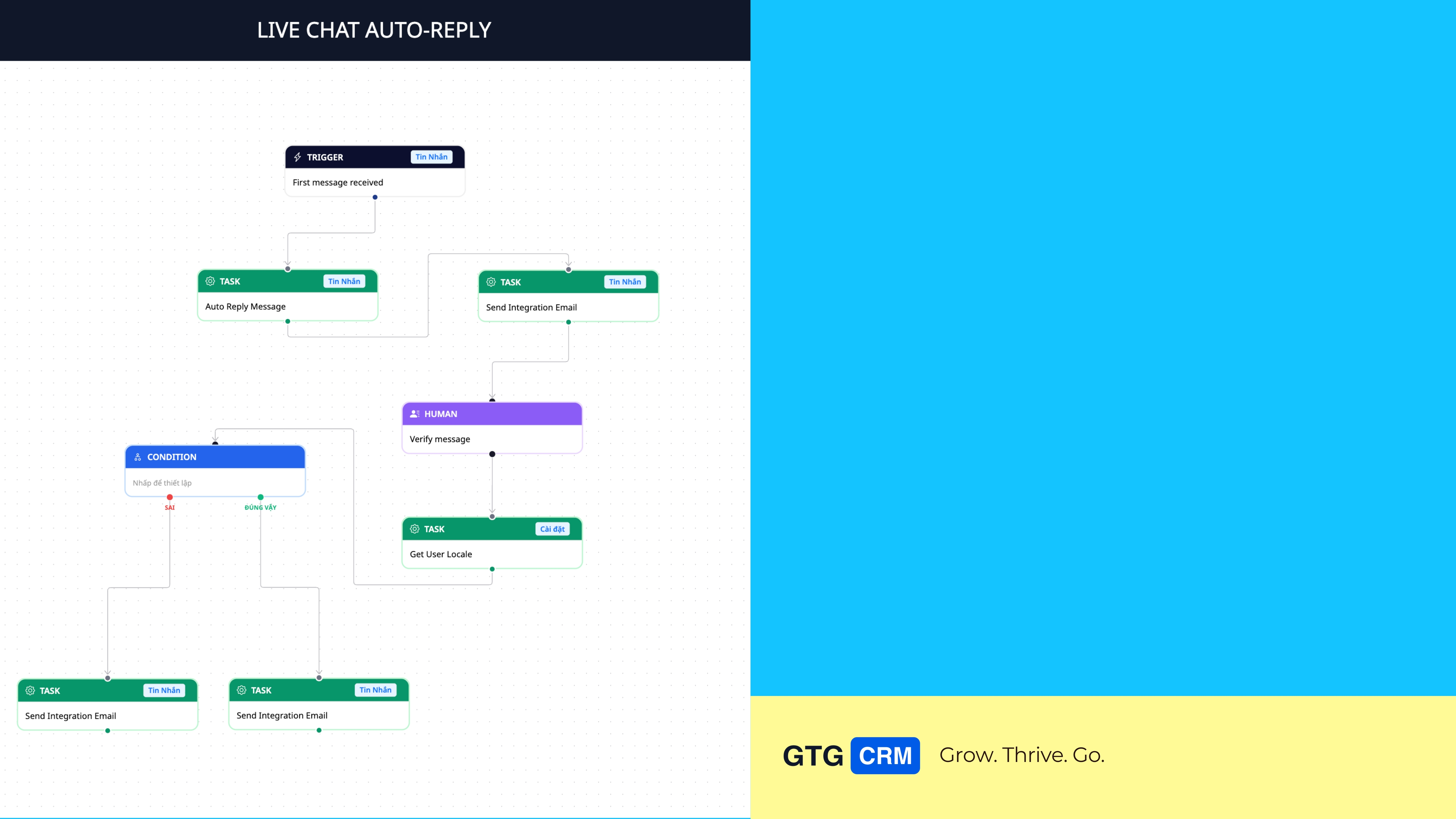
What You Will Be Able To Do After This Tutorial
Access Automations → create a workflow (from a template or from scratch) → set up Trigger, Condition, Action, Wait, Human → use "Ask AI" to configure quick steps and suggest the next step contextually → save and activate → view visual run history to see how far the workflow has run → use ready-made scenarios in the Two-Tier Automation Library.
Don't grasp the overall features yet? Preview the article Automation — Workflow Automation.
Preparation
1. Log in to GTG CRM, find the Automations menu on the left sidebar. — This is where you create and manage automated workflows.
2. (Recommended) Have email templates created in the Email Builder. — To use in the email sending step.
Step 1 — Access Automation & View List
-
From the main screen, click the Automations menu on the left sidebar.
-
View the list of created workflows: name, status (Active/Inactive), creation date, update date.
✅ Expected Result: A list of automations appears with the status of each workflow.


Step 2 — Create a New Automation (Select Template or From Scratch)
-
Click the "Create Now" button.
-
Select a pre-made template to start quickly, or Create from scratch to build your own.
-
The Workflow Builder interface appears for you to design the workflow.
✅ Expected Result: The Workflow Builder opens, ready to add steps.


Step 3 — Set Up Trigger (Starting Point)
-
Drag and drop the Trigger element onto the canvas (or click the existing Trigger node).
-
Select the Object Type (the object that will activate the workflow).
-
Select the Activity: Create · Update · Delete.
✅ Expected Result: The Trigger is configured. Note: after adding a Condition, the Trigger will be locked — configure the Trigger accurately first.


Step 4 — Set Up Condition (Criteria)
Drag and drop the Condition element onto the canvas and connect it to the Trigger.
Select the Field to check (Status, Type, Priority, Owner…).
Select the comparison value (To Do, Open, In Progress, Done, Cancelled…).
Choose the Operator: equals · not equals · in (contained within a list).
If you change the data source of the Condition, the system will ask for confirmation and indicate how many rules will be deleted. When saving, if there is a condition that is always true, the system will warn you beforehand.
✅ Expected result: The Condition correctly filters the cases you want before proceeding.

Step 5 — Set up Action
Drag and drop the Action element onto the canvas and connect it to the Condition.
Choose the type of action. The action library is extensive (over 120 actions across CRM, sales, inventory, accounting, messaging, notifications, support, tasks…). For example, Send Email:
Select recipients: Related contact or a specific team member.
Select email template created in the Email Builder.
Select sender (outgoing email account).
✅ Expected result: The Action is configured and connected to the workflow.


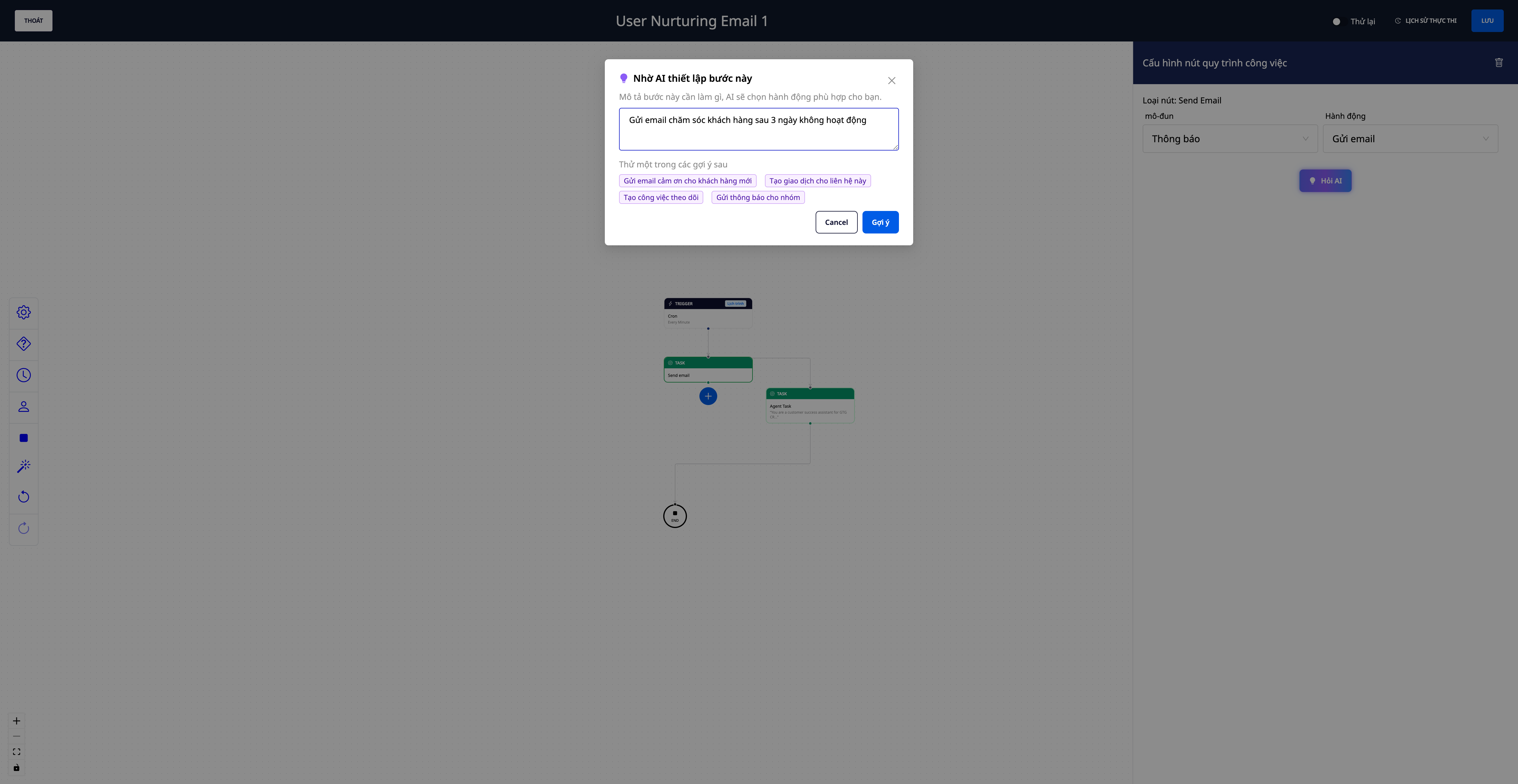
Step 6 — Use "Ask AI" to configure steps quickly
Add an Action step and open its configuration panel (when empty, the panel has an "Ask AI" button).
Click "Ask AI", then type what you want in plain language — for example, *"send a thank-you email to new customers"*.
AI automatically selects the appropriate action and pre-fills the step configuration; you just need to add the details.
✅ Expected result: The step is pre-filled with the correct action you described (AI only suggests actions that the system can execute).
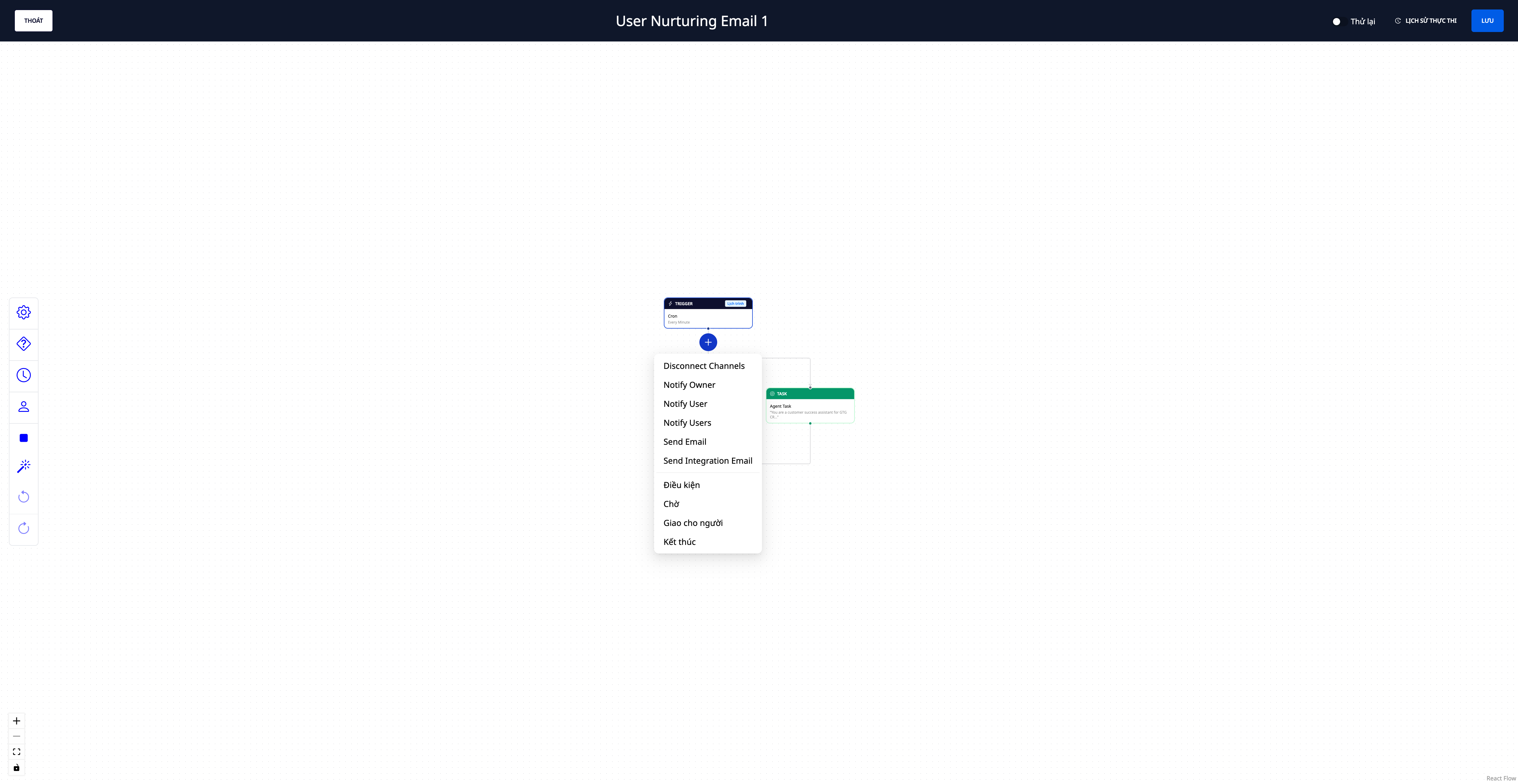
Step 7 — Add the next step using context-aware suggestions
Click "+ Add step" below an existing step.
Select from the list of suggested actions based on the object of the source step (e.g., after "Contact created" → Send email · Create deal · Update contact · Create task).
✅ Expected result: A new step pre-configured appears and is automatically connected to the workflow.
Step 8 — Set up Wait/Delay & Human (when needed)
Wait/Delay: drag the Wait element onto the canvas, enter the duration, and select the unit (Minutes/Hours/Days). For example: wait 10 minutes before proceeding to the next step.
Human: drag the Human element when human intervention is required — fill in the Title, Notes, Priority (Low/Medium/High), Assignee, and Deadline (relative: X days from reaching this step; or absolute: choose a specific date).
✅ Expected Outcome: The process pauses for the specified duration; the Human step creates a task awaiting assignee action before continuing.


Step 9 — Save and Activate Automation
Review the entire process.
Click Save to save.
The system displays a successful save message; switch the process to Active to run it.
✅ Expected Outcome: The process is saved and activated, ready to run when the Trigger occurs.


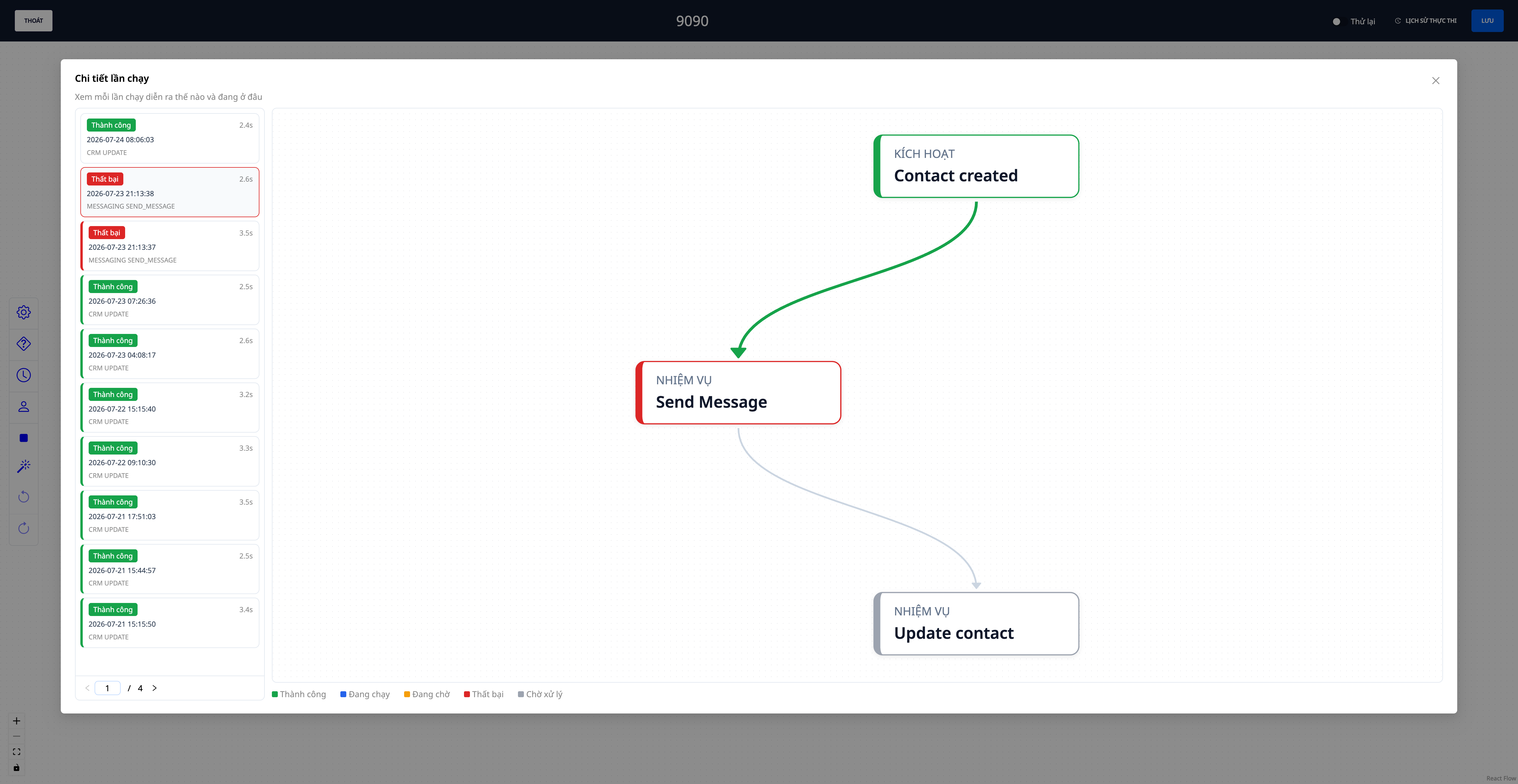
Step 10 — View Visual Run History
In the builder, open Run History.
Select a run from the list (with statuses: running · pending · succeeded · failed).
View the process diagram colored by the status of each step (green = completed, amber = pending, red = error); click a step to see details (duration, reason for waiting, errors, business data processed).
✅ Expected Outcome: You see exactly which step a particular run has reached, where it's currently stopped, and why — directly on the diagram.
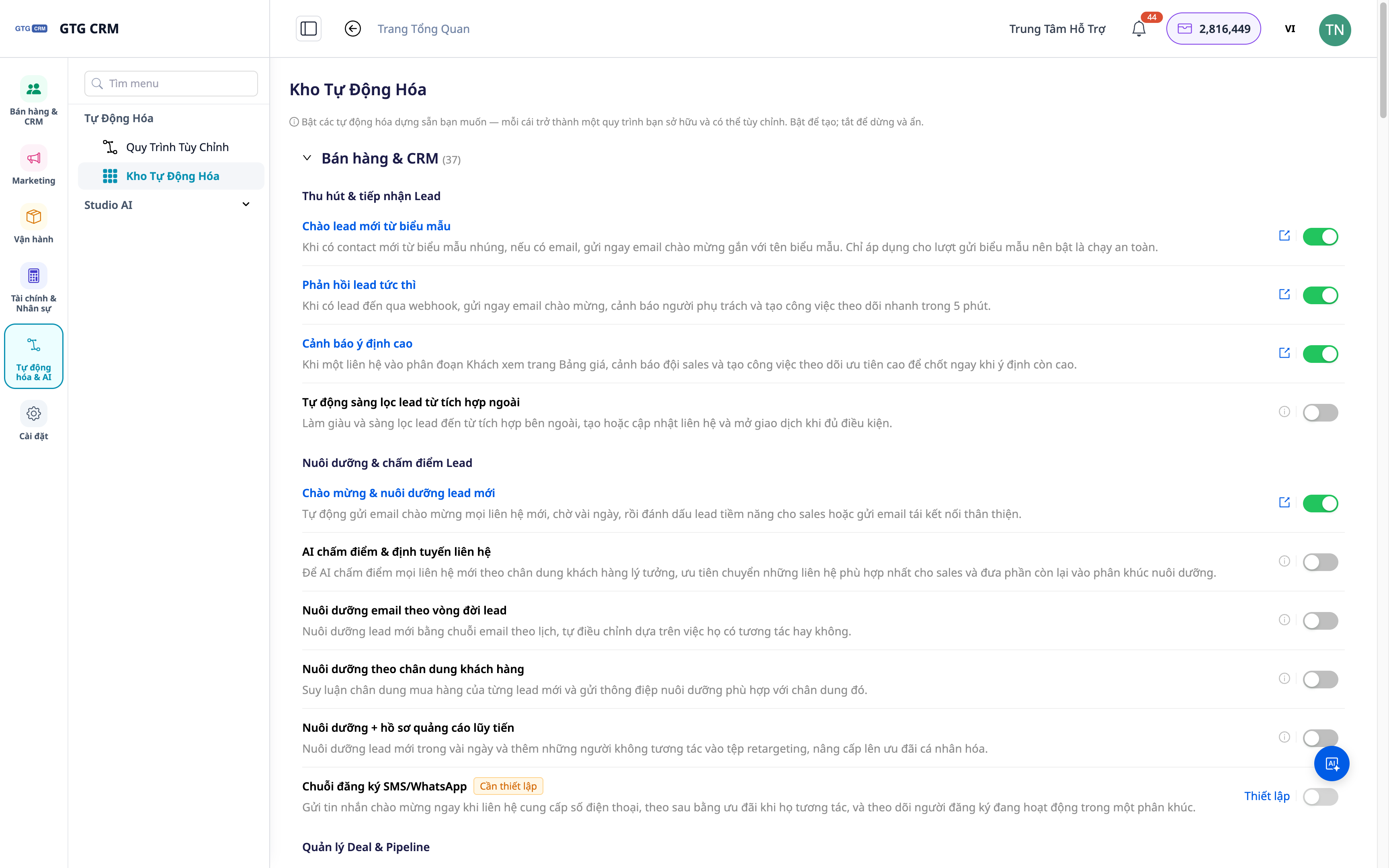
Step 11 — Browse the Two-Tier Automation Catalog and Use Pre-built Playbooks
Go to Automations, open the Automation Catalog. Browse by function cluster (CRM/Customers, Accounting, HR, Task Assignment, etc.) then open the playbook within.
Quick Use:
Contact/Company Playbooks: welcome messages, follow-up reminders for contacts/companies — activate and run.
Prospecting & Lead Generation Playbooks: after importing contacts/companies from AI search tools, attach a playbook to initiate the outreach sequence.
✅ Expected Outcome: Pre-built playbooks are activated and run; playbooks that are not yet usable are hidden for a cleaner view.
Quick Reference Table of Expected Outcomes
Open Automations — List of processes + statuses
Create New + Select Template — Workflow Builder opens
Configure Trigger/Condition/Action — Steps connected into a process diagram
Click "Ask AI" — Step pre-filled with the described action
"+ Add Step" — Next step is pre-configured, contextually relevant
Save + Active — Process runs when Trigger occurs
Open Run History — Diagram colored by step status; details for each step
Automated Warehouse Opening — Scenarios are available by functional cluster, turn on and run
Usage Tips
Start simple: create short workflows first, then gradually expand.
Leverage templates and "Ask AI" for quick setup.
Test before activating: run with test data, then open Run History to check each step.
Use clear names for easy management.
Prepare email templates in the Email Builder before using them in the email sending step.