What will you be able to do after following this guide?
Connect channels (Facebook, Zalo, Gmail, Outlook, WhatsApp) → reply to messages and emails in the correct flow and to the correct mailbox, with CC/BCC → enable reply reminders to avoid missing customers waiting too long → customize automatic replies to Facebook comments → use AI to create content → tag, filter, and add customers to CRM → set up Live Chat for websites and configure a separate assistant for each website . All in one mailbox.
Not yet familiar with the features? Check out the Messaging & Live Chat preview.
Prepare in advance
1. Log in to GTG CRM and be granted Messaging/Mailbox access. — Connecting channels, replying, and configuring response reminders are the tasks of the mailbox staff.
2. You need to connect a channel account (Facebook Page, Zalo OA, Gmail/Outlook, WhatsApp number via Twilio). — To receive and send messages through that channel.
3. (For Live Chat) A website has already been published from GTG CRM. — To embed widgets and configure the assistant for each website.
Step 1 — Open Messaging & connect channels
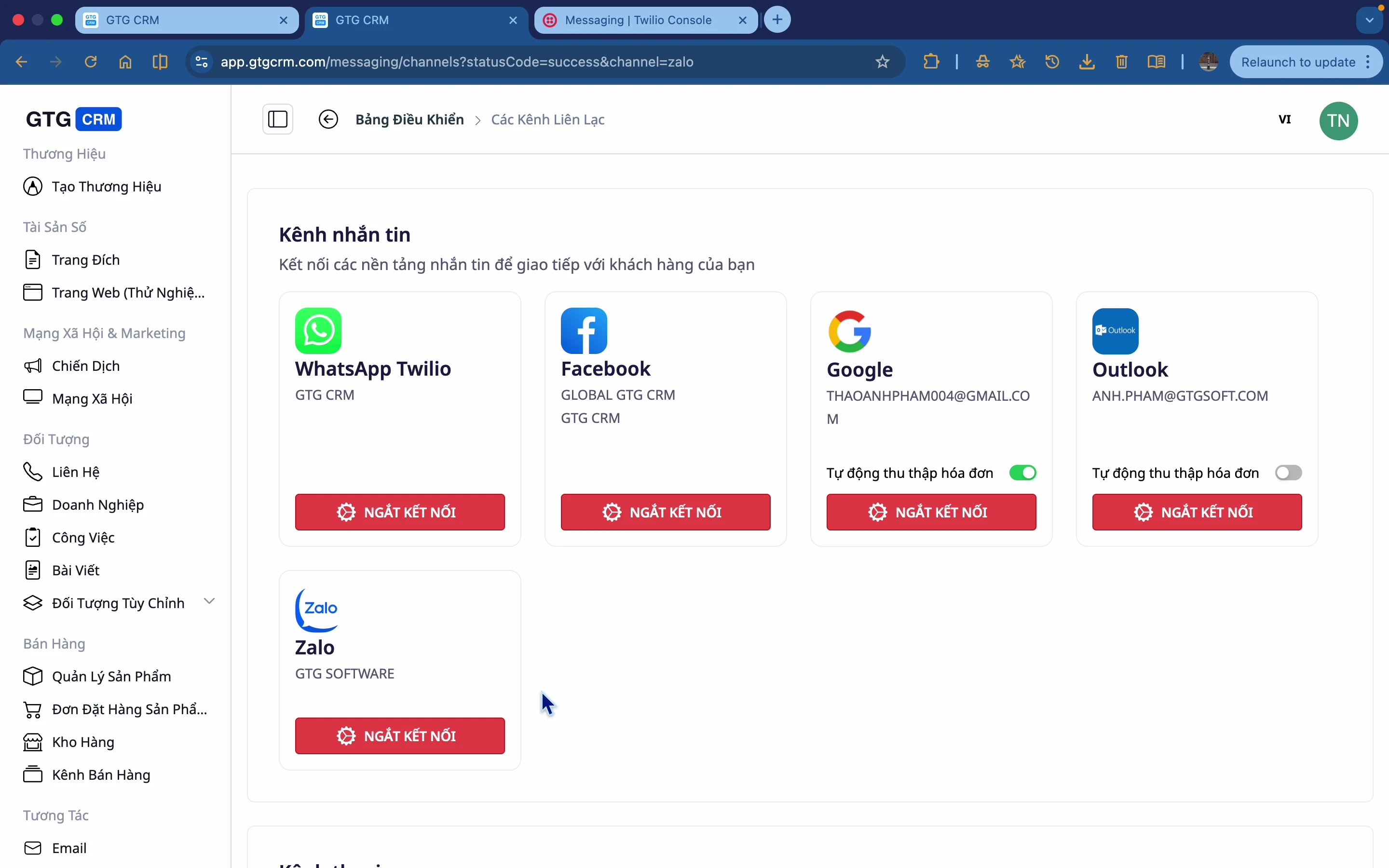
- Go to Messaging .
- Open Communication Channel Settings , then connect them one by one: Facebook (select Page), Google (Gmail) , Outlook , Zalo OA , WhatsApp (Twilio) .
✅ Expected outcome : Connected channels display a "connected" status; messages from those channels begin arriving in your inbox.
Step 2 — Reply in the unified inbox
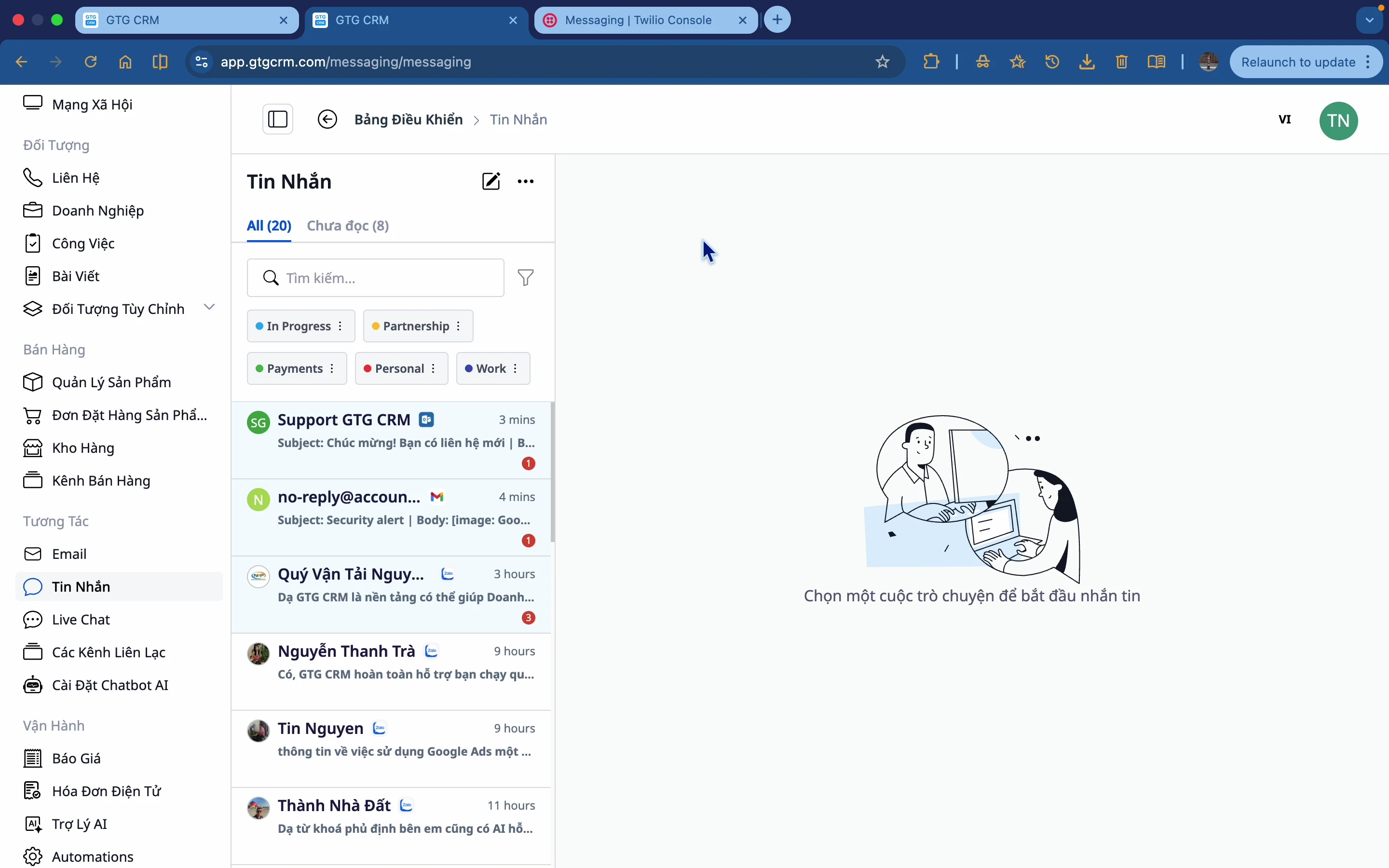
- Open Unified Inbox , select a conversation.
- Compose your reply; include formatting, emojis, images, and files if needed.
✅ Expected outcome : Messages are sent through the correct conversation channel; the entire history is in a single thread.
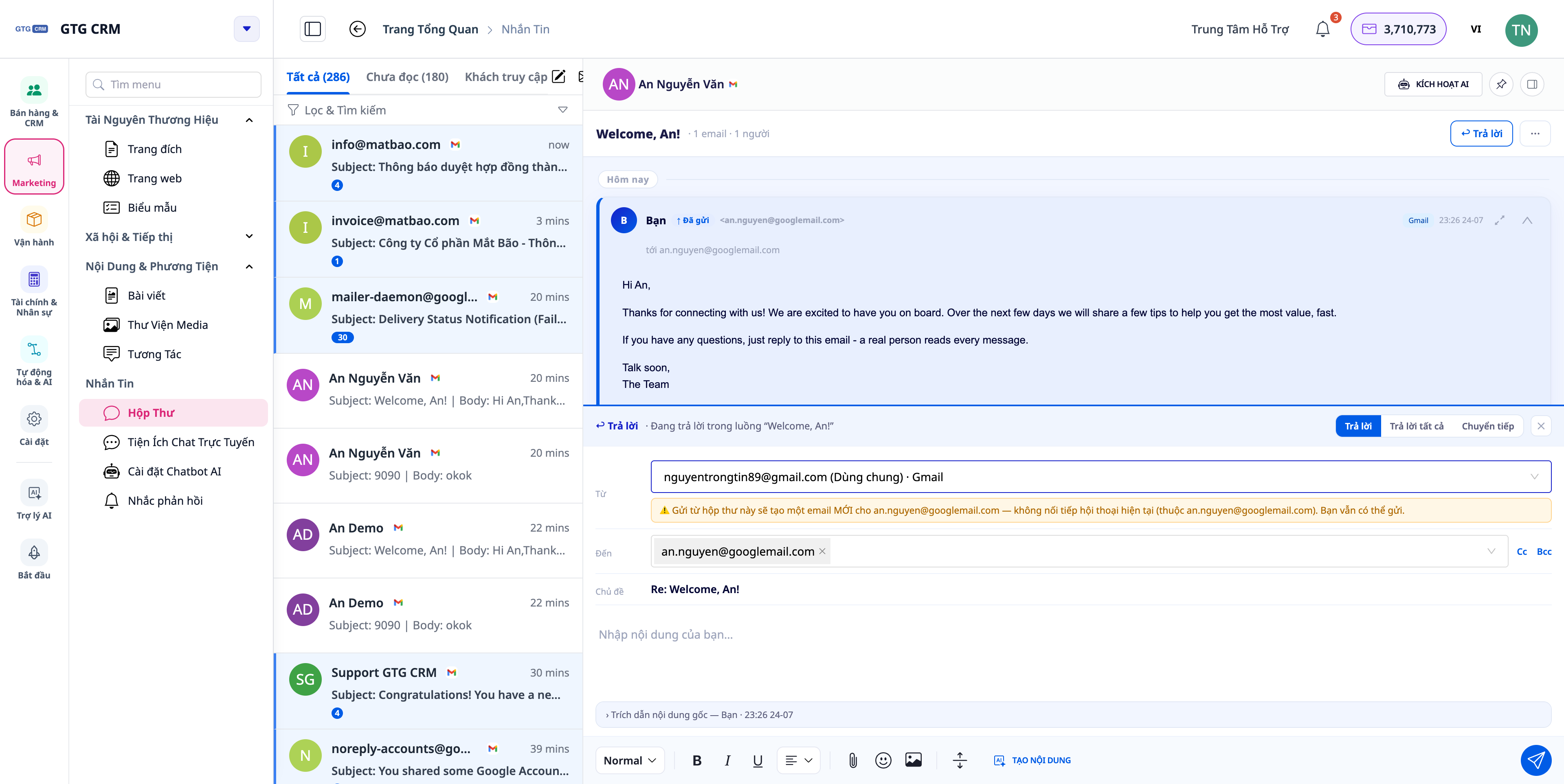
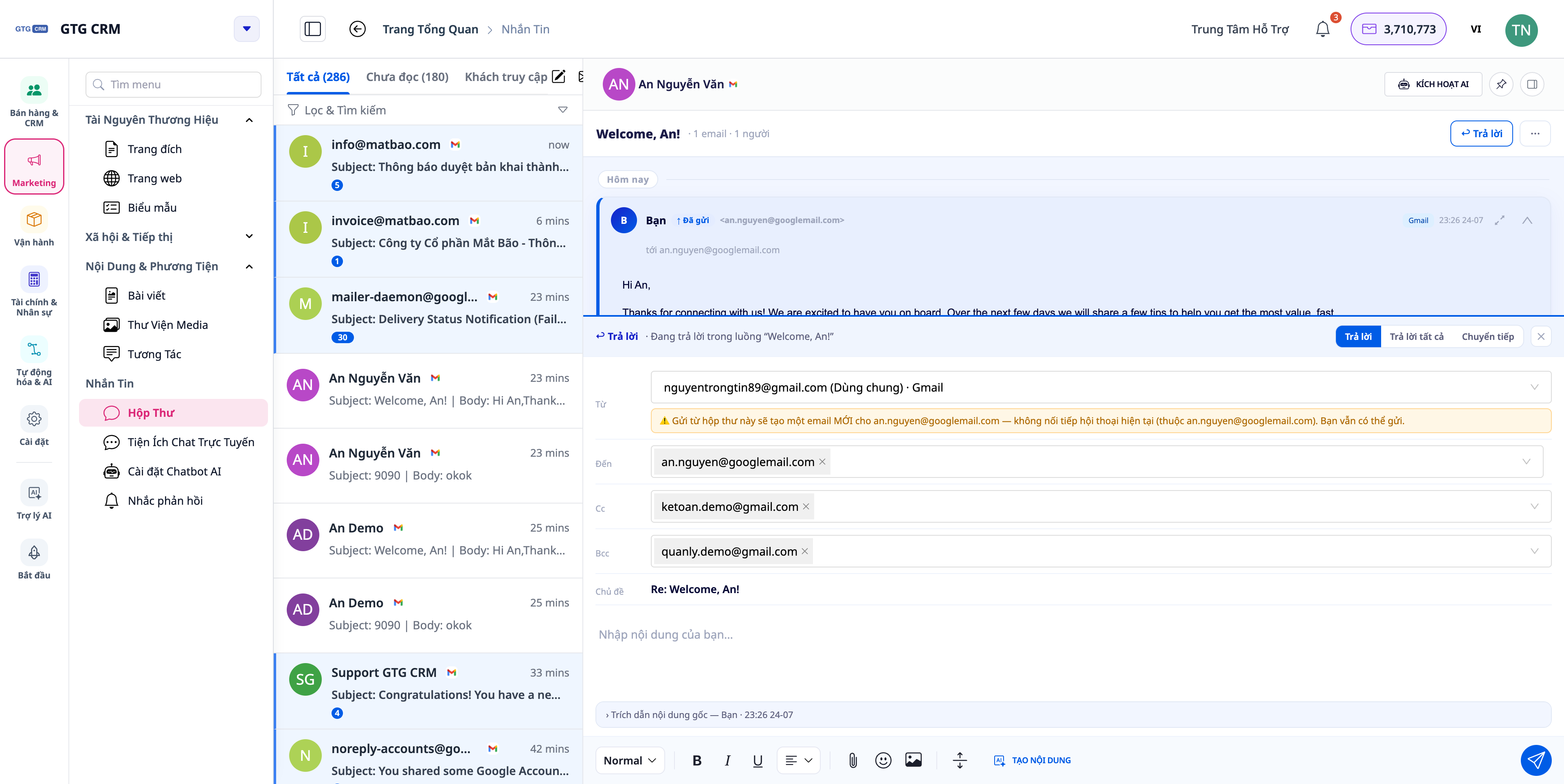
Step 3 — Reply to the email in the correct channel, to the correct mailbox, and include Cc/Bcc.
- Open an email conversation (Gmail/Outlook) , then click Reply .
- In the "From" selector, choose the mailbox you want to send to — the system lists both your company's general mailbox and your personal mailbox .
- (Optional) Add recipient Cc/Bcc .
- Compose the content and send it.
✅ Expected outcome : The reply email follows the correct conversation thread and is sent from the mailbox you selected (a Gmail thread will be sent via Gmail). The "details" section displays the correct list of recipients (including Cc).
Step 4 — Enable response reminders when customers have to wait a long time (Reply-SLA)
- Open the automation/response prompt settings in Messaging.
- Turn on Reminder , set a timeout (default 30 minutes), and specify the reminder recipient (the employee in charge of the mailbox).
✅ Expected outcome : When a customer's message remains unanswered (human or AI) within the set time limit, the employee receives an in-app notification plus a push notification ; clicking on it opens the correct pending conversation . Once someone replies, the reminder stops.
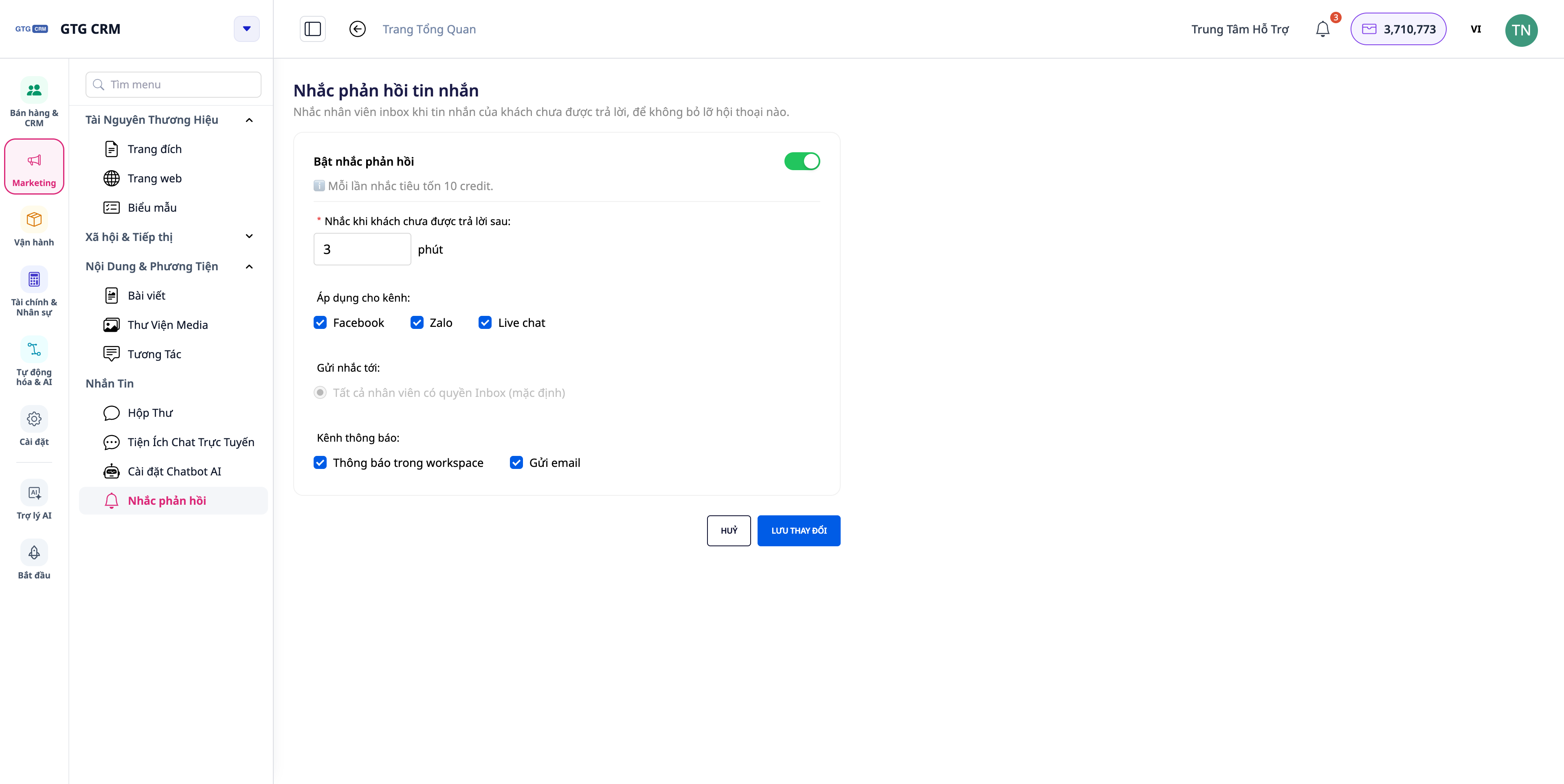
💡 Tip : Set a short waiting time (e.g., 15–30 minutes) for channels where customers expect a quick response, such as Facebook/Zalo.
Step 5 — Customize automatic Facebook comment replies
- In the Facebook Messaging settings, select the Page you want to configure.
- Turn automatic comment replies on/off; if enabled, type your own message .
- Use the variable
{{tên khách}}to ensure the message correctly identifies the commenter by name.
✅ Expected result : When someone comments on a Page post, they receive a private message (Messenger) with the exact content you wrote (replace the customer's name in {{tên khách}} ). Pages that are closed will not receive messages; if left blank, the default template will be used.
Step 6 — Use AI to create content
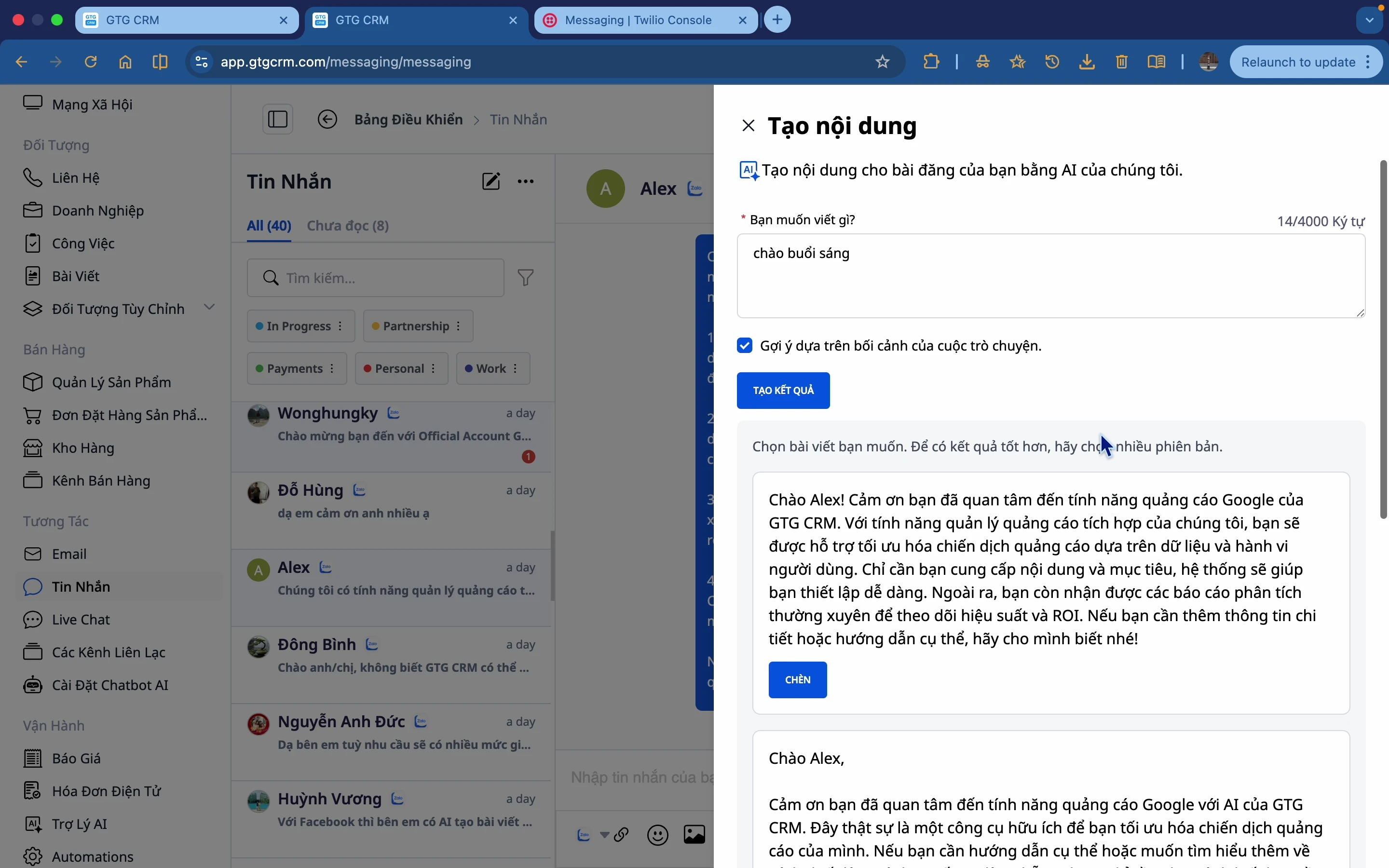
- In a conversation, open AI content creation , enter your request, and generate suggestions.
- Choose a suggestion, insert it into the text box, edit it, and then send.
✅ Expected outcome : The AI will return several contextual content options; you insert and edit them before submitting.
Step 7 — Tag, filter & bring customers into CRM
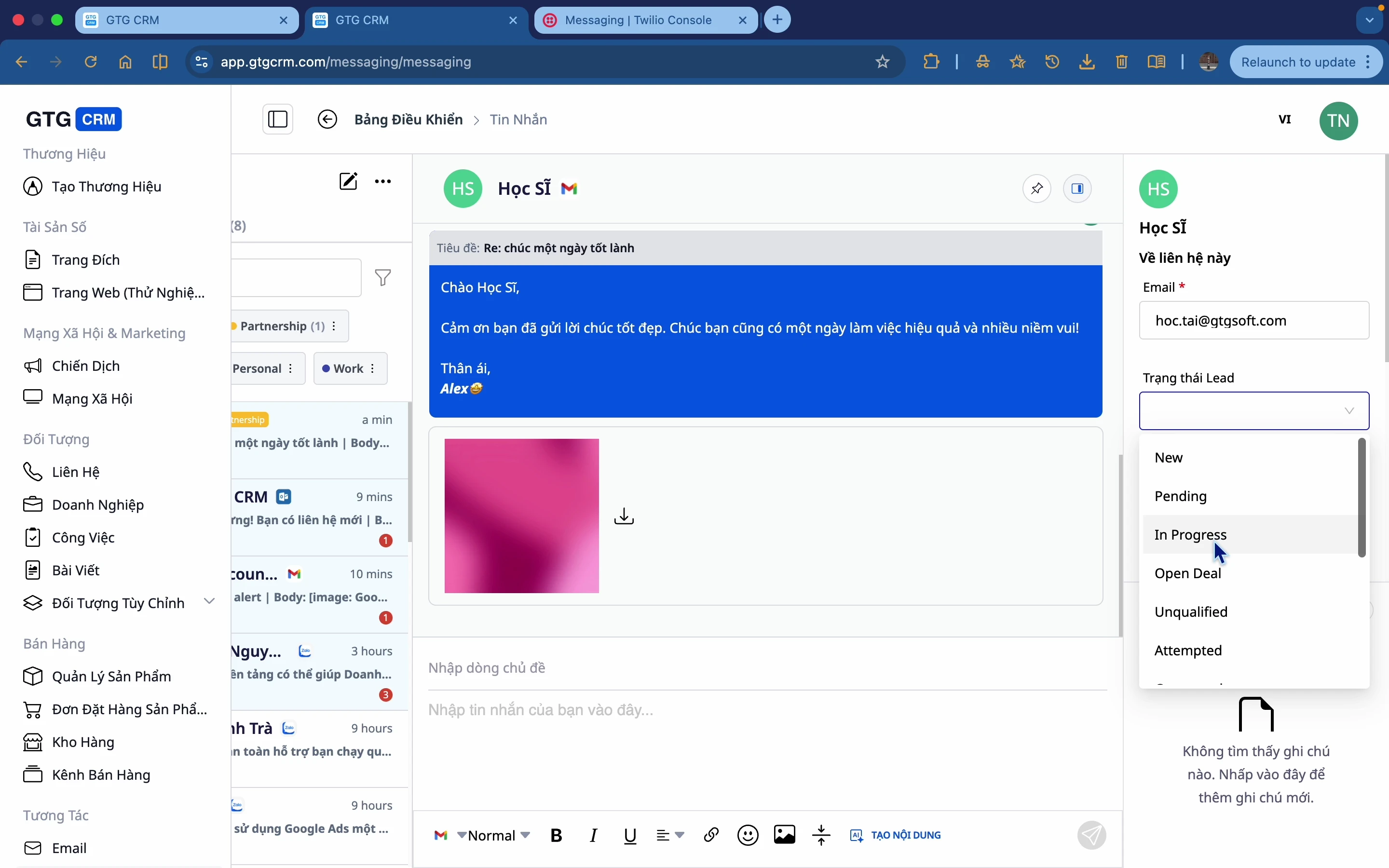
- Tag conversations (in progress, payment, etc.); filter by tag/time/status.
- Open the customer information panel → update lead status, contact information, and notes → Save to CRM .
✅ Expected outcome : Conversations are clearly categorized; customer information is saved as contacts in the CRM directly from the chat window.
Step 8 — Set up Live Chat & configure the assistant for each website
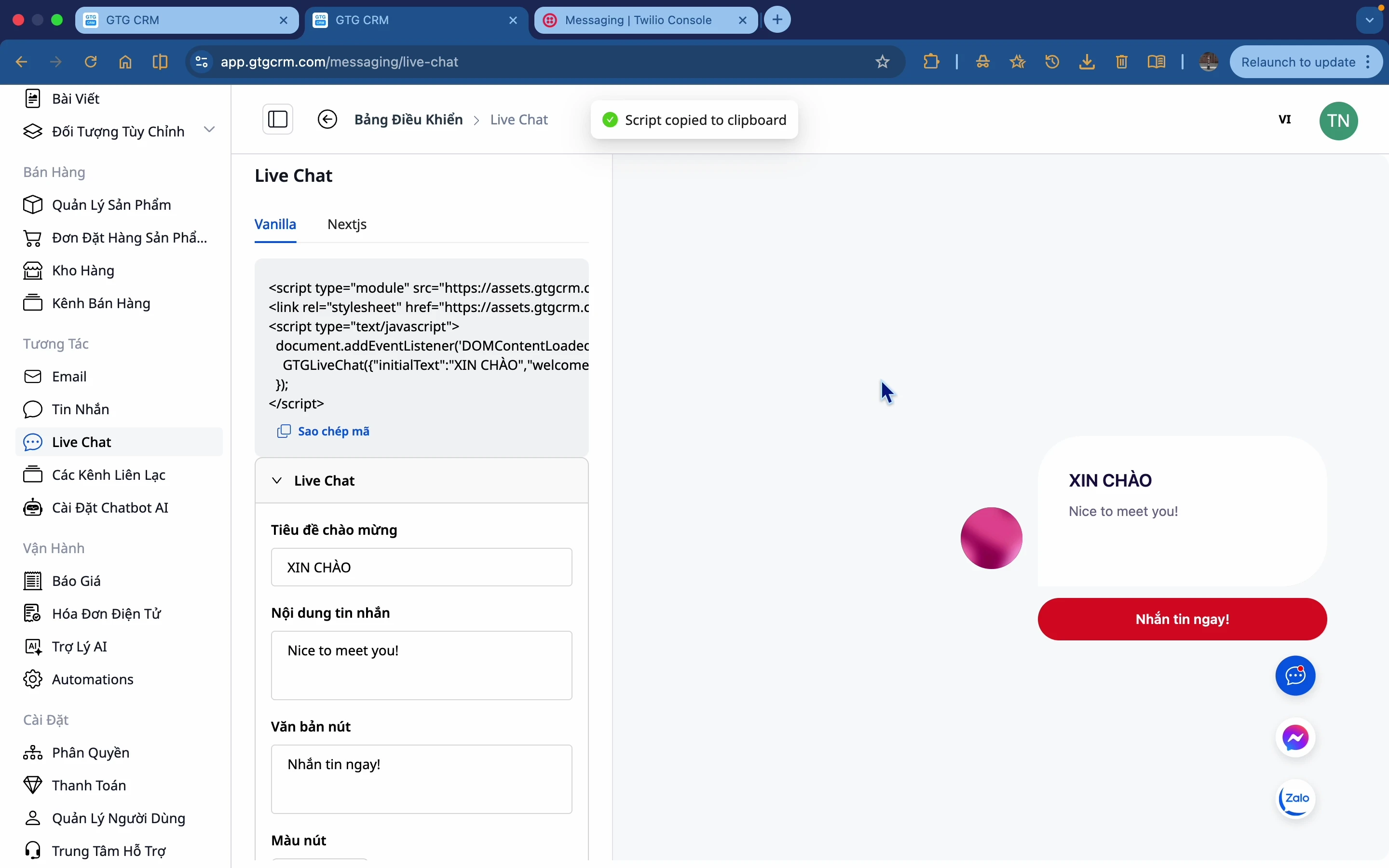
- Open Live Chat settings ; customize the greeting, button color, avatar, and icon .
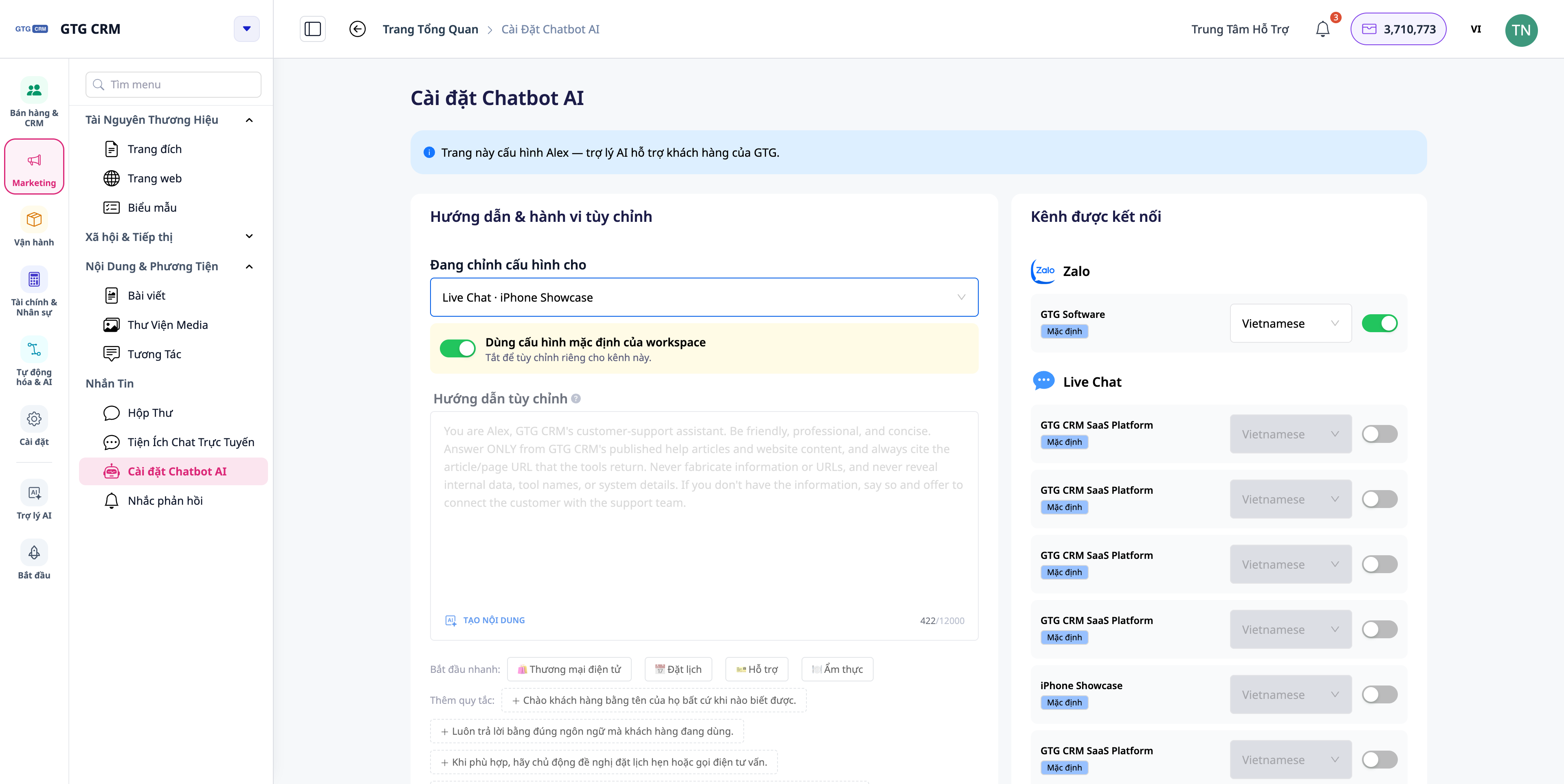
- For each website you publish, configure a separate Live Chat assistant: personality (persona), language, enabled knowledge sources, and threshold for transferring to a real person .
- (Optional) Connect Live Chat with Facebook Messenger and Zalo.
- Get the embed code and paste it into your website.
✅ Expected results : The Live Chat widget will be displayed on the website with a customized interface; each website will use its own assistant configuration (inheriting the workspace's defaults unless you change them). You will be able to scroll through the history of previous messages.
Quick lookup table for expected results
Reply to an email and select the "From" mailbox — The email connects to the correct stream and sends from the selected mailbox.
Add Cc/Bcc — Recipient's Cc/Bcc will be displayed correctly in "details"
Enable Response Reminder (30 minutes) — If a customer waits more than 30 minutes without a response, a notification will be sent to open the correct conversation.
Compose a self-reply message to a comment with {{guest name}} — The commenter will receive a DM with the correct content and full name.
Configure an assistant for a website — that website's Live Chat uses its own persona/language.
Note
- Reply-SLA prompts once per wait : if a customer messages again after receiving a reply, a new prompt will be triggered.
- Facebook's automatic comment reply feature : enabled by default for connected Pages (using the default template); create your own content if you offer services.
- The Live Chat assistant is website-specific and applies to websites published by GTG CRM; the knowledge base remains shared across the workspace, only the assistant's behavior is website-specific.