Many small and medium-sized businesses today understand the need for a stronger online presence. They know they need a website, a landing page, more systematic lead management, faster response times, and better lead nurturing. The problem isn't not knowing what they need. The problem is not knowing where to start to ensure a streamlined, sufficient, and uncluttered system .
This is a very common bottleneck.
Some businesses build websites first but lack a lead generation flow. Others run ads first but don't have a clear landing page. Some use CRM but their input data remains fragmented. And some businesses launch too many tools at once, ultimately failing to keep up with any team, and everything reverts to manual methods.
With SMBs, the challenge isn't building a huge system right from the start. The challenge is building a compact yet functional system that's suitable for the current stage of development and can be scaled up later without having to completely rebuild.
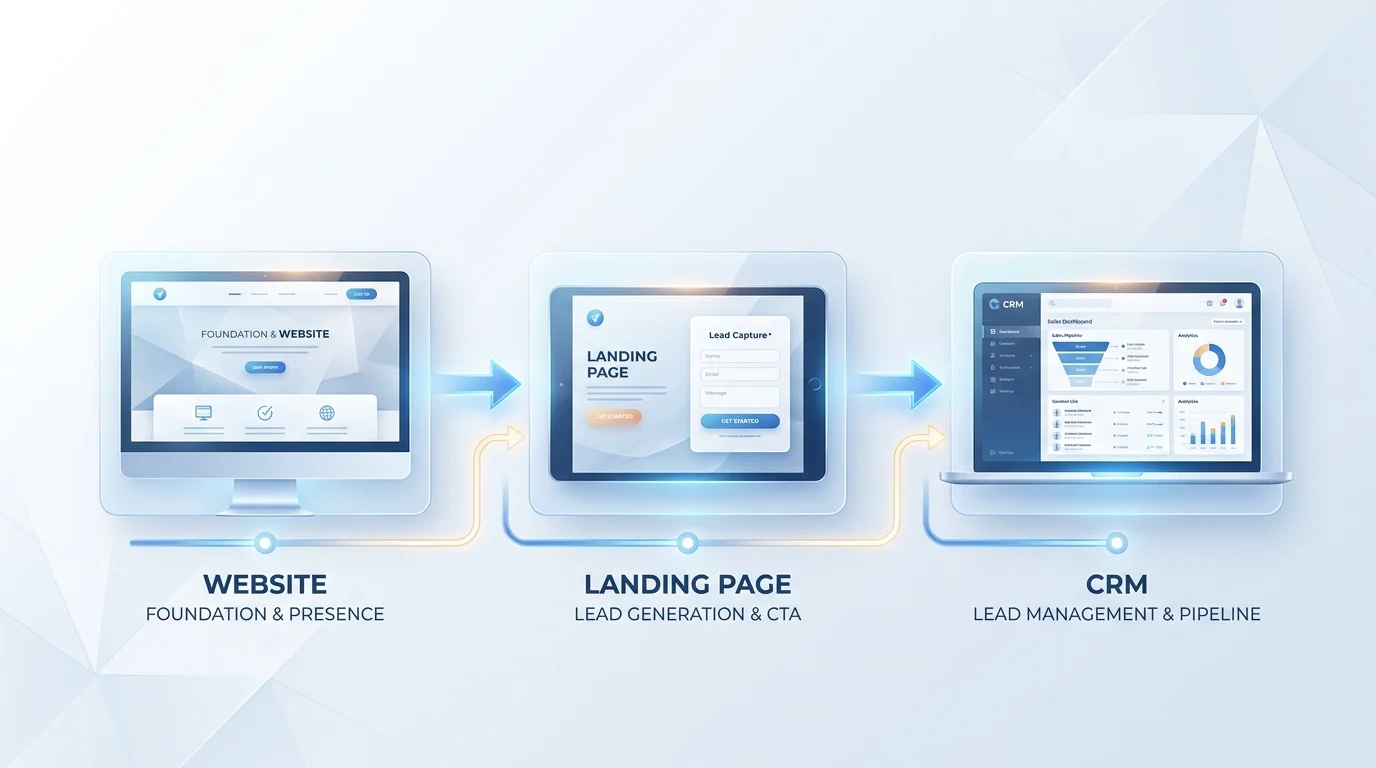
From that perspective, the roadmap should generally follow three main steps: Website → Landing Page → CRM . Once these three parts are clearer, businesses should then expand into Messaging and Automation .
Why do SMBs need a roadmap instead of trying to do everything at once?
The strength of small businesses lies in their ability to deploy quickly. However, their weakness is also limited resources. They have small teams, limited time, limited budgets, and the capacity to operate multiple platforms simultaneously is also not high.
Therefore, without clear priorities, businesses can easily fall into one of three situations:
- They have an online presence but haven't yet built trust.
- There are leads, but no system in place to convert them effectively.
- There are many tools, but they operate in a disjointed manner, and their true effectiveness is not visible.
That's why SMBs should follow a clear, logical roadmap. Each step addresses a different problem, but also prepares the groundwork for the next.
Step 1: Build online credibility with a website.
If a business doesn't already have a strong online presence, a website is almost always the best place to start.
The reason is quite simple. Before leaving their information, before signing up for a demo, before messaging or making a decision, customers usually want to verify who the business is, what it offers, and whether it's trustworthy. In many cases, the website is where they do that.
A good website doesn't need to be overly complex in the early stages. But it needs to accomplish a few core things:
- Help customers understand what the business is doing.
- creating a more professional and trustworthy impression.
- Having clear information about the service, solution, or capability.
- The call to action (CTA) should be clear enough for customers to know what the next step is.
This is the "foundation" step. Without this foundation, subsequent activities such as advertising, lead generation, or sales operations will struggle to be fully effective because customers still lack a place to test their trust.
In other words, a website is the first step for SMBs to build online credibility before thinking more deeply about conversions .
Step 2: Create clearer leads using a landing page.
Once the website has a basic foundation, businesses will move on to the next stage: not only establishing a presence, but also generating clearer leads .
This is where landing pages become important.
A website serves the overall brand. However, when a business runs a specific campaign, introduces a particular service, or needs to generate leads from advertising, the homepage is often not focused enough. Visitors are bombarded with too much information, the journey becomes diluted, and the conversion rate easily decreases.
Landing pages help address that very point. They allow businesses to create a more focused landing page for specific goals such as:
- run ads for a service
- Introducing a promotional program
- Collect leads via form
- Confirm your registration for a demo or consultation.
Unlike a website, a landing page doesn't need to say too much. It needs to say exactly what the customer is interested in, and then lead them to a clear action.
If step 1 is building trust , then step 2 is turning that interest into more concrete leads .
Step 3: Collect and track leads more systematically using CRM.
Once websites and landing pages start generating more consistent leads, businesses will soon face another challenge: once leads arrive, how do you keep them coming back?
This is where CRM comes in.
Many early SMBs still manage leads using files, inbox messages, emails, or disjointed notes. This might work fine when the number of leads is small. But as more leads come in, small sales teams can easily become overwhelmed or miss leads midway.
CRM helps businesses:
- Gather customer data in one place.
- Track leads more clearly by status.
- Reduce the number of customers scattered across many locations.
- This helps sales teams have a more structured workflow.
- This helps marketing teams gain a clearer understanding of lead quality.
This is a crucial step because it transforms online operations from a "customer interest" level to a "more systematic customer handling" level.
If step 2 is about generating leads, then step 3 is about integrating those leads into a more structured sales process .
After completing the three must-have steps, when should you expand?
Many small businesses often ask further: what about messaging, email, and automation?
The answer is: these parts are very useful, but should generally be added after the three core parts above have started running more smoothly.
When the website is still under development, the landing page is not yet available, and the CRM is not yet operational, adding too many extensions usually only makes the system heavier. But once the foundation is in place, the extensions will start to show their effectiveness more clearly.
Normally:
- Messaging is suitable when businesses need to respond to customers faster and consolidate cross-channel interactions more effectively.
- Automation is suitable when businesses want to nurture leads more consistently after establishing a relatively clear input flow.
- Email is suitable when businesses want to nurture leads after forms, registrations, or first touchpoints.
In short, these are the nice-to-have items after the must-haves , not because they are less important, but because they are more effective when placed in the right order.
30-60-90 day timeline for SMBs who want a streamlined yet systematic approach.
A simpler way to visualize it is to divide the route into 3 stages:
0–30 days: Complete the platform website
At this stage, the main goal is to create a sufficiently strong online presence so that customers understand and trust the business more.
Businesses should focus on: - basic website structure - clear brand message - core service or solution - call to action (CTA) and contact information - key trust signals
The goal for the first 30 days isn't perfection. The goal is to build a solid foundation so that customers don't lose trust on their first visit.
30–60 days: Deploy landing page for campaign or lead generation
Once the foundational website is in place, businesses can begin to separate campaigns that require clearer conversion metrics using landing pages.
At this stage, focus should be on: - one or more landing pages for a specific service or offer - a clear lead generation form - clearer call-to-actions (CTAs) for each campaign - measuring signals such as form fills, CTA clicks, and lead quality
This is the stage that helps businesses transition from a physical presence to a more systematic lead generation.
60–90 days: Bring leads into CRM and standardize the tracking flow.
When leads are more consistently coming in from websites and landing pages, CRM will help businesses avoid losing leads during the processing.
This phase should focus on: - gathering leads from the website and landing page into the CRM - tracking leads by basic status - clarifying the handoff between marketing and sales - reviewing lead quality and lead sources
After this point, businesses should consider expanding into messaging or automation if the need is clear enough.
Applicable framework: What stage is your business currently at?
If they want to implement it quickly, SMBs can ask themselves three questions:
Do customers have a place to understand and trust the business?
If you haven't already, start with the website.
Do customers have a clear landing page where they can leave their information?
If not, proceed to the landing page.
Does Lead have a place where he can be centrally monitored?
If not, CRM is the next step.
This framework helps businesses avoid the reverse order of things. Because if you optimize leads without building trust, or rush to implement CRM without a clear landing page, the overall effectiveness will usually not be high.
How does GTG CRM fit into this roadmap?
GTG CRM fits the step-by-step approach that many SMBs need.
Businesses can start with a website to build a stronger online presence. Then, they can expand to landing pages when they need to generate leads for specific campaigns. Once leads become more stable, CRM helps to collect and track customer data more effectively on a single platform.
The valuable aspect is that this roadmap doesn't force businesses to use too many disparate tools right from the start. Instead, businesses can go from the basics to more systematic lead generation in a more streamlined flow.
Once the system is more robust, businesses can then expand into areas like messaging or automation to speed up responses and manage leads more effectively.
Conclude
For small and medium-sized businesses, building an online system doesn't necessarily mean starting on a huge scale. What's more important is doing it in the right order.
Start by building your reputation with your website .
Next, we'll create a landing page to generate clearer leads.
Next, we'll use CRM to track leads more systematically.
That's a three-step roadmap that's concise enough for SMBs to implement in practice, but also robust enough for future expansion.
If your business is looking to undergo a digital transformation that is streamlined, easy to operate, and free from an overwhelming number of tools, then this is a very logical starting point.
Turn what you've just read into tangible results — apply it now with GTG CRM, free.
Apply now