Many businesses have had websites for a long time, but these websites haven't really done a good job of attracting customers and supporting conversions. Some websites exist just for the sake of having one, some have decent interfaces but are very ineffective, and some spend money on advertising regularly but visitors leave without taking any action.
This is a fairly common situation for online businesses, especially those looking to increase leads, build trust, and establish a more structured sales system. The problem isn't always with the product or the advertising budget. Often, the website itself is the bottleneck.
A good website isn't just about being beautiful. It needs to help customers understand what the business offers, why they should trust it, why they should contact it immediately, and what the next step should be. If the website fails to do all of that, it's likely causing the business to miss out on many opportunities every day.
Why do weak websites cause businesses to lose customers?
A website is often one of the most important touchpoints in the customer journey. They might find you through ads, social media, Google search, email, or a referral. But when they want to check credibility, learn more, or make a decision, they usually return to your website.
If a website lacks clarity, persuasiveness, or provides a poor user experience, visitors won't need prior notice of dissatisfaction. They'll simply leave the site.
It's worth noting that many businesses still think their website is "okay" simply because it's still operational. But a website being operational doesn't necessarily mean it's bringing in customers.
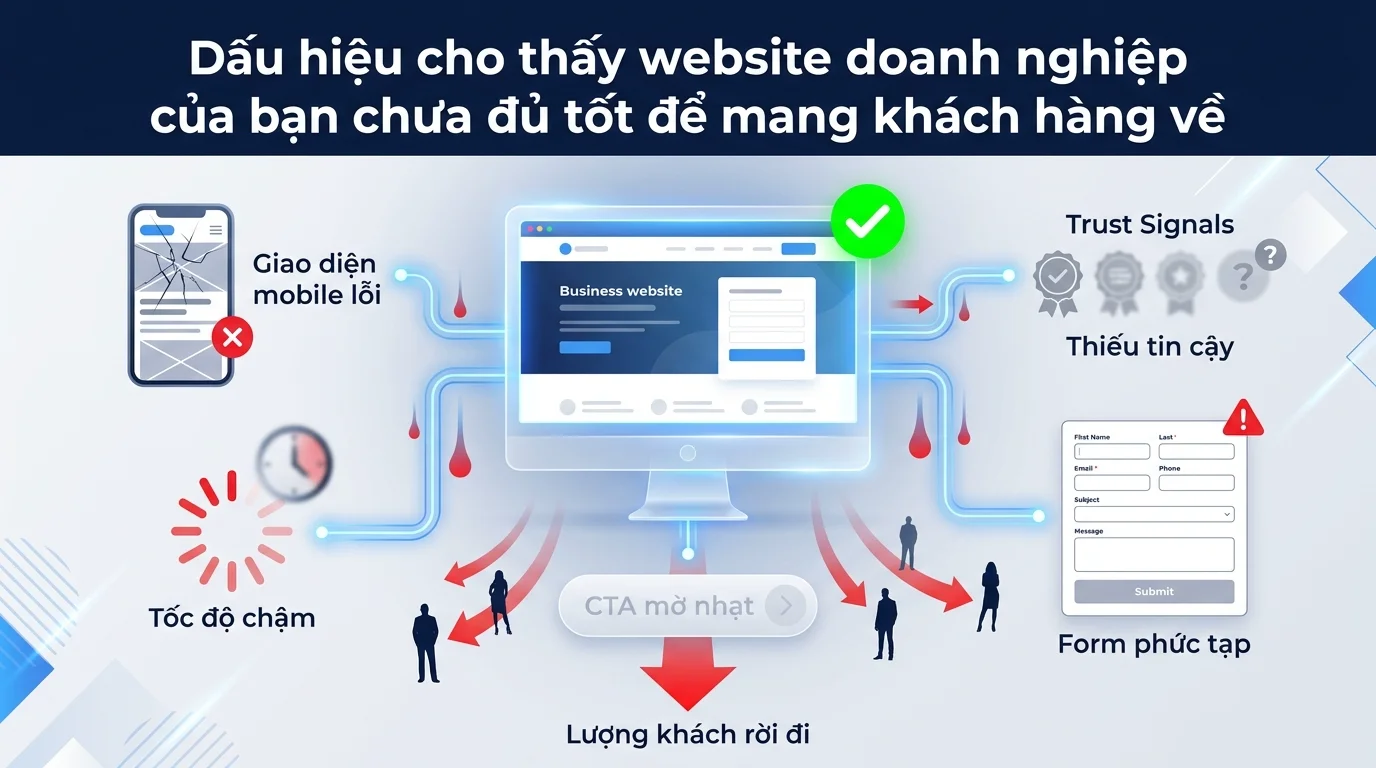
This checklist shows that your business website may not be good enough.
Below are some very common signs. If your website experiences several or more of these issues, it's time to seriously consider an upgrade.
1. Lack of a clear Call to Action (CTA).
One of the biggest mistakes business websites make is letting visitors view the site but not knowing what to do next.
If readers don't see a prominent contact button, a clear registration form, a strong call to action, or a call to action (CTA) placed in a hard-to-see location, then even if they are interested, the likelihood of taking action remains low.
An effective website needs to clearly guide customers through the process: register for a consultation, get a quote, leave their information, view a demo, buy now, or message for advice. If the website only provides information, it will be difficult to generate real conversions.
2. Lack of elements that build trust.
Many websites contain all the basic information but still lack one crucial element: a reason for customers to trust them.
Visitors, especially newcomers, naturally have a few questions. Is this business trustworthy? Who have they worked for? Are there any real customer reviews? What are their policies? Are their processes clear?
If a website lacks elements such as a clear introduction, realistic images, customer testimonials, case studies, partner logos, transparent contact information, or proof of capability, customers will be less likely to leave their information. They aren't necessarily against you; they just aren't confident enough to take the next step.
3. Slow page load speed
This is a mistake that causes many websites to lose customers, and businesses often overlook it.
When a website loads slowly, visitors will leave before they have a chance to see the content. This is especially dangerous if the business is running ads, as every click lost midway through the process is real budget being wasted.
A slow website not only negatively impacts user experience but also reduces the effectiveness of all traffic generation efforts. No matter how good the content is, if customers can't wait to see it, the website fails in the first step.
4. Poor mobile experience.
Most customers now access websites from their phones. However, many websites are still designed in a way that looks good on a computer but becomes cluttered on a phone, with small text, misaligned images, hard-to-click buttons, and difficult-to-fill forms.
When mobile performance is poor, businesses are missing out on a significant portion of conversion opportunities. Customers are not inclined to sympathize with a difficult-to-use website; they simply switch to a more user-friendly option.
If a business is investing in content, SEO, or advertising but its website isn't optimized for mobile devices, the overall effectiveness will be significantly reduced.
5. The form isn't good enough to generate leads.
Many websites have forms, but they are often placed in inconspicuous locations, contain unconvincing content, or require too much information upfront. This discourages users from proceeding and causes them to abandon the process midway.
An effective form needs to be concise, clear, and timely. More importantly, customers must understand why they should fill out the form right now. A simple input field without context, benefits, and a suitable call to action (CTA) will fail to fulfill its purpose.
Quick website audit
You can quickly check yourself using the checklist below:
- [ ] The website has a clear CTA at the top of the page.
- [ ] There are factors that increase trust such as feedback, partners, case studies, or clear business introductions.
- [ ] Page load speed is fast enough so that visitors don't leave too soon.
- [ ] The interface displays well on mobile phones.
- [ ] The form is concise, easy to fill out, and placed correctly.
- [ ] The content on the website clearly states what the customer will receive.
- [ ] Homepage or important pages that lead to specific actions
- [ ] The website accurately reflects the current brand image.
If you've missed checking quite a few items, that's a sign your website isn't robust enough to support your business.
A weak website not only leads to lost customers but also reduces the effectiveness of other channels.
A poorly designed website doesn't just affect itself; it drags down the effectiveness of many other activities.
When running ads, a weak website reduces the conversion rate after a click.
When doing SEO, a weak website causes visitors to come and leave quickly.
When building a brand, a weak website diminishes the sense of professionalism and credibility.
When the sales team sends links to customers for reference, a weak website reduces the chances of closing the deal.
In other words, a website is no longer a secondary item. For online businesses, it's the central platform for gathering attention from multiple channels in one place.
Website upgrades no longer require a complicated, complete overhaul.
One of the reasons many businesses are slow to upgrade their websites is because they think it will be very time-consuming. They imagine having to hire multiple parties, rewrite all the content, redo each section, adjust the interface multiple times, and find it difficult to proactively manage changes if needed quickly later on.
That's also when next-generation website creation tools become more essential. What businesses need is not just a beautiful website, but a faster, more flexible way to create websites that support better conversions.
How does GTG CRM help businesses upgrade their websites?
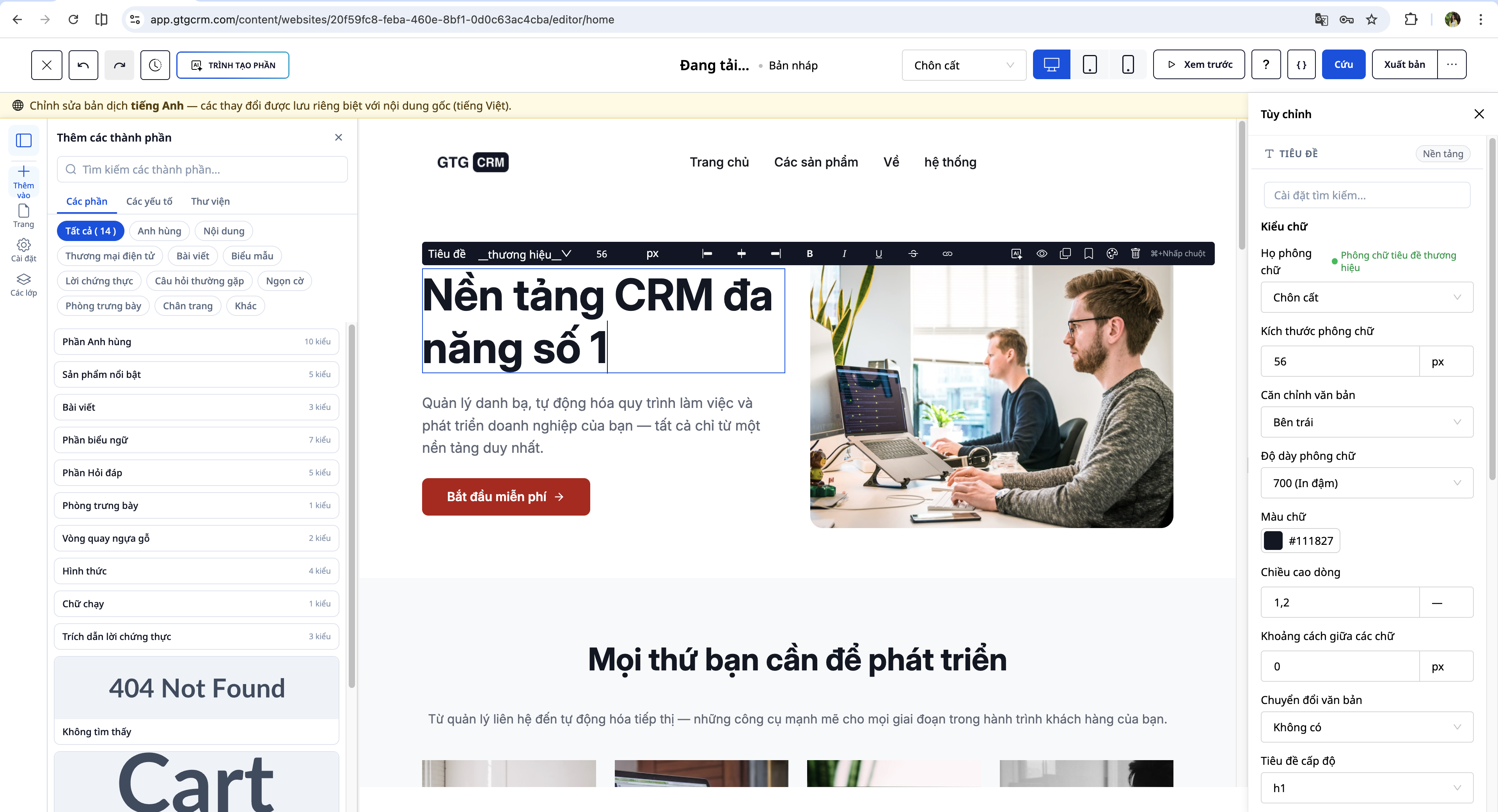
GTG CRM provides SEO-friendly website templates so businesses can get started faster with a clean, easy-to-deploy structure, suitable for building a more professional online presence.
In addition, GTG CRM also supports creating a completely new website using AI . This is a very noteworthy feature for businesses that don't want to start with a complex design, or need to create a website faster to launch a campaign.
Beyond simply creating a complete website, the AI in GTG CRM can also assist in creating individual sections for the website . For example, if you want to add a promotional countdown section, you only need to describe a few key points, and the system will help create a suitable section to insert into the website. This approach gives businesses much more flexibility when needing to update content according to sales programs, campaign seasons, or new conversion goals.
The key point is that businesses shouldn't view their website as something fixed and then left to its own devices. With GTG CRM, websites can be adjusted, enhanced, and developed more flexibly according to the actual needs of the business.
Conclude
If your business website lacks CTAs, trust, loads slowly, displays poorly on mobile devices, or has inadequate forms, it's very likely that you have an online presence but not a website good enough to bring customers in.
This isn't just about the interface. It's about retaining visitors, building trust, and leading them to the final action.
The more important a website is as a touchpoint, the less a business should let it perform at a "mediocre" level. It's time to view websites as conversion tools, not just places to present information.
With GTG CRM, businesses can begin upgrading their websites in a more streamlined, faster, and flexible way, from using SEO-friendly website templates to creating new websites with AI, and even adding individual sections based on real-world needs with just a few short descriptions.
If your current website isn't good enough to attract customers, upgrading it isn't something to consider. It's something you should start doing soon.
Turn what you've just read into tangible results — apply it now with GTG CRM, free.
Apply now