As businesses grow, transitioning from independent business to registered sole proprietorship is a crucial step in legitimizing operations, building credibility, and expanding business opportunities. However, many online shop owners and retailers are still confused about the procedures, required documents, and tax declaration process after registration.
This article will provide you with a detailed, step-by-step checklist of the necessary documents and procedures when converting to a tax-filing sole proprietorship. From preparing paperwork and registering with the tax authorities to the periodic tax filing process – everything will be presented clearly and easily understandable so you can proactively manage it.
Understanding the process not only saves you time and money but also ensures compliance with legal regulations, avoiding unnecessary risks in your business operations.
Why Should You Switch to a Household Business with Tax Filing?
- Legalizing business operations - Building trust with customers and partners.
- Obtaining a tax identification number is a mandatory requirement when cooperating with businesses and companies.
- Issuing valid invoices - Serving corporate clients who require VAT invoices.
- Open a business bank account - Professional transactions, separate personal finances.
- Access to loan capital - Banks prioritize lending to business households with tax identification numbers.
- Building a long-term brand – The foundation for business growth.
Checklist of Documents to Prepare
Step 1: Register a Business
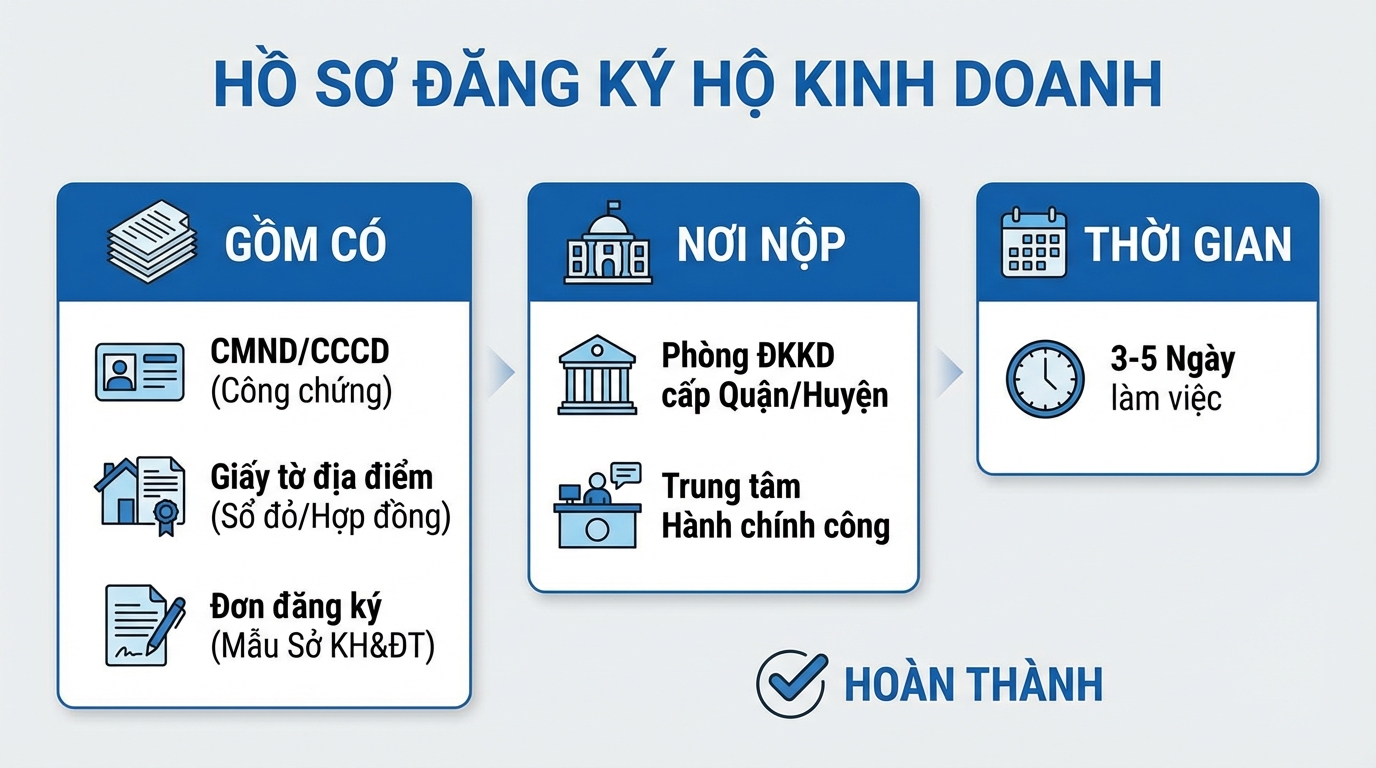
The file includes:
- National Identity Card/Citizen ID Card (notarized copy)
- Documents proving the business location:
- Land ownership certificate (if you are the homeowner)
- Rental agreement (original or notarized copy)
- Authorization letter for the use of the premises (if borrowing the premises)
- Business registration application form (according to the template of the Department of Planning and Investment)
Where to submit the application: - Business Registration Office under the Department of Planning and Investment at the district/county level - Or Public Administration Center (if available)
Processing time: 3-5 business days
Step 2: Register for Tax with the Tax Authority
After obtaining your business registration certificate, you need to register for tax within 10 days .
The file includes:
- Business registration certificate (copy)
- Copy of the head of household's ID card/citizen identification card
- Tax registration form (form 01-ĐK-TCT) - Download from the General Department of Taxation website.
- Lease/rental agreement for the business premises (if any)
Where to submit: - District/County Tax Office where the business is located - Or register online via eTax (recommended)
Results received: - Personal tax identification number (10 digits) - Notification regarding invoice usage
Download the tax registration form now.
Step 3: Register for Invoice Usage
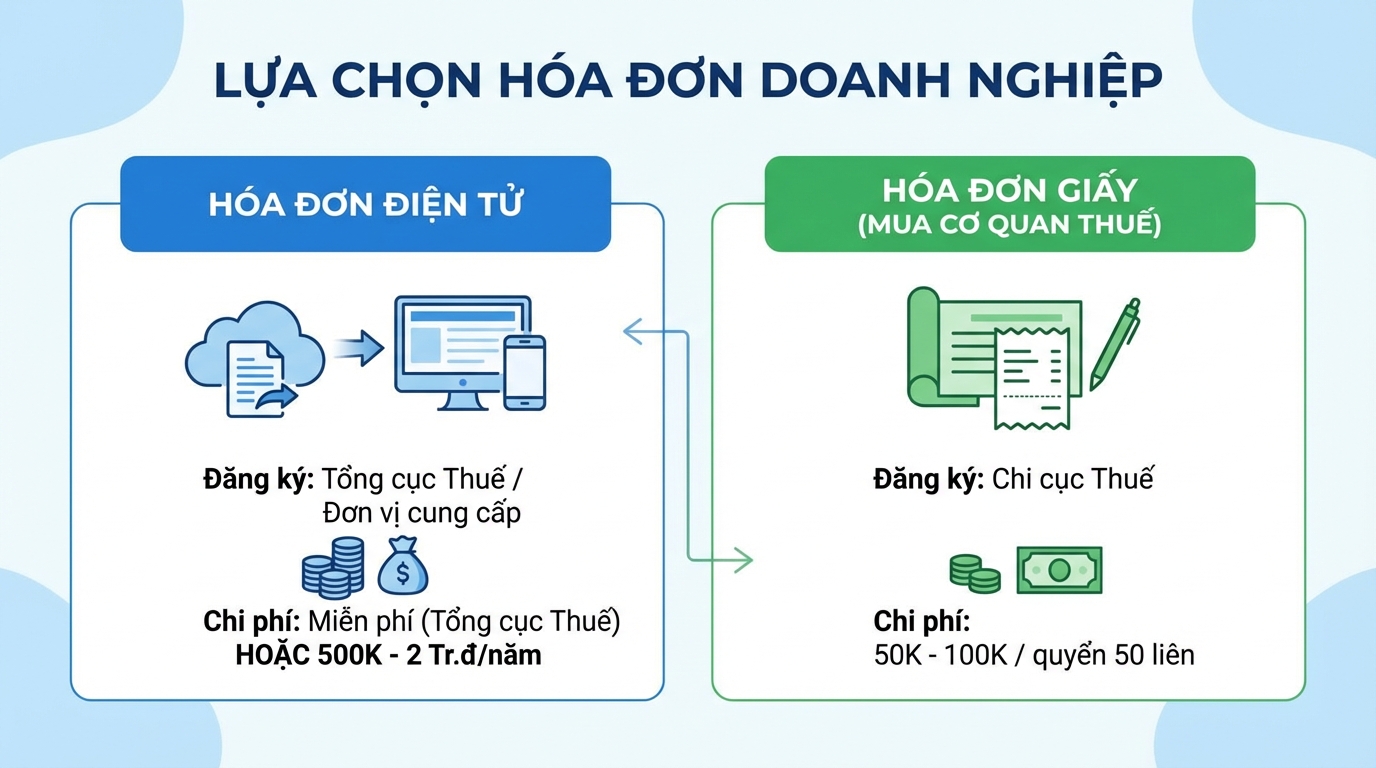
Household businesses have two options:
Option 1: Electronic Invoice - Register through the General Department of Taxation's website or through an electronic invoice provider - Cost: Free (if through the General Department of Taxation) or VND 500,000 - VND 2,000,000/year (through a provider)
Option 2: Paper invoices (purchased from the tax authority) - Submit an application to purchase invoices at the Tax Office - Cost: Approximately 50,000 VND - 100,000 VND for a booklet of 50 invoices.
Periodic Tax Filing Procedure
Types of Taxes That Need to Be Declared
1. Value Added Tax (VAT)
Declaration method: - Percentage: Revenue × 1% (for goods sales) or × 5% (for services) - Declaration period: Quarterly (in the first month of the following quarter) - Declaration form: 01/GTGT
2. Personal Income Tax (PIT)
Declaration method: - Rate: Revenue × 0.5% (goods sales) or × 2% (services) - Declaration period: Quarterly - Declaration form: 02/TNCN-HKD
3. Business License Tax
- Tax rate: VND 1,000,000/year (for household businesses)
- Submission deadline: Before January 30th of each year
- Declaration form: 01/MB
Declaration Method
1. Online tax declaration (recommended): - Access: https://thuedientu.gdt.gov.vn - Log in using your tax identification number - Fill out the online declaration form and submit
2. Direct declaration: - Bring the paper declaration form to the Tax Office - Present relevant documents
3. Through a tax agent: - Cost: 500,000 VND - 1,500,000 VND/quarter - Convenient for busy people
Benefits of Switching to File-Based Tax Returns
- Financial transparency - Easily track revenue, expenses, and profits.
- Enhance credibility - Build trust with corporate clients for long-term partnerships.
- Business expansion - Opportunity to participate in bidding processes and collaborate with larger companies.
- Access to loans - Banks are more likely to approve loans when you have a clear tax record.
- Professional management requires a robust sales and inventory management system.
Important Note
Regarding the Deadline
- Late declarations will be subject to fines ranging from 400,000 VND to 2,000,000 VND, depending on the severity of the violation.
- Late tax payment: Penalty of 0.03% per day on the amount of tax overdue.
- Incorrect tax declarations resulting in tax underpayment: Penalties range from 10% to 30% of the underpaid amount.
Regarding Accounting Records
- Household businesses are not required to keep accounting records like enterprises.
- However, it is advisable to keep a record of revenue and expenses for easier accounting.
- Keep purchase and sales invoices for at least 5 years.
Regarding the Conversion to a Company
- When revenue reaches 3 billion VND/year or more, consider converting to a sole proprietorship or limited liability company.
- Sole proprietorships are not permitted to open branches.
- Some sectors require being a business entity (import/export, large-scale construction, etc.).
Conclude
Switching to a tax-declared sole proprietorship is a crucial step in your business development journey. Although it may initially seem complicated with many documents and procedures, once you understand the process, maintaining legal operations will become easier and bring many practical benefits.
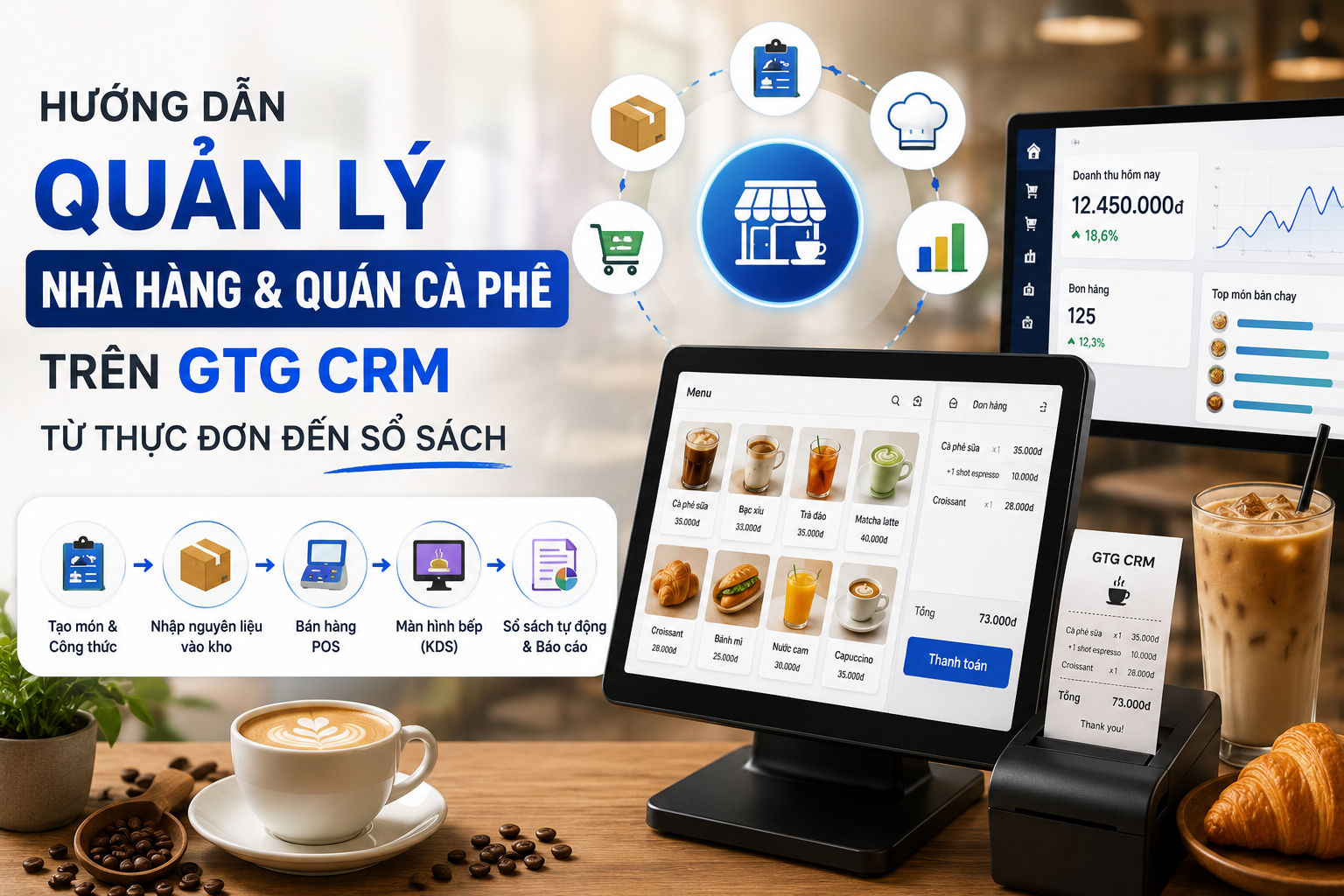
To provide maximum support for the business operations of household businesses, GTG CRM offers a comprehensive management platform, helping you manage every step from start to finish professionally:
- Multichannel sales management - Integrate orders from your website, Shopee, Lazada, and TikTok Shop into one place.
- Automated inventory management - Real-time inventory updates, out-of-stock alerts.
- Shipping management - Connect with shipping carriers, track order status.
- Automatic invoice generation - Create electronic invoices instantly when an order is placed.
- Manage incoming/outgoing invoices - Track expenses, revenue, and profits clearly.
- A standardized, closed-loop process – from receiving goods, selling goods, warehousing, to tax declaration.
With GTG CRM, you not only meet all your tax management and filing requirements but also save time, improve business efficiency, and are ready to scale up when needed.
Start today - Let GTG CRM be your partner on your journey to sustainable growth!
Turn what you've just read into tangible results — apply it now with GTG CRM, free.
Apply now