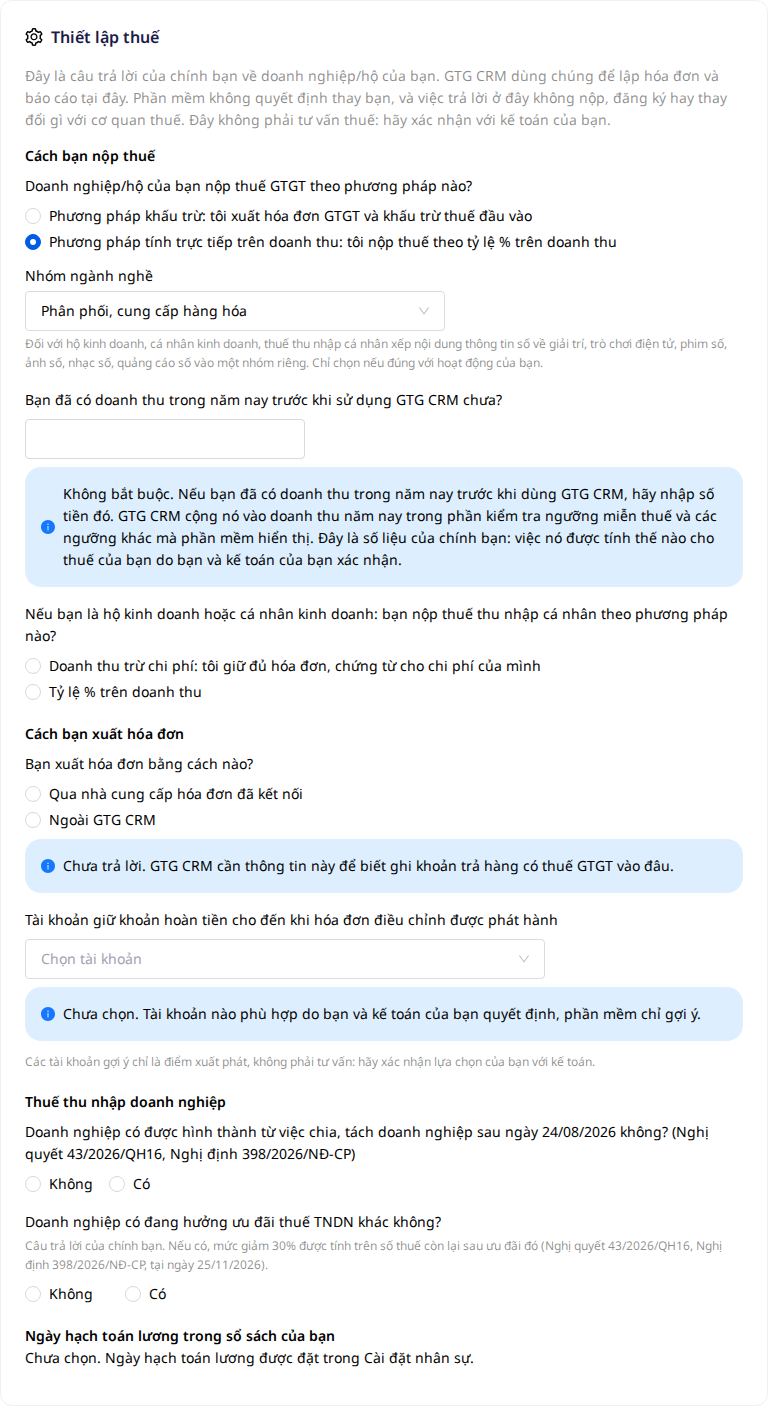
Updated on 29/10/2026. Decree 141/2026/NĐ-CP has added paragraph 15 to Article 4 of Decree 320/2025/NĐ-CP (Decree 141/2026/NĐ-CP, Article 2), effective from 01/01/2026 (Decree 141/2026/NĐ-CP, Article 3): income of enterprises and organizations established in accordance with Vietnamese law provisions with annual total revenue of 1 billion dong or less shall be exempted from corporate income tax. The annual total revenue used as a basis for determination is the total revenue from sales and service provision activities (not including revenue deductions), revenue from financial activities and other income on the Appendix of production and business activity results attached to the corporate income tax settlement declaration of the immediately preceding tax year (paragraph 15 point a). This tax exemption provision does not apply to enterprises established in accordance with Vietnamese law provisions that are subsidiaries or affiliated companies where enterprises in the affiliated relationship are not enterprises meeting the tax exemption conditions (paragraph 15 point d). Please consult with your accountant to determine whether your situation qualifies for this tax exemption. The content section below does not yet include this regulation.
The Government has officially issued Decree 320/2025/NĐ-CP, a document providing detailed regulations and guidance on the implementation of the Corporate Income Tax Law 2025. This Decree clarifies how to determine taxable income, tax calculation methods, tax rates as well as corporate income tax incentive policies.
This is an important legal basis that directly affects the tax declaration and settlement activities of enterprises from the 2025 tax year onwards. Therefore, organizations, business households converting to enterprises, and operating enterprises need to proactively update to apply the regulations correctly and minimize tax risks.
Overview of Decree 320/2025/NĐ-CP
On 15/12/2025, the Government issued Decree 320/2025/NĐ-CP to provide detailed regulations on certain articles and organizational measures for implementing the Corporate Income Tax Law.
The Decree consists of 6 chapters, 26 articles, with the following specific content:
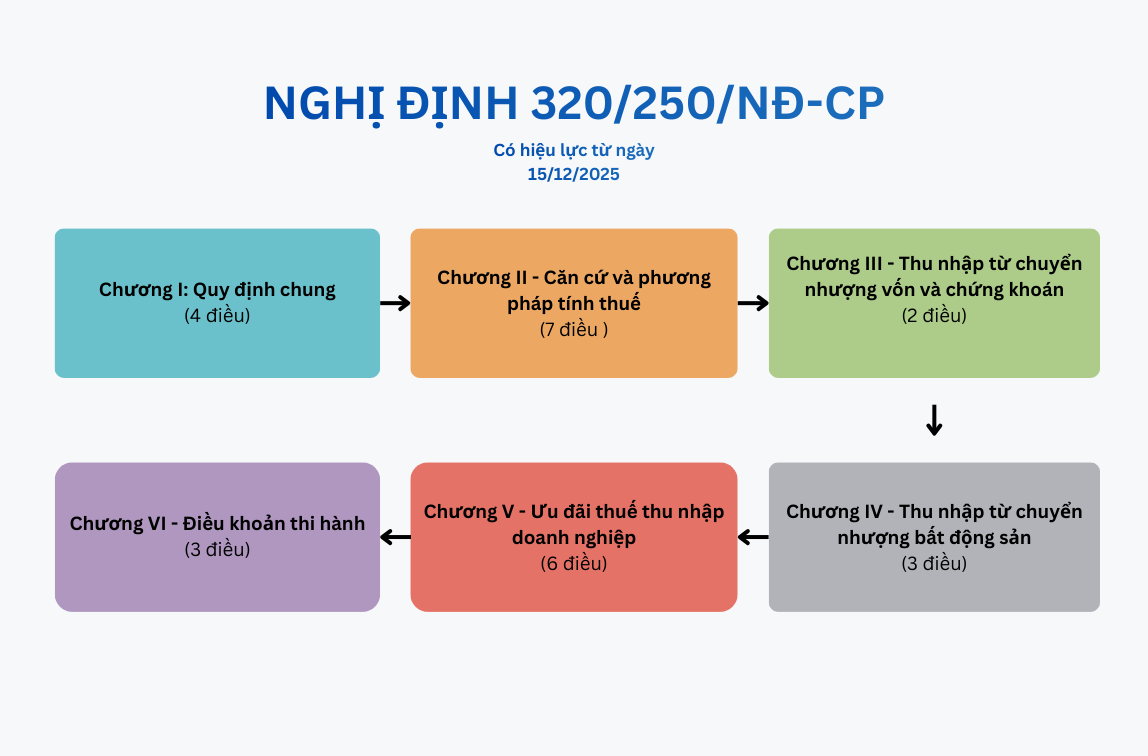
Content of the entire Decree 320/2025/NĐ-CP
Chapter I - General Provisions
Consisting of 4 articles (Articles 1 to 4)
Chapter II - Basis and Methods for Tax Calculation
Consisting of 8 articles (Articles 5 to 12)
Chapter III - Income from Capital Transfer and Securities
Consisting of 2 articles (Articles 13, 14)
Chapter IV - Income from Real Estate Transfer
Consisting of 3 articles (Articles 15 to 17)
Chapter V - Corporate Income Tax Incentives
Consisting of 6 articles (Articles 18 to 23)
Chapter VI - Implementation Provisions
Consisting of 3 articles (Articles 24 to 26)
View the full text of Decree 320/2025/NĐ-CP
Scope of Adjustment and Applicable Subjects
The Decree provides detailed regulations on the implementation of the Corporate Income Tax Law, including:
- Determining taxable income
- Tax basis
- Tax rate
- Tax calculation method
- Principles and conditions for enjoying tax incentives
Applicable subjects are organizations and individuals related to the above contents.
Corporate income tax payers include:
- Enterprises established and operating under Vietnamese law
- Foreign enterprises with or without a permanent establishment in Vietnam
- Public service units, cooperatives, cooperative unions
- Credit institutions and other economic organizations with taxable income
Determining taxable corporate income
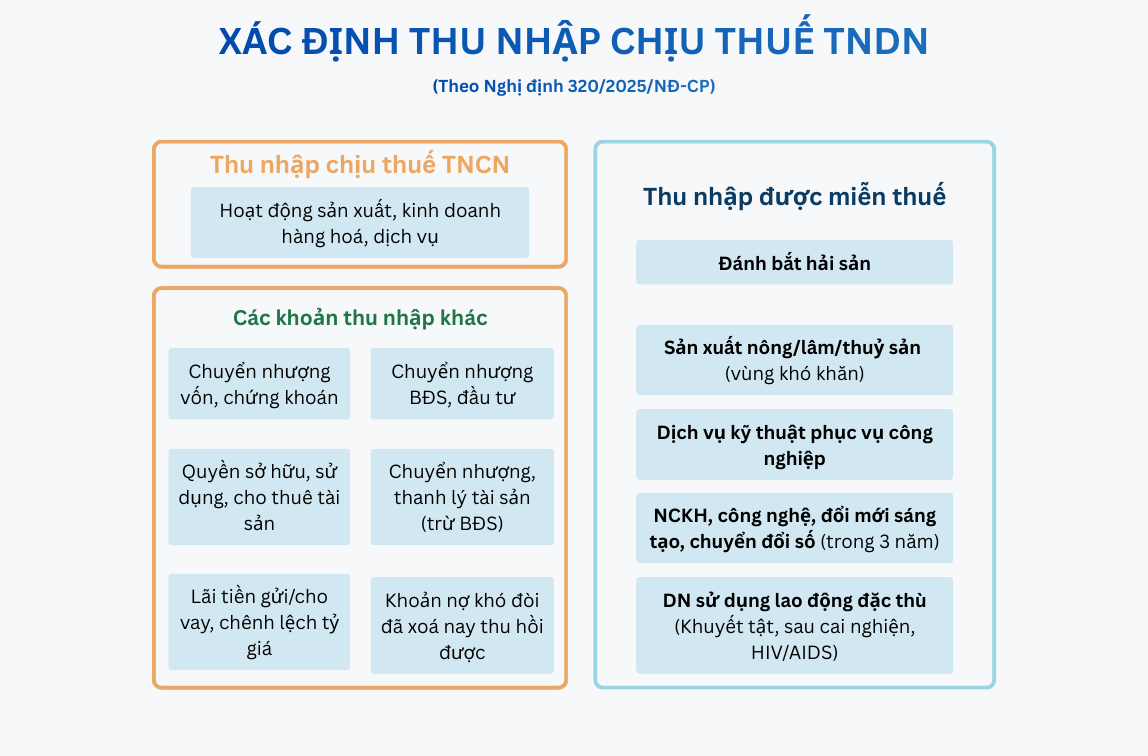
How to determine taxable corporate income
Taxable corporate income
According to Decree 320/2025/NĐ-CP, taxable corporate income includes:
- Income from production, business activities, goods and services
- Other income as provided by tax law
The group of other income is defined quite broadly, including but not limited to:
- Income from capital transfer, securities transfer
- Income from real estate and investment project transfer
- Income from ownership rights and asset use rights
- Income from asset rental
- Income from liquidation and asset transfer (excluding real estate)
- Deposit interest, loan interest
- Exchange rate differences
- Bad debts written off but recovered
- Gifts and other income as prescribed
Enterprises need to properly classify these income items to make complete declarations when determining taxable income.
Tax-exempt corporate income
In addition to taxable income, the Decree also clearly stipulates tax-exempt income, which typically includes:
- Income from marine product fishing activities
- Income from agricultural, forestry, aquaculture production, particularly in areas with difficult socio-economic conditions
- Income from technical services directly serving agriculture
- Income from scientific research contracts, technology development, innovation and digital transformation (tax-exempt during contract implementation but not exceeding 03 years from when income is received from contract implementation: Decree 320/2025/NĐ-CP, Article 4 Section 4 Point a)
- Income from production and business activities of goods and services of enterprises with 30% or more of average annual employees being persons with disabilities, persons after drug rehabilitation, persons infected with human immunodeficiency virus causing acquired immunodeficiency syndrome (HIV/AIDS) and with average annual employees of 20 people or more, excluding enterprises operating in the financial sector and real estate business; enterprises receiving tax exemption must still meet the conditions specified in this section (Decree 320/2025/NĐ-CP, Article 4 Section 5)
Basis and method for calculating CIT
Tax calculation basis:
Corporate income tax is determined based on:
- Taxable income in the period
- Corresponding CIT rate
Principles of offsetting gains, losses and loss carryforward:
Enterprises are permitted to offset gains and losses between production and business activities within the same tax period. However, note that:
- Losses from real estate transfer or investment projects cannot be offset against income from activities enjoying tax incentives
- Losses are carried forward in full and continuously to subsequent years, not exceeding 05 years
Revenue for calculating taxable income
Revenue for calculating taxable income is all amounts the enterprise receives from sales, processing and service provision, regardless of whether payment has been collected or not.
The Decree clearly guides:
- Timing of revenue recognition
-
Method for determining revenue in special cases such as:
- Installment sales, deferred payment sales
- Asset leasing
- Construction and installation activities
- Business cooperation contracts (BCC)
- Other cases as prescribed
Deductible and non-deductible expenses
Conditions for expenses to be deductible:
An expense item to be counted as a valid expense must simultaneously meet 3 conditions:
- Actually incurred and related to production and business activities
- Have complete invoices and legal supporting documents
- Have payment evidence using non-cash payment for transactions from 05 million dong or more
Non-deductible expenses, including:
- Expenses that do not meet the conditions mentioned above
- Administrative penalties
- Portion of expenses exceeding the prescribed limit for employee benefits
- Portion of loan interest corresponding to the shortage in charter capital
Corporate income tax rates
According to Decree 320/2025/NĐ-CP:
Standard tax rate: 20%
Preferential tax rates by revenue scale:
- 15%: enterprises with total annual revenue not exceeding 3 billion dong
- 17%: enterprises with revenue from over 3 billion to not exceeding 50 billion dong
Special tax rates:
- 25% to 50% for oil and gas exploration, prospecting and exploitation activities
- 40% or 50% for rare natural resource exploitation
Foreign enterprises with no permanent establishment in Vietnam apply tax at the percentage rate on revenue, for example:
- Services: 5% (except restaurant, hotel and casino management: 10%)
- Royalties: 10%
- Capital transfer: 2%
Corporate income tax incentives
Industries and areas eligible for incentives
Notable industries and sectors eligible for incentives:
- High-tech applications, R&D
- Software production and IT services
- Supporting industries
- Renewable energy, clean energy
- Investment in important State infrastructure
- Large-scale production projects with investment capital from 12,000 billion dong
Regional incentives apply to:
- Areas with difficult or particularly difficult socio-economic conditions
- Economic zones, high-tech zones, high-tech agricultural zones, concentrated digital technology zones
Preferential tax rates
- 10% tax rate for 15 years for new investment projects in preferred industries or particularly difficult areas
- 10% tax rate throughout the operating period for certain agricultural, social mobilization, and social housing sectors
- 17% tax rate for 10 years for other preferred projects or in difficult areas
Tax exemptions and reductions
- Exemption for 04 years, 50% reduction for the following 09 years according to Clause 1 Article 19 of the Corporate Income Tax Law
- Exemption for 02 years, 50% reduction for the following 04 years according to Clause 4 Article 19 of the Decree
- Incentives for expansion investment projects
- 02-year tax exemption for newly established enterprises from business households
- Additional incentives for expenses on female workers and ethnic minority workers
Effective date
Decree 320/2025/NĐ-CP takes effect from 15/12/2025 and applies to the 2025 corporate income tax calculation period.
Enterprises are selected to apply regulations on revenue, expenses, incentives, tax exemptions, and loss carryforwards according to one of the following milestones:
From the beginning of the 2025 tax year
- From the date the Corporate Income Tax Law takes effect
- From the date the Decree takes effect
Certain specific provisions, such as cashless payments and capital transfers, apply from the date the Decree takes effect.
Summary
Decree 320/2025/NĐ-CP sets higher requirements for revenue transparency and tax obligations, especially for small enterprises. Actively monitoring revenue, issuing complete invoices, and storing data centrally not only helps comply with regulations but also helps reduce the risk of tax assessments that do not reflect reality. With integrated sales management, revenue, and invoice tools on GTG CRM, enterprises can control business data effectively from the start, facilitate more transparent cooperation with tax authorities, and create a foundation for sustainable operations in line with the spirit of Decree 320/2025/NĐ-CP. Notable features include:
- Create and manage electronic invoices directly from transaction data.
- Automatically populate customer information, reducing errors from manual data entry.
- Track invoice status (issued, sent, paid).
- Store invoices centrally, making them easy to search and reconcile when needed.
- Connect with leading electronic invoice providers such as Sinvoce, Misa,... helping enterprises comply with current legal regulations.
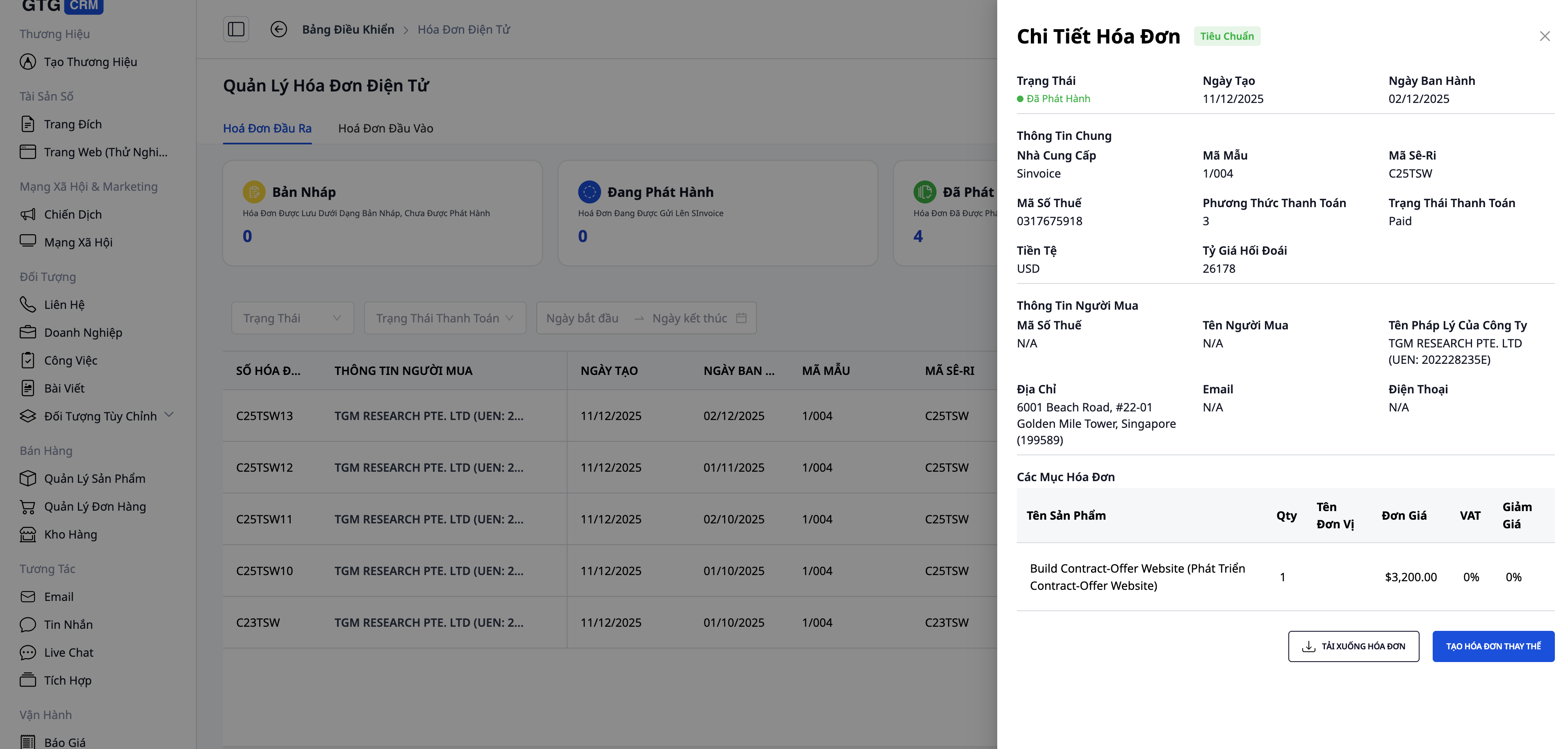
Illustration of an invoice created from GTG CRM
Turn what you just read into real results — apply now with GTG CRM, free.
Apply now