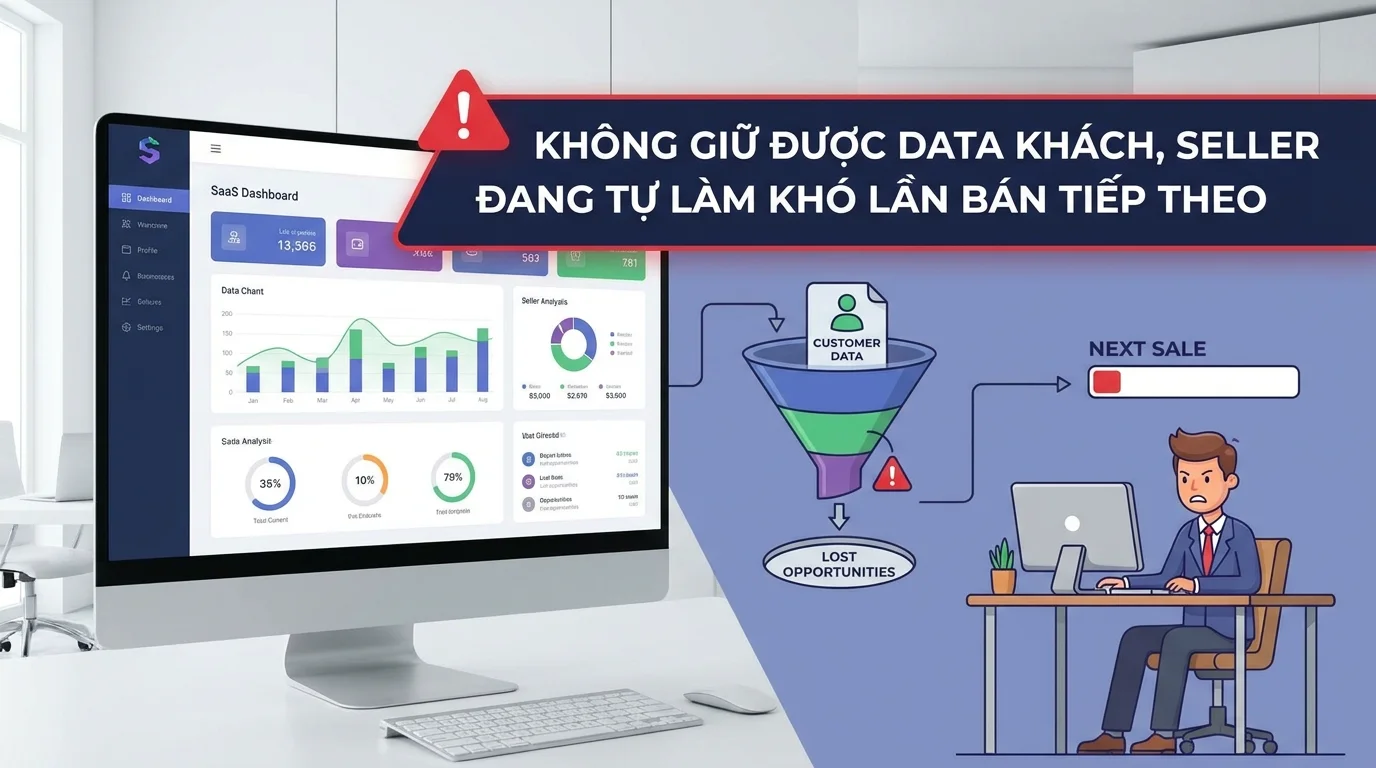
Many online sellers today focus on closing deals today, forgetting that every customer who leaves their information represents a future sales opportunity. Without a well-structured customer data system, each sale is like starting from scratch: running new ads, finding new customers, and incurring new costs. However, if sellers know how to properly store and manage customer data, reselling, nurturing, and remarketing becomes much easier, significantly reducing business costs.

This article will help you understand why maintaining customer data for sellers is not just a good idea, but a necessity for sustainable business. In particular, by integrating a sales website, seller landing page, and seller CRM into a seamless process, you'll never miss a sales opportunity again.
Why do many sellers still neglect to retain customer data?
In reality, most online sellers, especially beginners or those already selling on e-commerce platforms, tend to focus solely on whether or not they get orders. They're happy when they get orders, and worried when they don't. But they rarely ask themselves: after a customer makes a purchase, do I know who they are? Where are they from? What products are they interested in? Did they leave any contact information?
There are several reasons for this situation. Firstly, sellers think that having a marketplace or a fan page is enough and that they don't need to manage their own data. Secondly, they haven't realized the long-term value of retaining customer data. Thirdly, they don't know how to store and manage customer information systematically.
However, as the market becomes increasingly competitive and advertising costs rise, relying entirely on third-party platforms will leave sellers vulnerable. Without first-party data—that is, customer data they collect and own—sellers will be unable to proactively re-engage with existing customers, conduct effective remarketing, or build their own customer base.
Why is customer data so important?
Customer data is more than just names, phone numbers, or emails. It's the foundation for understanding who your customers are, where they come from, what they care about, and most importantly, how to resell to them without incurring additional advertising costs.
Imagine you run a Facebook ad costing 500,000 VND to get 10 potential customers to your landing page. Of those, 3 fill out the form, 2 message you for information, but only 1 makes a purchase immediately. If you don't keep the information of the remaining 4, you've completely lost the opportunity to sell to them later. The next time you have a new product or a promotion, you'll have to run another ad, find new customers, and spend another 500,000 VND.
But if you have a CRM system for sellers to store the information of the 9 people who have visited your landing page, you can proactively message, call, or email them when a suitable product becomes available. The cost of retaining existing customers is always much lower than the cost of acquiring new ones. This is why maintaining customer data for sellers is crucial in online business today.
What types of data do sellers need to retain?
It doesn't need to be complicated, but you need to know what basic information is worth saving. Below is a list of data types that online sellers should collect and manage:
- Basic contact information : Name, phone number, email. This is the minimum information you need to contact your customers.
- Customer sources: Are customers coming in from Facebook Ads, Google, TikTok, or through friend referrals? Knowing the source helps you evaluate channel effectiveness and allocate your budget more effectively.
- Products of interest : Which products do customers inquire about, and which product pages are viewed most frequently? This information helps you understand the true needs of your customers.
- Interaction history : How many times have customers filled out the form, what questions have they asked via message, and whether they have made a purchase or not. This is the basis for you to decide on your next approach strategy.
- Customer status : New customer, potential customer, customer who has purchased, or customer who has finalized a deal but hasn't paid yet. Classifying customers helps you provide the right service to the right people at the right time.
This data not only helps you remember who your customers are, but also helps you understand what they want, thereby building more effective sales and remarketing strategies for sellers.
How do websites, landing pages, and CRM systems work together?
Many sellers think that having a website or landing page is enough, but in reality, without connecting it to a CRM, customer data is still easily lost or not utilized.
A sales website is where customers learn about products, view detailed information, and read reviews. Landing pages for sellers are often used to run advertisements, focusing on a specific product or promotion, with the main goal of collecting customer information through lead generation forms or contact buttons.
When customers fill out forms on websites or landing pages, or when they message via live chat, that data needs to be automatically pushed to the CRM. The CRM is where all contact information is centralized, helping sellers manage, categorize, and provide customer service in a systematic way. Without this step, all the customer information will be scattered in many places, difficult to manage, and easily overlooked.
A simple but effective process could go like this:
- Customers see ads on Facebook or TikTok and click on the landing page.
- Customers view product information, find it appealing, and fill out a form to receive advice or special offers.
- The information customers fill out in the form is automatically saved to the CRM.
- The seller receives notification of a new customer and proactively contacts them to provide advice.
- If the customer doesn't make a purchase immediately, the information is still saved in the CRM so the seller can follow up with them later.
Without a CRM, sellers would have to manually copy information from forms into Excel or jot it down elsewhere, which is prone to errors and time-consuming. Furthermore, as the number of customers increases, manual management becomes extremely difficult.
Practical example: From form to CRM, what does the seller retain?
Let's say you're an online cosmetics seller. You run Facebook ads that direct customers to a landing page introducing a new skincare serum. The landing page includes a simple form asking customers to fill in their name, phone number, and email address to receive a 15% discount code.
A customer named Huong, 28 years old, saw the advertisement and clicked on it. She filled out the form, received a discount code, but didn't buy immediately because she was still considering her options. Without a CRM, Huong's information would only remain in an email list or an Excel file that you might never revisit.
But if you've connected your landing page to your CRM, Huong's information will automatically be saved to the system with the following details:
- Name: Huong
- Phone number: 0912345678
- Email: huong@example.com
- Source: Facebook Ads – Skin Serum Campaign
- Product of interest: Skin serum
- Status: Potential Customer
- Date information was left: April 15, 2026
After two days, you can proactively message Huong via Zalo or call her to inquire further about the product. If Huong still hasn't purchased, you can send an email reminding her about the expiring discount code. Or, a month later, when you have a new promotion, you can send a message to Huong and all other customers who have previously shown interest in the skin serum.
This is the power of retaining customer data. You not only sell to a customer once, but you also have the opportunity to sell to them again and again, without incurring additional advertising costs to find new customers.
Why is first-party data becoming increasingly important?
In the context of increasingly challenging digital advertising due to data privacy policies such as iOS 14, GDPR, and platforms restricting user data sharing, owning first-party data becomes a significant competitive advantage.
First-party data is data that you collect directly from your customers, not through a third party. This could be information customers fill out on website forms, information they send via live chat, or information they leave when making a purchase. Unlike data from Facebook or Google, which you have no control over, first-party data belongs to you; you have the right to use and manage it in your own way.
When you have first-party data, you can:
- Gain autonomy in re-engaging customers without relying on platform algorithms.
- Develop a remarketing strategy based on the actual behavior and needs of your customers.
- Create personalized customer care programs to increase customer retention rates.
- Reduce advertising costs because you can focus on retaining existing customers instead of constantly searching for new ones.
This is why many large businesses are investing heavily in building CRM systems and collecting customer data. Smaller sellers need to do the same if they want to compete sustainably.
How does GTG CRM help sellers connect with customer data?
GTG CRM is a solution that helps online sellers connect their sales websites, seller landing pages, and CRM systems into a seamless process, ensuring that no customer information is missed.
With GTG CRM, you can:
- Create a professional website or landing page to attract customers.
- Integrate customer information collection forms directly into your website or landing page.
- Data from the form will automatically create or update contact information in the CRM.
- Manage all customer information centrally in one place, making it easy to categorize and manage.
- Use messaging or live chat to assist customers immediately when they need help.
- Automate processes from websites, landing pages, forms to CRM, minimizing manual operations.
GTG CRM not only helps you retain customer data, but also helps you manage and utilize that data effectively. With a well-structured CRM system, you no longer have to worry about losing potential customers or incurring high costs to acquire new ones.
Conclude
Failing to retain customer data is the reason why many sellers struggle to find new customers, constantly incur high advertising costs, and never build a loyal customer base. Meanwhile, sellers who know how to retain customer data and manage it using CRM have a significant advantage: easier resale, lower costs, and more sustainable business.
If you're selling online and don't yet have a customer data management system, it's time to change. Start by connecting your website to your CRM using GTG CRM, build a process for collecting customer information from landing pages, lead generation forms, and live chat, and then manage and nurture them systematically. This is how you'll avoid making things difficult for yourself in future sales.
Frequently Asked Questions
Why do sellers need to keep customer data?
Maintaining customer data provides sellers with a basis for reselling, re-engaging, and reaching out to existing customers without incurring additional advertising costs to find new ones. This is a crucial factor for sustainable business and reduced operating costs.
What types of data should sellers retain?
Sellers should retain essential information such as name, phone number, email address, source of customer visits, products of interest, interaction history, and customer status. This data helps sellers understand customers and develop appropriate customer care strategies.
What role do websites and landing pages play in retaining customer data?
Websites and landing pages are where customers leave a trace by filling out forms, sending messages, or viewing products. When connected to a CRM, this data is stored and managed centrally, helping sellers not miss any sales opportunities.
How does CRM help sellers manage their customers?
CRM is a central hub for all customer information, making it easy for sellers to categorize, track interaction history, and provide systematic customer care. Instead of manual management using Excel, CRM automates and optimizes workflows.
What is first-party data and why is it important for sellers?
First-party data is data that sellers collect directly from customers, without going through a third party. This is a crucial asset that helps sellers proactively re-engage customers, build remarketing strategies, and reduce reliance on advertising platforms.
How does remarketing for sellers work when customer data is available?
Having customer data in the CRM allows sellers to proactively contact customers who have shown interest but haven't made a purchase, or send special offers to existing customers. This is a much more effective approach than running ads to find new customers.
Turn what you've just read into tangible results — apply it now with GTG CRM, free.
Apply now