What Does an Ad-Ready Landing Page Need for Sellers to Increase Conversions?
You pour millions of VND daily into Facebook Ads. You get clicks, but no orders. Customers visit your page, scroll for a few seconds, and leave. The problem isn't the ads – it's the page you're directing customers to.
A landing page – also known as an ad landing page – is what determines whether your ad spend generates results. A good landing page can turn 5 out of 100 clickers into customers. A bad landing page will bring in only 1 lost lead from 100 clicks.
So, what does an ad-ready landing page for sellers need? This article will go through each section of the page – from the very first headline to the final button – so you know exactly what to do if you truly want to increase conversions.
The First 5 Seconds: The Hero Section Decides Everything
When someone clicks on your ad, they have an expectation. Whatever the ad promises, they want to see that exact thing on the landing page. If they don't recognize within the first 5 seconds that they are in the right place, they'll hit the back button.
This is why the hero section – the first part that appears on the screen – is more important than any other part of the page.
An effective hero section needs three things:
- A headline that clearly states the benefit
- A sub-headline that briefly explains
- A clear CTA button
The headline doesn't need to be fancy, it needs to be accurate. Don't write "Comprehensive Sales Solution", it's too general, anyone can say that. Be more specific:
"Triple your ad orders without increasing your budget"
There's a principle called message match: the content on the landing page must match the ad that led to it. If the ad says "Reduce cost per lead by 50%", the landing page should also talk about reducing lead costs.
And don't forget: the hero section should have a CTA button right there. About 5-10% of visitors are ready to take action from the start.
Presenting Value: Tell Customers What They Get
After the hero section, customers will ask themselves: "Specifically, how does this help me?"
This is when you need to clearly present the value. But don't start with features, start with pain points.
Common problems for sellers running ads:
- Customers leave immediately
- Cannot measure traffic sources
- Form is too long → abandon
- Have leads but don't nurture → cold leads
When you address the pain points accurately, customers will nod in agreement.
Then, provide the corresponding solution:
| Problem | Solution |
|---|---|
| Customers leave | Mobile-optimized landing page |
| Cannot measure effectiveness | UTM tracking + real-time dashboard |
| Long form | Smart form with collapsible/expandable fields |
| Cold leads | CRM + automation follow-up |
Don't list features like a spec sheet – tell a story.
👉 Tip: use real screenshots instead of stock photos.
Build Trust Right on the Page
Sellers are very sensitive about money. They need proof.
The trust section needs to answer:
"Who is using this? Is it trustworthy?"
How to do it:
- Customer logos (6-10 logos)
- Specific metrics:
- Number of sellers using it
- Number of leads collected
- % conversion increase
- Security badges:
- SSL
- GDPR
- "Data is encrypted"
Social Proof: Let Customers Speak for You
Other people's words are always stronger than yours.
❌ Bad:
"Great service!"
✅ Good:
"Before using it, CVR was 1.2%. After using the landing page + CRM, it increased to 4.1% — reducing CPL by nearly 3 times."
A good testimonial needs:
- Context (before)
- Action (what was done)
- Result (numerical outcome)
FAQ: The Place to Handle All Final Objections
FAQs aren't just for show. This is where you handle objections.
Common questions:
- Can I use it without knowing how to code?
- Does it integrate with Facebook Pixel?
- How much does it cost?
- Is my data safe?
Principles for writing FAQs:
- Put difficult questions first
- Answers must provide benefits
- Keep it concise (3-4 lines)
Example:
Do you support Facebook Pixel? → Yes. You can integrate it directly and know exactly which ads generate leads.
CTA: Small Button, Big Impact
A CTA is not:
- "Submit"
- "Send"
A good CTA = Action + Benefit
Examples:
- "Create ad-ready landing pages — Free"
- "Get a consultation within 24 hours"
Underneath the CTA, there should be microcopy:
- No credit card required
- Setup in 5 minutes
- No spam
Can increase conversions by 10-15%
The 3 CTA Rule:
- Hero
- Mid-page
- End of page
Form: Fewer Fields, More Leads
Each field = 5-10% decrease in conversion.
Optimized form:
- Name
- Phone Number
- Business Size
❌ Do not ask for:
- Address
- Date of birth
- Job title
Best practices:
- Labels above fields
- Placeholders with examples
- Real-time validation
- No complex CAPTCHAs
Add: Information is absolutely secure
After Customer Submits: Don't Stop at "Thank You"
Common mistake:
"Thank you" → nothing else.
Standard CRO:
1. Dedicated Thank-You Page
- Use for tracking (Pixel, Google Ads)
2. Guide the Next Steps
"An expert will contact you within 2 hours"
3. Keep Customers within the Ecosystem
- Case studies
- Demo videos
- Fan page
4. Email within 1 Minute
- Confirmation
- Summary of value
- Resources
5. Live Chat
"Do you have any questions?"
👉 Hottest leads are right after submission.
Conclusion
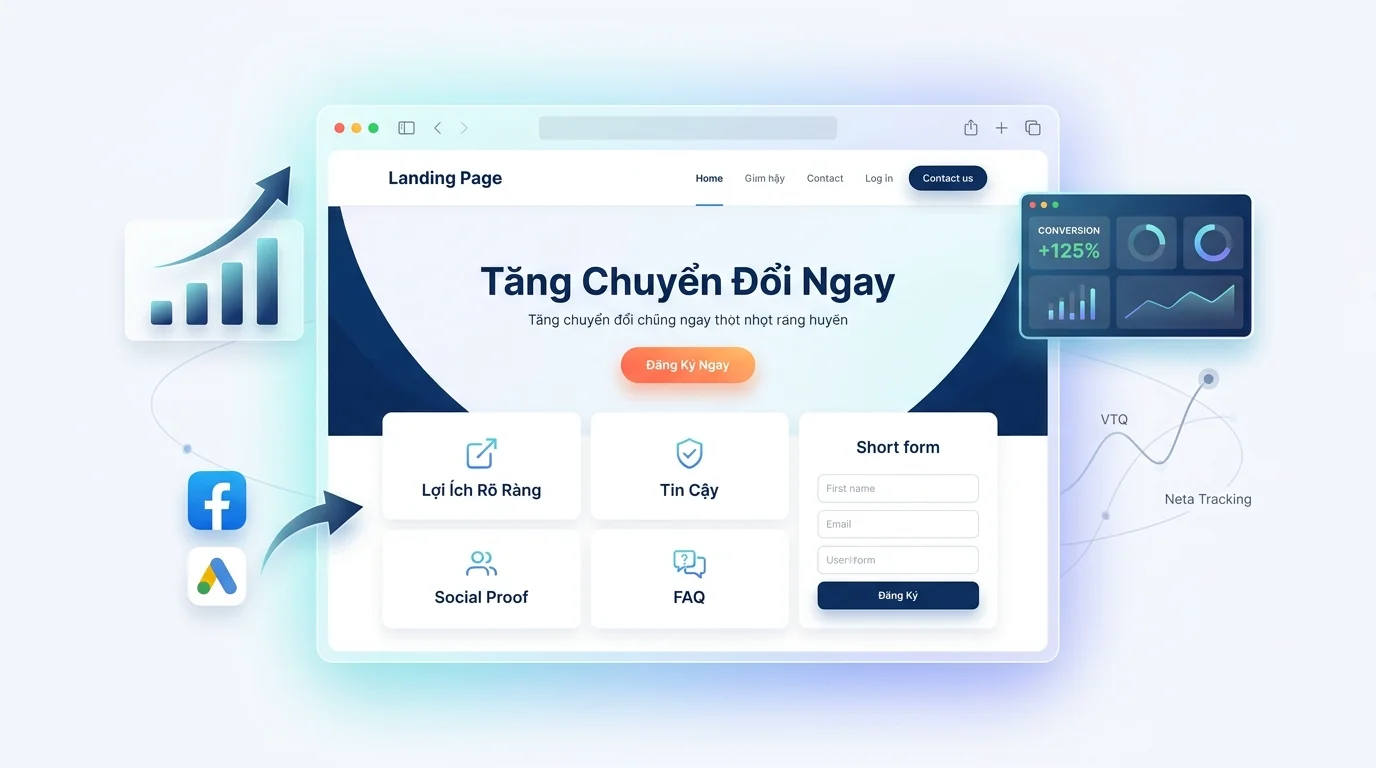
A standard landing page includes:
- Hero
- Offer
- Trust
- Social Proof
- FAQ
- CTA
- Thank-you flow
| Section | Role |
|---|---|
| Hero | Attract |
| Offer | Explain value |
| Trust | Build confidence |
| Social proof | Prove |
| FAQ | Handle concerns |
| CTA | Drive action |
| Thank-you | Nurture leads |
Turn what you've just read into real results — apply it now with GTG CRM, for free.
Apply Now