When first starting an online business, one of the most "addictive" feelings is seeing orders come in continuously. Each order notification popping up creates a sense that the business is on the right track. However, after a short while, many realize that despite a good number of orders, the actual profit is disproportionate, or even negative.
The reason often lies not in the product or market, but in evaluating performance solely based on the number of orders, while overlooking a host of hidden costs.
Order volume only reflects sales activity, not profit
Order volume indicates that you are selling, but it doesn't tell you how much money you are making from those sales. An order is only truly valuable when the profit earned exceeds the total costs incurred to create and fulfill it.
Advertising costs are not the only expenses
Newcomers often only consider advertising costs when assessing profit and loss. However, advertising is just the tip of the iceberg. For an order to be completed, businesses incur many other costs that, if not accounted for, will lead to completely inaccurate assessments.
Operating costs silently erode profits
Costs such as personnel for order processing, packaging, warehousing, software, support tools, or even the entrepreneur's own time are often not accurately or fully calculated. As order volume increases, these operating costs rise accordingly. At a certain threshold, businesses realize that the more they sell, the more tired they become, yet profits do not increase proportionally.
Delivery, return costs, and loss risks
Another hidden cost often overlooked is that associated with delivery and returns. Not all orders are successfully delivered, and each returned order incurs costs for shipping, handling, and inventory.
Taxes and financial obligations cannot be ignored
In the early stages, many online entrepreneurs do not fully factor in tax obligations into their profit and loss calculations. When tax costs accumulate or arise suddenly, businesses realize that their actual profit is much lower than they initially thought.
Not tracking cash flow leads to a misjudgment of the entire operation
Recorded revenue does not equate to money in the bank, and incurred expenses don't always appear immediately. When cash flow is not managed, it's easy for entrepreneurs to fall into a state of "selling well but still lacking money."
Why are beginners so prone to these mistakes?
The biggest reason is the lack of a comprehensive data aggregation system. When information about orders, costs, advertising, and operations is scattered across multiple locations, it becomes nearly impossible to see the big picture.
How does GTG CRM help avoid the "many orders but no profit" mistake?
GTG CRM helps businesses centrally manage orders, revenue, and related activities within a single platform. When data is stored and tracked consistently, entrepreneurs can clearly see the relationship between order volume, advertising costs, operating costs, and actual business results.
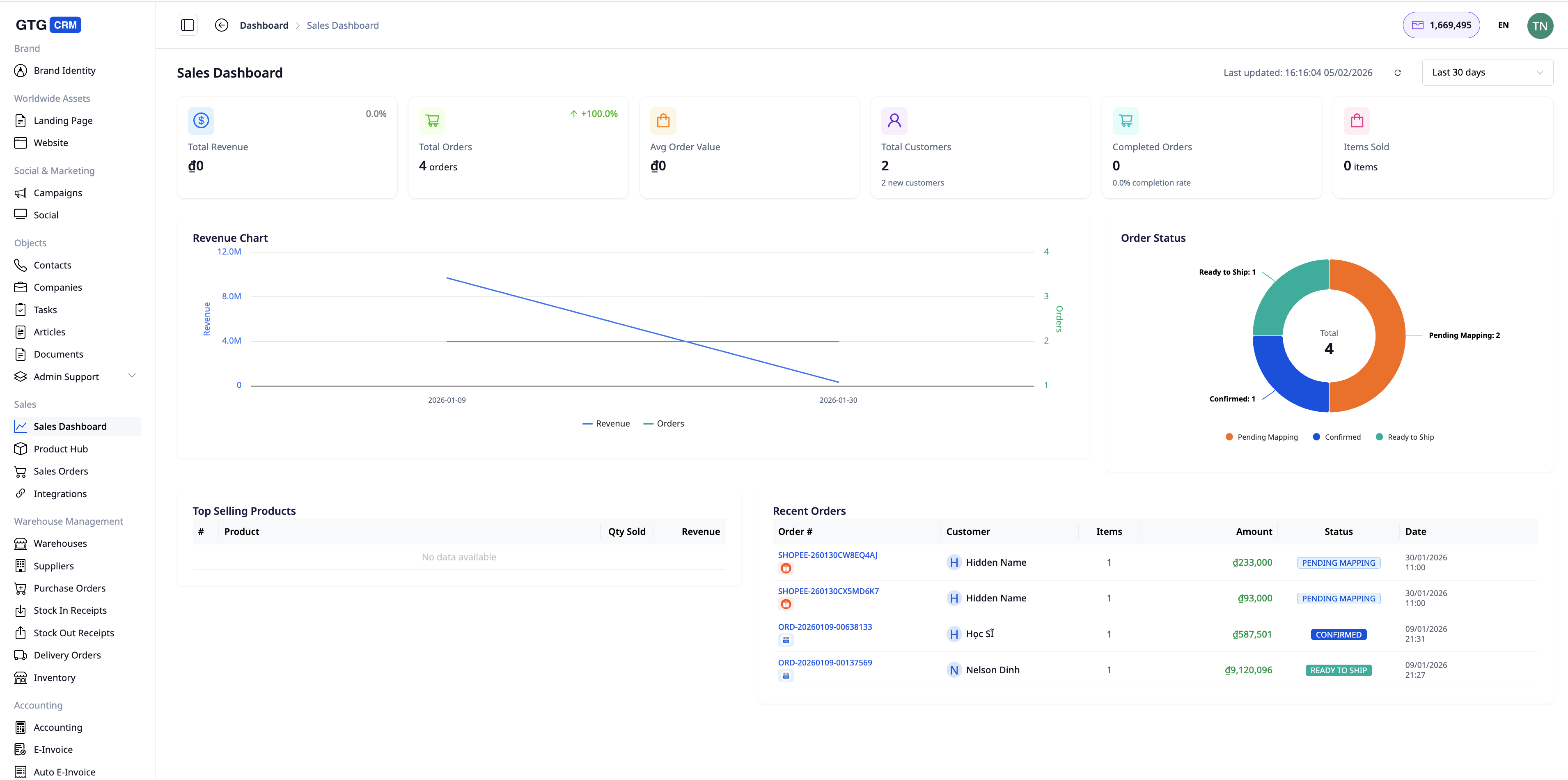
Instead of manually cross-referencing data from multiple sources, GTG CRM automatically aggregates and analyzes it, enabling businesses to make decisions based on actual data, not emotions.
Read more: Guide to effective order management with GTG CRM
Conclusion
Order volume is a positive signal, but it's not the sole measure of success. By focusing only on order volume and ignoring hidden costs, entrepreneurs easily push themselves into a situation of working hard with no profit.
To build a sustainable online business, one needs to see the whole picture, not just the easily visible part. And this can only be achieved with a sufficiently clear system for tracking and control.
Turn what you just read into real results — apply now with GTG CRM, for free.
Apply now