When "price reduction" is no longer a strategy, but merely a market reaction.
2026 is predicted to be the most intensely competitive period for Vietnam's e-commerce industry.
Advertising budgets are increasing, consumer behavior is changing faster than ever, and the "discount-promotion" model has reached its effectiveness limit.
In this context, brands are beginning to shift towards a new approach: gaining a deep understanding of consumer purchasing motivations and their actual needs space (Demand Space).
This method helps businesses answer three fundamental questions:
- What needs are customers driving their purchases (functional vs. emotional)?
- How much are they willing to pay for each use case?
- And where is the "white space" —the market gap that brands can exploit?
Demand Space – A new growth roadmap for e-commerce businesses.
Demand Space is more than just a market research technique.
It is a strategic lens that helps businesses identify the consumer's "purchase moment" —when needs, context, and emotions intersect.
Instead of simply segmenting customers by demographics or income, Demand Space goes deeper:
- Why do they buy (motivations, goals, emotions)?
- When did they buy it (use scenario, time, environment)?
- How much are they willing to pay (perceived value vs. actual value)?
From there, the brand can reposition its products, restructure its portfolio, and focus investment on the segment with the highest profit margins.
Case Study: The Shampoo Industry – When Data Reveals Untapped Need
Step 1 – Analyze demand by value segment (AOV)
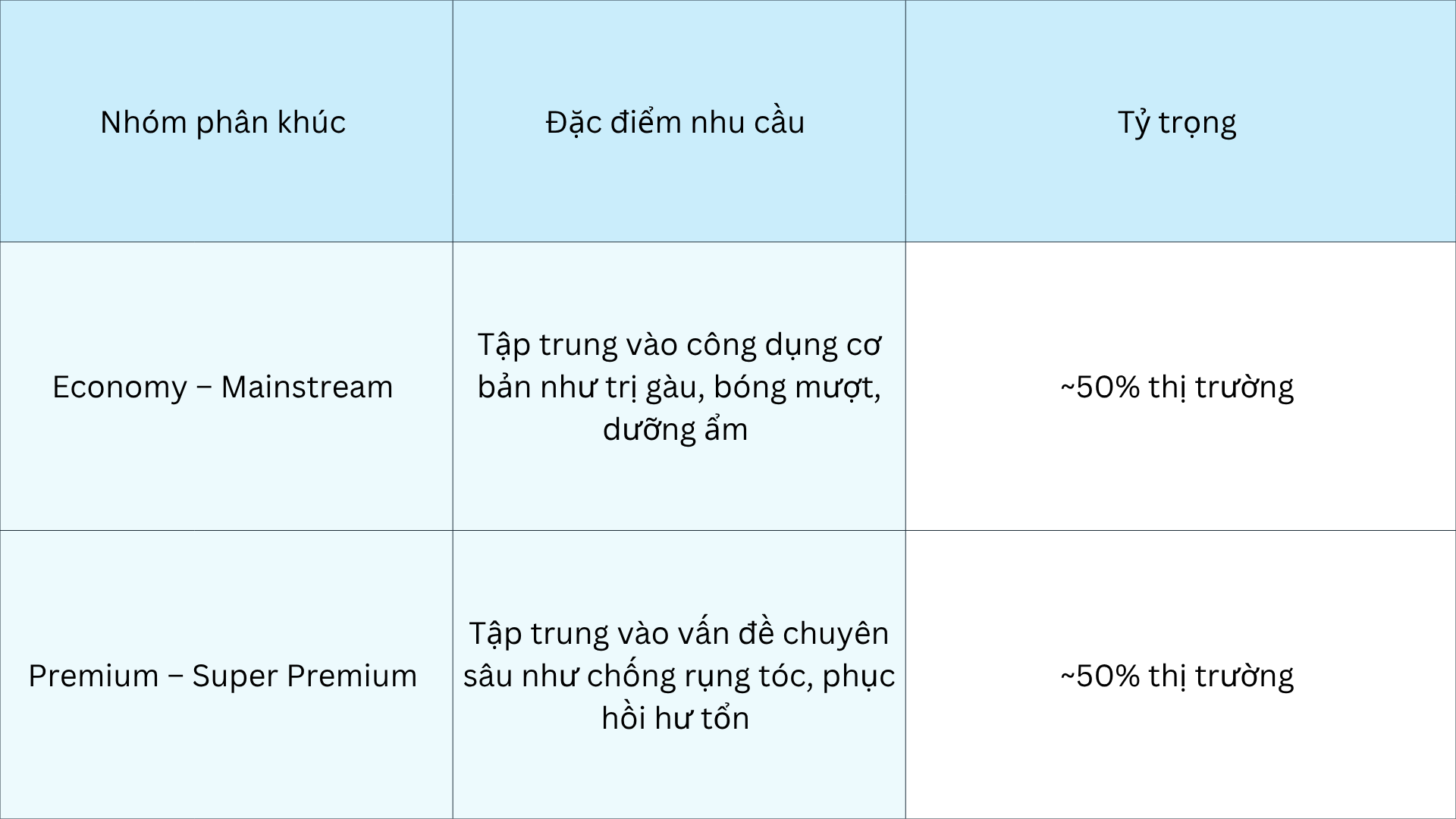
E-commerce data for 2024–2025 shows a clear differentiation in order value (AOV) and demand within the shampoo industry:
Key insight:
Consumers are willing to pay more for solutions that address deep-seated problems, but remain price-sensitive for basic products.
Strategic implication: Brands aiming to increase AOV must position their products in the premium segment, alongside a content education strategy that helps consumers understand the "unique" value.
Step 2 – New Growth Space: Anti-Hair Fall
The Anti-Hair Fall segment is currently a "hot topic" on e-commerce platforms (Shopee, Lazada, TikTok Shop).
Actual data:
- The top 5 leading brands are all domestic: Nguyen Xuan, Giot Lanh, Cocoon, Nam Nung, Pura d'or.
- Giọt Lành increased its market share by 2.5% in just one year, reaching a total of 3.2% and surpassing many major competitors.
- This brand has a wide reach, from Mainstream to Super Premium, allowing it to reach diverse customer segments and optimize marketing costs.
Expert analysis:
The success of Giọt Lành is due to:
- Reading Demand Space correctly: “I want a natural, safe product that I can use long-term for weak hair.”
- Control the value chain – from content and sales channels to after-sales service.
- Fostering trust through genuine reviews and the message of "caring for your hair from the roots."
Step 3 – The Winning Strategy in Demand Space: L'Oréal Paris in the Damage Repair Segment
In contrast to the domestic group, L'Oréal Paris dominates the Damage Repair segment – where profit margins are highest.
Results 2024:
- Growth of +2.2% in Super Premium and +0.6% in Massstige brought the total market share to 3%.
- Leading in brand equity and high-end customer conversions thanks to its positioning as "hair restoration science".
It is worth noting:
A market gap remains in the Super Premium segment, where consumers seek "product lines with proprietary certifications or technologies."
This is the "white space"—a new area of opportunity for local brands or startups to create specialized hair care products (following the clean beauty and organic haircare trends).
GTG CRM – A platform that helps businesses transform Demand Space into real action.
Demand Space analysis is only truly valuable when businesses have the tools to transform insights into measurable campaigns.
That's why major brands today – from FMCG and cosmetics to F&B – are shifting from manual marketing to systematized marketing using CRM and automation.
GTG CRM helps businesses manage Demand Space through three main competency layers:
Integrating customer data – Understanding the underlying needs behind behavior.
- GTG CRM consolidates all data from Facebook, Zalo, TikTok, websites, emails, and stores into a single platform.
- Each customer is "packaged" according to their behavior, source, AOV, and purchase status.
- Businesses can easily create their own Demand Space (e.g., groups like "buying because of hair loss," "buying because of hair restoration" ) to make informed decisions about product, pricing, and content.
Implement the right campaign – Marketing based on the customer journey.
- AI Landing Page: Quickly create landing pages tailored to specific needs (Anti-Hair Fall, Damage Repair, etc.).
- Automation Workflow: Send automated email/SMS/Zalo sequences to different Demand Spaces.
- AI Ad Generator: suggests ad titles and descriptions that match different user behaviors.
For example:
People in Demand Space "Anti-Hair Loss" will receive content about "Nourishing hair from the roots - reducing hair loss in just 7 days".
Meanwhile, the "Damage Repair" group will see the message "Healthy hair from the inside out – thanks to Aminexil™ repair technology".
Measure – Optimize – Forecast Growth
- ROI Dashboard: Track performance by Demand Space.
- CRM Report: Measures conversion rates for each behavioral group.
- AI Forecast: predicts the next shopping trends by season and holiday.
As a result, Demand Space is not just an insight report, but a series of concrete actions that help optimize sales, increase ROI, and reduce budget waste.
Conclusion: From Demand Space to GTG CRM – A Strategic Pair for the New Era of E-Commerce
The e-commerce market in the near future will no longer be a "playground for whoever offers the deepest discounts," but rather a race to see who understands customers better and responds faster.
Demand Space analytics provides strategic depth, while GTG CRM delivers operational and measurement power.
This combination helps businesses:
- Identify the right "demand space" to win .
- Create the “right message” for the right people with the right content and offers .
- And measure the “true return on investment” (Right ROI).
When strategies are built on data and technology, growth is no longer accidental—it's the result of a systemic effort.
GTG CRM provides comprehensive support for Demand Space strategies and future e-commerce growth.
From landing pages, content, CRM to automation and ROI reporting – all in one unified platform.
Your business can achieve similar results — starting for free.
Begin the journey