Many sellers face the same problem: ads are running, budgets are being spent, clicks are coming in, but the number of orders isn't increasing as expected. At first glance, everyone thinks the issue lies with ad content, incorrect targeting, or an unappealing product. However, in reality, there's a very common mistake that many overlook: customers click on the ad, but where they are taken is not good enough to close the deal.
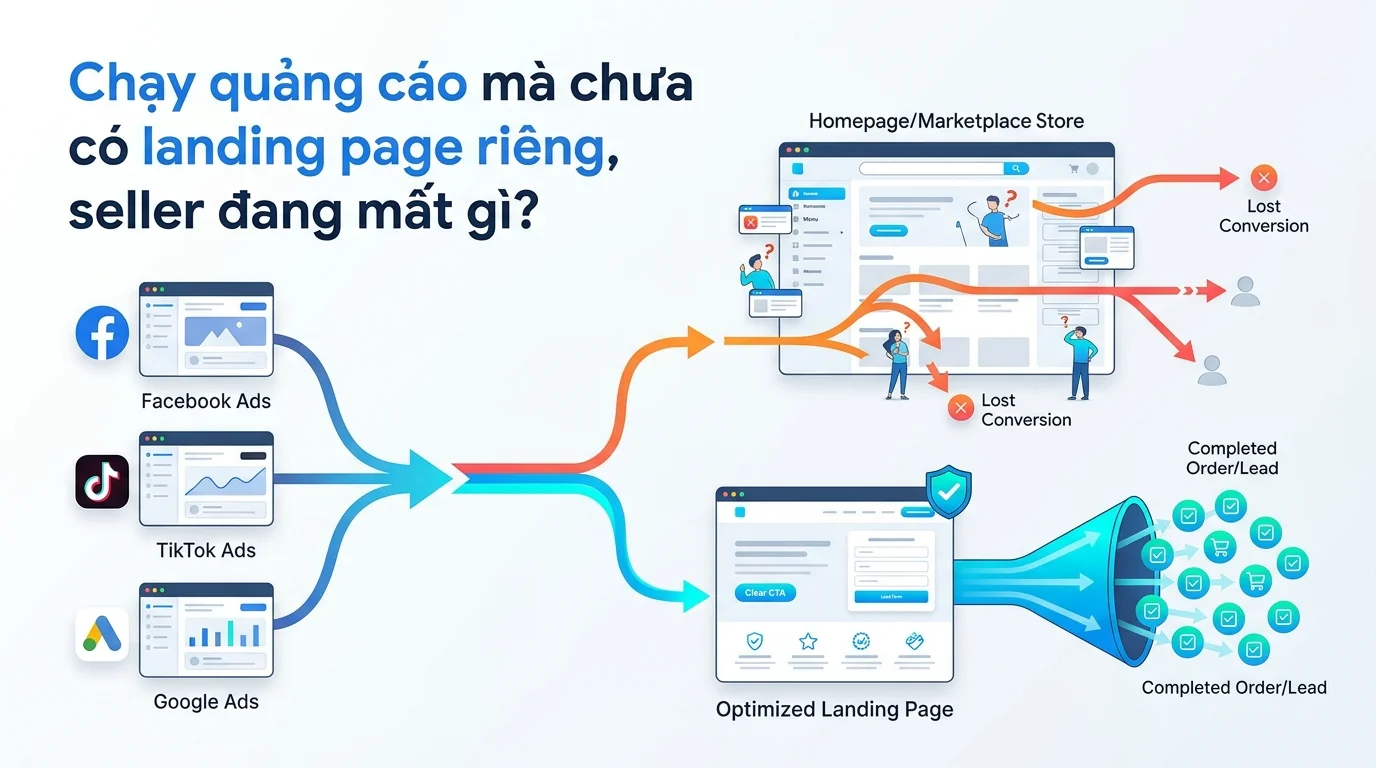
This is a common situation for sellers running Facebook, TikTok, or Google ads, but still directing traffic to marketplaces, homepages, or overly general pages. The problem isn't a lack of interest. The issue is that after the click, customers are not guided through a clear enough journey to make a purchase, leave their information, or initiate a consultation.
Simply put, ads can help you bring interested people closer. But the landing page is where you convert that interest into conversions.
What are sellers losing when they don't have a dedicated landing page?
1. Loss of seamlessness between the ad and the post-click experience
Customers click on an ad because they are attracted by a specific promise. This could be an offer, a featured product line, a cost-saving bundle, or a clear benefit. But if after clicking, they are taken to a homepage with too many menus, categories, and various content, the emotional connection is immediately broken.
Online users typically have short attention spans. They don't want to search for what they just saw in the ad. They want to be directed to exactly that item, for that specific reason, and be shown the next clear step.
2. Loss of customer focus
Homepages or marketplace storefronts often serve multiple purposes simultaneously. They need to introduce the brand, display numerous products, and direct users to various sections. This isn't wrong, but it's not suitable as a destination for a specific advertising campaign.
Traffic from ads needs a more focused destination. A place where customers immediately understand who the product is for, what problem it solves, why they should choose it, and what the next step is. If the destination is too broad, customers will easily get distracted, leave, and sellers will lose the very interest they paid to acquire.
3. Lost opportunity to tell the right sales story
A good ad is only enough to get the initial click. To build trust and encourage action, sellers need a space to tell a more complete story. The landing page is that space.
Here, you can guide customers through the right sequence: what problem they are facing, how this product helps, why it's trustworthy, what the feedback is, what the current offer entails, and how they should act immediately. If you only direct customers to a marketplace or homepage, it's very difficult to control this journey.
4. Loss of data for ad optimization
When all traffic is directed to an overly general page, it's very difficult for sellers to pinpoint the exact problem. It's unclear if customers leave because the headline isn't compelling enough, the content isn't persuasive, the CTA isn't clear, or the page is too cluttered. This makes ad optimization feel more like guesswork.
Conversely, with dedicated landing pages for each campaign, sellers can clearly see the effectiveness of each message, product group, registration form, or call-to-action button. This is a crucial foundation for effective long-term advertising, rather than just running ads based on intuition.
5. Wasted money due to unoptimized final touchpoint
Many sellers focus on optimizing ad creatives but forget that advertising is just the first step. The touchpoint that determines whether a customer stays or leaves is the landing page. If that page isn't clear enough, persuasive enough, and easy enough to use, each click becomes significantly more expensive.
To put it bluntly, if you don't have a suitable landing page, you're not just missing a sales page. You are diminishing the effectiveness of your entire advertising budget.
Why is directing traffic to marketplaces or homepages often ineffective?
Because ad traffic doesn't follow a "discovery" behavior, but rather a "targeted interest" behavior. They just saw something compelling enough to click. At this point, they need to be further persuaded, not thrown into a broad space and forced to filter information themselves.
For example, if an ad promotes a skincare combo for oily skin, customers expect to see that exact combo after clicking, with clear images, specific benefits, real testimonials, and a clear buy or message consultation button. But if they are directed to a homepage with all sorts of products, banners, and menus, they are likely to leave before they can even grasp the true value.
This is why a landing page isn't just a "nice-to-have." For serious advertisers, it's almost a necessity to increase conversion rates.
What should a good landing page for sellers include?
An effective landing page doesn't necessarily need to be overly complex. But it needs to have the following crucial components:
A clear headline that matches the ad. Customers must immediately see that this is what they clicked on.
An introductory section clearly stating what the product is, who it's for, and its main benefits. Don't make customers guess.
Clear product images or illustrations. Images are a powerful trust-building element.

Specific benefits instead of generic descriptions. Customers buy results, not features.
Credible proof. This could be testimonials, real photos, mini case studies, clear policies, or elements that make customers feel more secure.
A clear CTA. Whether you want customers to buy now, fill out a form, or message for consultation, state it clearly and place it appropriately.
A concise lead form or capture point. Don't make customers go through too many steps.
In short, a landing page is a page created to serve one specific conversion goal, not to display everything you have.
How does GTG CRM help sellers create landing pages?
Many sellers understand the need for a landing page but hesitate to implement it, thinking it will be time-consuming, require hiring designers, writing content, integrating forms, connecting chat, and making multiple revisions. This is why many continue to advertise in the old way, even knowing it's not optimized.
GTG CRM makes this process simpler and more practical for online businesses.
Drag-and-drop landing page builder: helps you quickly create dedicated pages for each campaign.
AI-powered SEO content writing assistance: saves time on headlines, descriptions, and main content for the page.
Integrated forms and Live Chat: help convert visitors into customer information or actual conversations.
The key is that sellers no longer have to advertise with a "throw traffic and hope for the best" approach. With dedicated landing pages, each campaign will have a clearer destination, be easier to measure, and simpler to optimize.
Conclusion
If you're running ads but don't have a dedicated landing page yet, you're not just losing conversions. You're also losing customer focus, losing data for optimization, and losing the true value from your advertising budget.
Ads help draw interested people closer to you. But the landing page is where you keep them, persuade them, and guide them to the final action.
With GTG CRM, sellers can get started faster by creating dedicated landing pages for each campaign, combined with AI content writing, forms, and Live Chat, to avoid missing out on truly interested customers.
If you've spent money to get a click, invest a little more to give that click a chance to become an order.
Turn what you've just read into real results — apply it now with GTG CRM, for free.
Apply Now