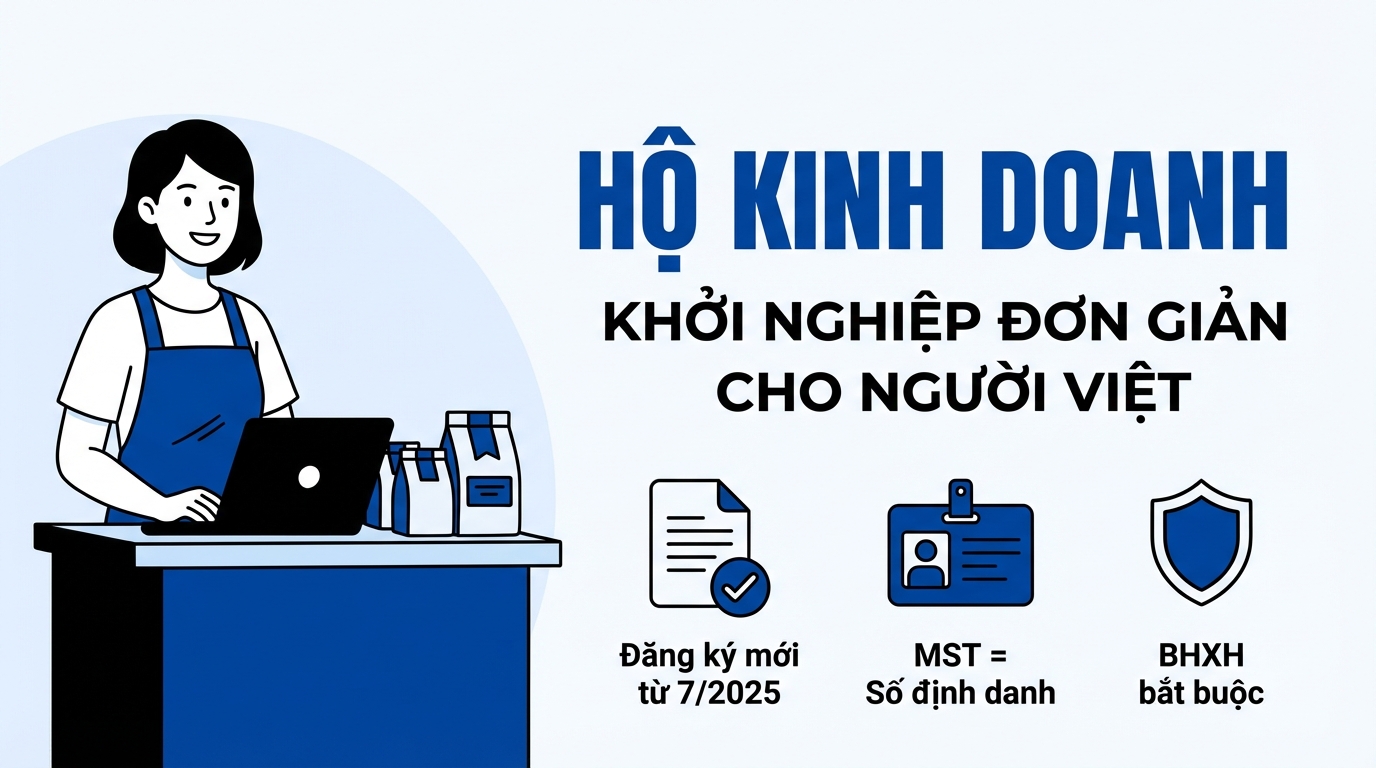
Starting a business doesn't have to be complicated with company registration procedures or large capital. Many people start by selling online, opening a small coffee shop or grocery store as a household business. This is a flexible business model, suitable for those who want to test business ideas or create an additional source of income.
However, many people still don't clearly understand how household businesses operate, how to register them, and what their obligations are to the state. This article will help you understand each aspect in the simplest and most practical way.
What is a Household Business Really?
A household business is a small-scale business, operated by one person or by members within the same household. The registered owner is solely responsible for all business activities with their personal assets.
Unlike a company, a household business does not have independent legal personhood. This means you cannot establish branches or representative offices like a company. If multiple family members are involved, one person must be appointed as the official representative, and this person will be recognized as the household head.
According to Decree 168/2025/ND-CP, each person is only allowed to establish one household business nationwide. However, you can still operate in multiple locations, provided you register one as the main headquarters and notify the tax authority about the other locations.
The household business registration number is also your tax code, which is automatically issued upon completion of the registration process through the commune-level system.

Is an Individual Business Different from a Household Business?
Many people wonder about the difference between an individual business and a household business. In essence, an individual business is usually understood as a person operating independently, not related to a household. Meanwhile, a household business can include multiple participating members who share responsibility.
However, under current legal regulations, both are collectively referred to as household businesses and are subject to the same management and tax obligations. This distinction is primarily conceptual rather than legal.
The Issue of Tax Codes for Household Businesses
When you register a household business, you will automatically be issued a tax code. This is a unique identification number generated by the tax registration application system and directly recorded on the Household Business Registration Certificate.
From July 1, 2025, there will be a significant change according to Circular 86/2024/TT-BTC and Decree 168/2025/ND-CP. The tax code for household businesses will be replaced by the personal identification number. This is a move to standardize data and simplify administrative procedures throughout the state management system.
If you do not have a personal tax code, you need to register for tax for the first time at the Tax Department of your place of residence or through the National Public Service Portal. For those who already have a personal tax code and their information matches the National Population Database, the system will automatically update without requiring any further procedures.
In case of discrepancies in information, you need to contact the Tax Department directly for timely adjustments. If you were previously issued more than one tax code, you need to provide identification information to consolidate all into a single code.
Who is Eligible to Establish a Household Business?
Not everyone can register a household business. According to Decree 168/2025/ND-CP, you must be a Vietnamese citizen and have full civil act capacity according to the Civil Code. This means you must be 18 years old and have the full capacity to perceive and control your actions.
Households can also register, but the members must be Vietnamese citizens, and one person must be appointed as the official representative to manage business activities.
There are some cases where registration as a household business is not mandatory. Specifically, these are households engaged in agricultural, forestry, fishery, or salt production, or small-scale activities such as street vending or itinerant trading with low income. However, if operating in a conditionally regulated investment and business sector as stipulated by the provincial People's Committee, registration is still required.
You need to carefully consider your personal resources such as capital, skills, time, and risk tolerance before deciding to register a household business. This model is suitable for those who want to start small and have flexibility in management.
Detailed Household Business Registration Process
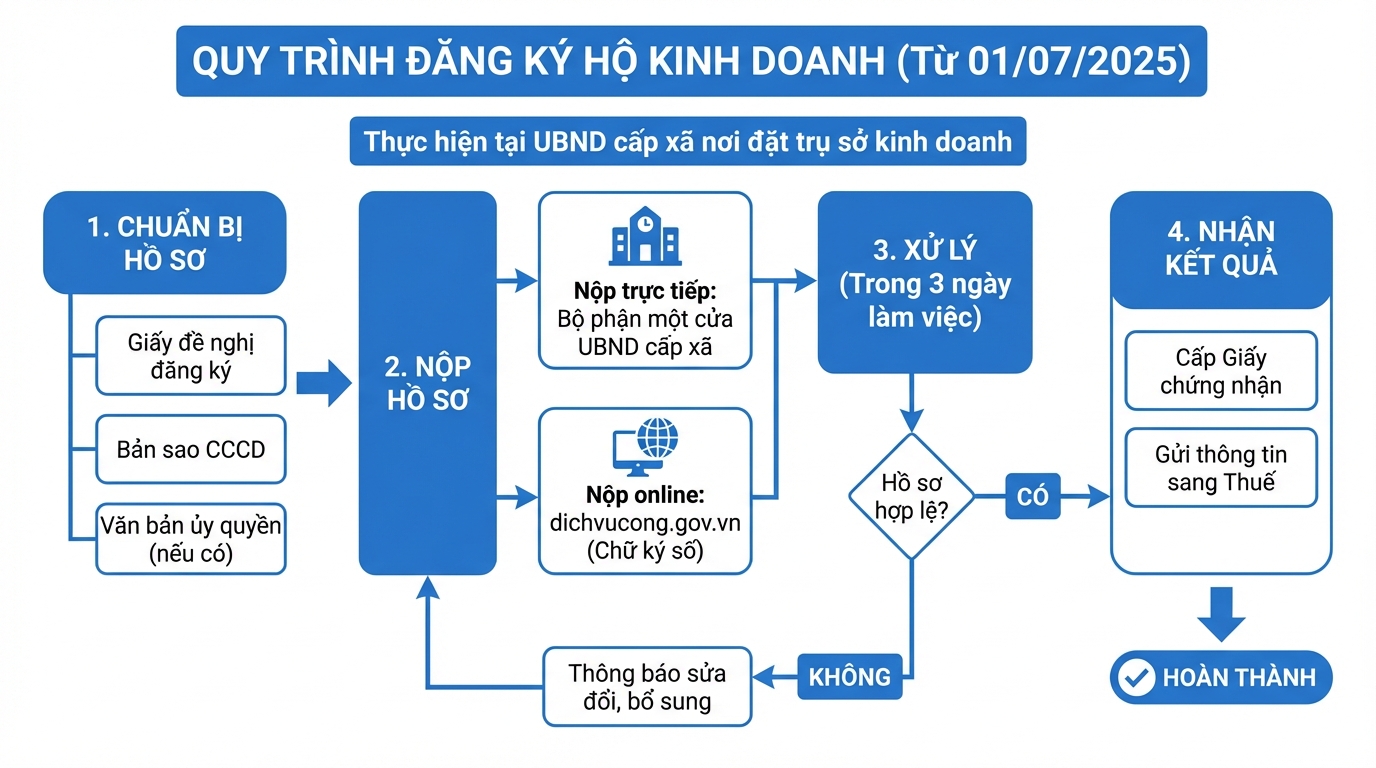
From July 1, 2025, the household business registration procedure will be carried out at the commune-level People's Committee where the business is located, instead of the district level as before. This helps shorten the distance and speed up processing.
Prepare Documents
You need to prepare the application for household business registration according to the prescribed form, a copy of the ID card of the individual or household members. If the household appoints a representative, a notarized or certified power of attorney is required.
Submit Documents
You have two options to submit your application. The first is to submit it directly at the one-stop shop of the commune-level People's Committee where the business is located. The second is to submit it online through the dichvucong.gov.vn portal using a digital signature, which saves travel time.
Receive Results
Within three working days, if the application is valid, the commune-level People's Committee will issue the Household Business Registration Certificate and send the information to the tax system to issue the household business registration number. If the application is incomplete or contains errors, you will receive specific notification to make amendments and additions.
Submitting online through the National Public Service Portal allows you to track the processing progress and receive results quickly without needing to visit in person multiple times.
Tax Obligations of Household Businesses
Household businesses must fulfill their tax obligations depending on their scale, industry, and revenue. Common taxes include Value Added Tax (VAT), Personal Income Tax (PIT), and some specific taxes such as excise tax or environmental protection tax depending on the goods and services traded.
According to the amended Personal Income Tax Law passed on December 10, 2025, from January 1, 2026, household businesses with revenue of VND 500 million or more in a calendar year will have to pay VAT and PIT.
You can declare and pay taxes through various channels. The administrative procedure resolution information system, the eTax Mobile application on your phone, or by accessing thuedientu.gdt.gov.vn can all be used.
Depending on revenue and industry, household businesses can pay taxes using the fixed tax method or the declared tax method. The fixed tax method is usually applied to households with stable revenue and small scale, while the declared tax method requires more detailed record-keeping of revenue and expenses.
Regulations on Mandatory Social Insurance
From July 1, 2025, according to the Social Insurance Law 2024, officially registered household business owners must participate in mandatory social insurance. This is an important change aimed at expanding social security for freelance workers.
The mandatory social insurance contribution rate is calculated at 25% of the salary used as the basis for contribution. Of this, 22% goes to the retirement and survivorship fund, and 3% goes to the sickness and maternity fund. You have the right to choose your salary level as the basis for contribution, but it cannot be lower than the reference level and cannot exceed twenty times the reference level.
Currently, the reference level applied is VND 2,340,000 per month according to Decree 73/2024/ND-CP. Thus, the minimum monthly contribution is VND 585,000. You can flexibly choose to contribute monthly, quarterly, or every six months depending on your financial situation.
Participating in mandatory social insurance provides many long-term benefits. You will receive a pension in old age, survivorship benefits for your dependents, and maternity and sickness benefits. This is an investment in the future and peace of mind for yourself and your family.
Points to Note When Operating
Understanding household businesses and their accompanying legal obligations is essential before you decide to start a business. While this model is simple, it still requires seriousness in adhering to regulations on registration, taxes, and social insurance.
You need to regularly monitor changes in policies and regulations to ensure your business operations are always legal. Fulfilling your obligations not only helps avoid legal risks but also creates a solid foundation for long-term development.
If you need support with cash flow management, tax payments, or other financial solutions during your business operations, choosing a reputable banking partner will help you run everything more smoothly and professionally.
Note: The information in this article is for reference purposes only and may change over time. You should consult the current legal documents or contact the competent authorities for the most accurate information.
Turn what you've just read into real results — apply it now with GTG CRM, for free.
Apply Now