Many online sellers fall into a familiar state: orders still come in daily, platform notifications are constant, but the more they sell, the more tired they become and the harder it is to grasp where they stand in the overall business picture.
Ask a few seemingly simple questions that are surprisingly difficult to answer immediately:
- How many orders did I sell today, but how many were actually completed?
- Is revenue increasing due to selling more or due to higher order values?
- Where are orders getting stuck the most: awaiting confirmation, awaiting delivery, or being returned?
- Which items are selling well, and which have been in stock for a long time but are being overlooked?
The problem isn't that you can't sell, but that all your sales data is scattered and not being "read" correctly.
Common Mistakes in Manual Sales Tracking
Looking at Revenue, Not Order Status
Most sellers only look at total revenue or total orders. Meanwhile, cash flow and operational efficiency lie in order status.
For example, on a day with 50 orders:
- How many were canceled?
- How many are just "awaiting confirmation"?
- How many have been successfully delivered and are ready for reconciliation?
Without clear segmentation, sellers can easily fall into a growth illusion.
Not Knowing Where Orders Are Stuck
When managing manually, sellers often only know that "orders are being processed," but not specifically:
- Stuck in the packing stage
- Stuck in shipping
- Or being returned due to confirmation errors
The consequences are:
- Slow processing
- Slow customer response
- An increasing return rate without a clear cause
Not Seeing the Connection Between Orders – Customers – Products
An order is not just "an order." It's related to:
- Which customer bought it
- Which product they bought
- What the average order value is
- Whether it's their first purchase or a repeat one
Disjointed management prevents sellers from understanding purchasing behavior, only seeing an ever-increasing workload.
When Sales Data Is Consolidated, the Story Begins to Change
The problem for most online sellers isn't a lack of data, but a lack of a place to view the data correctly.
With a centralized sales dashboard:
- Revenue isn't just a number; it's placed alongside order volume, average order value, and customer count.
- Order statuses are clearly categorized: awaiting confirmation, preparing, shipping, completed, canceled.
- Sellers immediately know where orders are stuck, instead of having to sift through individual orders.
This is when sales tracking shifts from "reactive" to "proactive."
GTG CRM Helps Online Sellers See the Big Picture Instead of Guessing
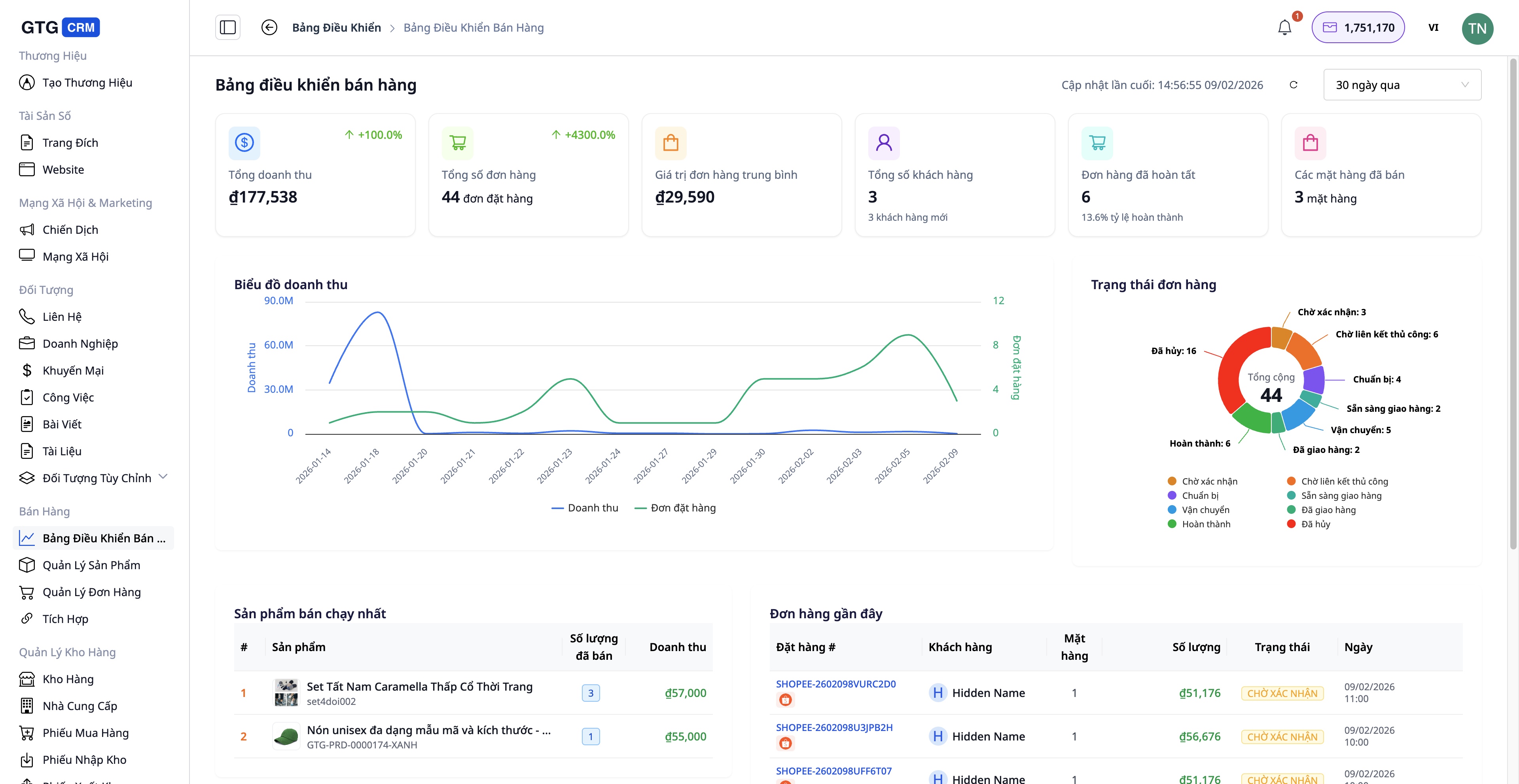
GTG CRM is designed for exactly this problem: consolidating all sales data onto a single dashboard so sellers can understand at a glance, without needing to create manual reports.
Specifically, GTG CRM supports:
- Real-time tracking of revenue, order volume, average order value, and customer count.
- Clear analysis of order statuses to identify where orders are bottlenecked.
- Quickly viewing best-selling products to avoid impulsive inventory purchases.
- Connecting orders, customers, and products within the same data flow.
Most importantly, sellers don't need to be accounting or data analysis experts, as the system organizes data according to logical operations.
Conclusion
When online businesses are small, manual management might be "acceptable." But as order volume increases, the inability to clearly see sales data becomes the biggest risk, not advertising or competition.
A clear sales dashboard doesn't just help you know how much you sold today; it helps you:
- Know if you are growing or leaking,
- Know where to focus your efforts first,
- And know that your next decisions should be data-driven, not based on gut feelings.
This is precisely why GTG CRM was built: to help online sellers control their daily sales before things become too messy to fix.
Turn what you've just read into real results — apply now with GTG CRM, for free.
Apply Now