With the boom in e-commerce, the question "Does revenue on e-commerce platforms need to be declared for tax purposes?" has become a major concern for hundreds of thousands of individuals and business households selling online. In reality, many people still confuse "selling on a platform" with "no need for declaration," leading to risks of back taxes and penalties when tax authorities reconcile data.
This article clarifies the nature of tax obligations for revenue on e-commerce platforms, key policy changes from 2025-2026, and how sellers need to prepare to avoid being caught off guard.
If you are selling on Shopee, Lazada, TikTok Shop, or other e-commerce platforms, the issue boils down to 3 determining factors:
- As who are you selling (individual, business household, enterprise)?
- Are you selling on a platform with or without payment functionality?
- Is the application time before or after July 1, 2025?
Do sellers on e-commerce platforms have to declare and pay taxes?
In principle, if a business activity arises, there is a tax obligation, regardless of the selling method. Revenue on e-commerce platforms is not "virtual revenue", but actual revenue generated from the sale of goods and provision of services.
Therefore, if a seller has revenue from selling activities on a platform, in principle, they must still declare and calculate taxes according to regulations.
The fundamental principle: Selling on a platform ≠ exemption from tax declaration
The law makes no distinction between:
- Online or offline sales
- Sales via platforms or direct sales
- Receiving COD payments or e-wallets
The difference lies only in the method of collection, declaration, and data reconciliation.
Major change from mid-2025: E-commerce platforms deduct and pay taxes on behalf
From July 1, 2025, according to new regulations, e-commerce platforms with payment functionality in Vietnam will deduct and pay taxes on behalf of individuals and business households selling on their platforms.
However, sellers will still need to:
- Provide complete identification information to the platform
- Monitor deducted revenue
- Declare other tax obligations if any arise
- Store data for reconciliation and explanation
For platforms without payment functionality, the obligation to declare and pay taxes remains with the seller.
Read more: In 2026, Will Business Households Declare Taxes Monthly or Quarterly?
How is revenue on platforms calculated for declaration?
According to tax law, taxable revenue is gross revenue, meaning the total value of goods and services that the seller receives according to the transaction.
According to tax regulations:
- Revenue = total sales value recorded on the order
NOT:
- The actual amount received in the account
- Revenue after deducting platform fees
- Revenue after deducting returned goods
For example:
- Order value: 1,000,000 VND
- Platform fee: 100,000 VND
- You only receive 900,000 VND
→ Taxable revenue is still 1,000,000 VND
Revenue on platforms is closely tied to electronic invoices
Sellers need to clearly distinguish:
- Cases where the platform issues invoices on your behalf
- Cases where the seller must issue their own invoices
- How to handle returns, refunds, and revenue adjustments
Read more: Comprehensive Guide to Substitute Invoices and Adjustment Invoices
Practical solution: Not about learning the law, but about managing the right system
When selling across multiple channels and platforms:
- Manual record-keeping → definitely inaccurate
- Disparate Excel files → impossible to reconcile
- When summoned → unable to provide proof
Integrated management platforms like GTG CRM solve this bottleneck:
- Synchronize products from Shopee, Tiktok Shop, Lazada
- Aggregate all orders from platforms, websites, and offline channels
- Link revenue ↔ invoices ↔ inventory ↔ accounting
- Issue electronic invoices through MISA, S-Invoice
- Automatically issue substitute invoices for returns
- Maintain data logs for explanation when needed
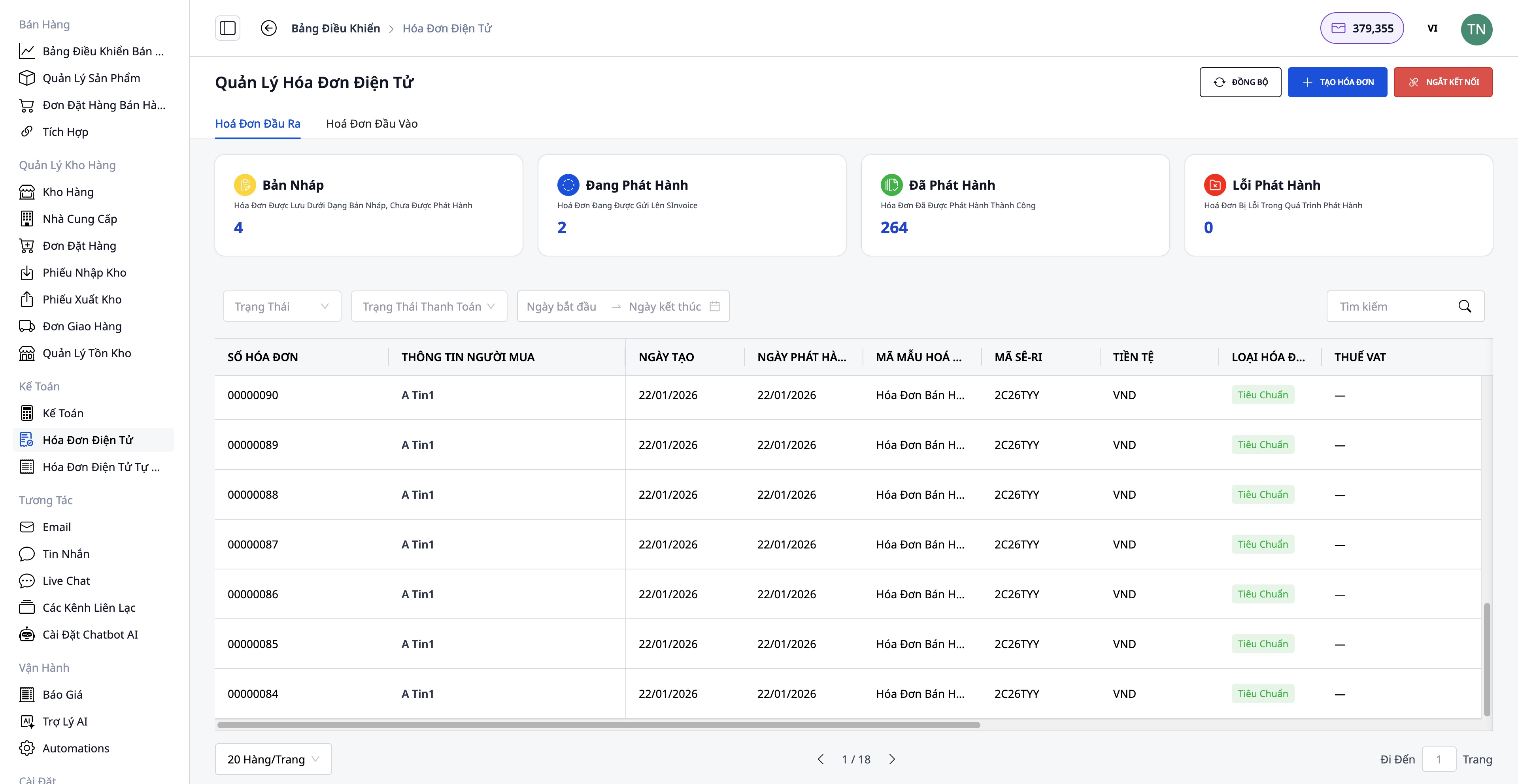
GTG CRM automatically issues invoices through MISA, S-Invoice
Conclusion
Revenue on e-commerce platforms is definitely subject to tax management. The current difference lies not in whether it "needs to be declared or not," but in who declares it, how it is declared, and how the data is reconciled.
In a context where e-commerce platforms, banks, and tax authorities have closely connected data, selling online without controlling revenue and tax obligations is no longer a potential risk, but a present danger.
Sellers who want to succeed long-term need to:
- Understand the true nature of revenue on platforms
- Closely monitor policy changes
- And invest in a suitable management system from the outset
Turn what you've just read into actual results — apply now with GTG CRM, for free.
Apply Now