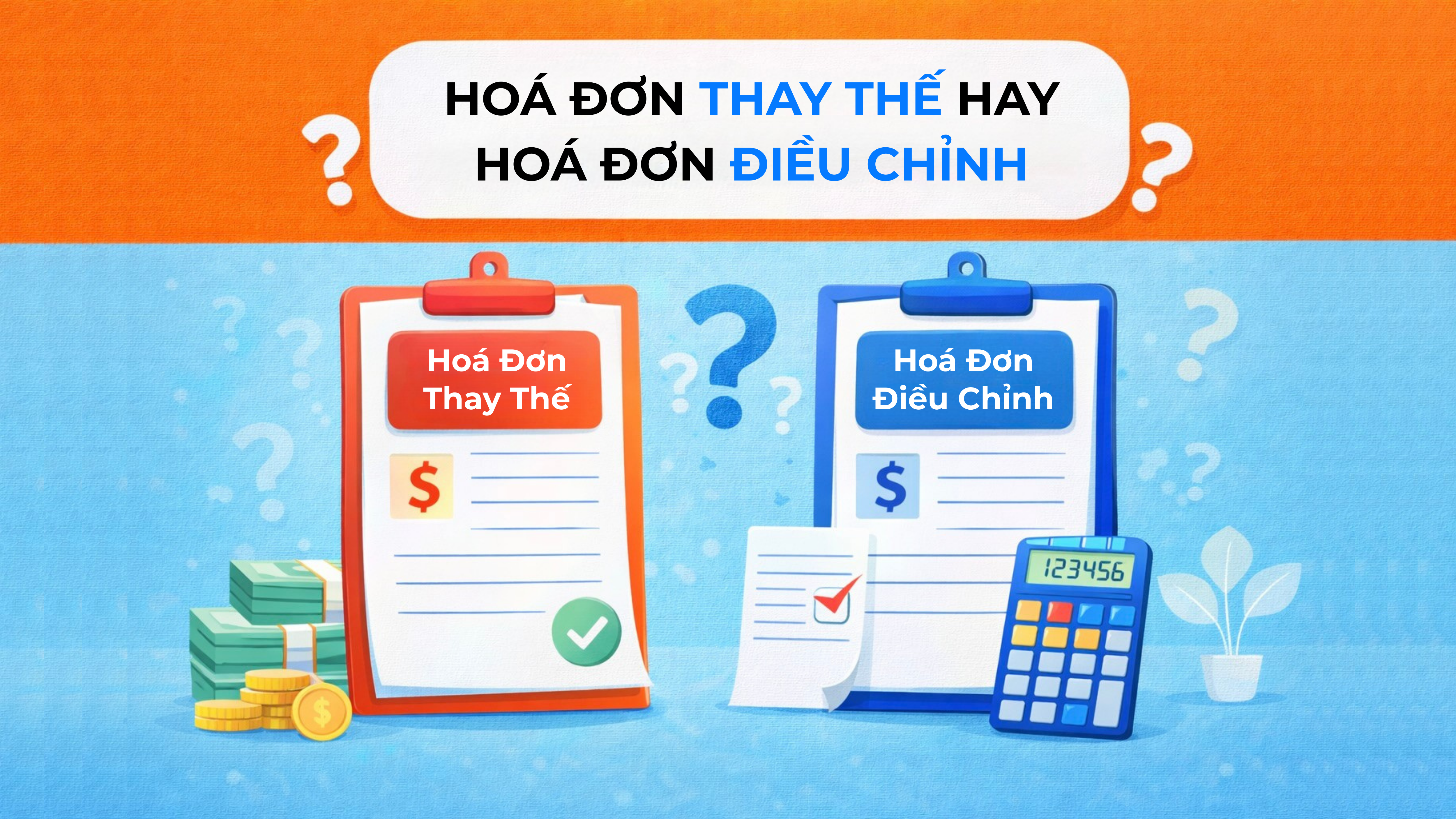
The processing of electronic invoices with errors is a common occurrence in accounting and tax practices. Depending on the nature of the error and the business transaction, the seller can choose to issue a replacement invoice or a corrected invoice in accordance with legal regulations.
Decree No. 70/2025/ND-CP (amending and supplementing Decree No. 123/2020/ND-CP) has clarified the scope and application of these two methods. The following article explains their legal essence to help distinguish and apply them accurately.
Replacement Invoice
Concept
A replacement invoice is an electronic invoice issued to entirely replace the content of a previously issued electronic invoice that has a serious error, rendering the original invoice no longer suitable for tax declaration and accounting purposes.
The replacement invoice must clearly state: "Replaces invoice Template No. …, Symbol …, Number …, dated … month … year …".
When to Issue a Replacement Invoice
A replacement invoice is used when the issued invoice has a material error:
- Incorrect tax identification number of the seller or buyer
- Incorrect payment amount, including the sum, tax rate, and tax amount
- Incorrect information about goods or services, such as type, specifications, or quality
- The invoice is damaged, torn, erased, or has missing information
- The invoice is lost or unusable
Legal Principles for Issuing a Replacement Invoice
- The replacement must be agreed upon or formally notified to the buyer
- The replacement invoice entirely supersedes the original invoice; they do not coexist in terms of declaration value
- The data of the replacement invoice must be clearly linked to the invoice being replaced
- Tax declarations are made based on the replacement invoice
Corrected Invoice
Concept
A corrected invoice is an electronic invoice issued to adjust a part of the content of a previously issued electronic invoice, in cases where the original invoice remains legally valid but has discrepancies or requires adjustments.
The corrected invoice must clearly state: "Corrects invoice Template No. …, Symbol …, Number …, dated … month … year …".
When to Issue a Corrected Invoice
Firstly, for invoices issued with errors in:
- Tax identification number
- Amount
- Tax rate, tax amount
- Information about goods or services
and the parties choose the correction method instead of replacement.
Secondly, for invoices issued correctly at the time of issuance but subsequently arise:
- Adjustments to payment value upon settlement
- Adjustments to volume or value based on the conclusion of competent authorities
Thirdly, for specific cases:
- Commercial discounts based on sales volume or output
- Returns of goods or services (in whole or in part)
- Adjustment of fees or refunds in the insurance sector
- Transaction adjustments in real estate and construction
- Service fee adjustments in banking and payment intermediary services
- Adjustments in telecommunications and prepaid card sectors
Legal Principles for Issuing a Corrected Invoice
- A corrected invoice does not invalidate the original invoice
- Tax declarations are made in the period when the corrected invoice is issued; prior periods are not retroactively adjusted
- The content of the correction must accurately reflect the economic nature of the transaction
- The corrected invoice must be accompanied by supporting documents such as an agreement or a detailed list
Distinguishing Between Replacement and Corrected Invoices
| Criterion | Replacement Invoice | Corrected Invoice |
|---|---|---|
| Scope of Impact | Entirely replaces the original invoice | Adjusts part of the content |
| Value of Original Invoice | No longer usable | Remains valid |
| Nature of Use | Serious error | Adjusting discrepancies or arising changes |
| Tax Declaration Method | Based on the replacement invoice | Declare the adjusted portion |
| Legal Nature | A new invoice completely replacing the old one | A supplementary, adjusted invoice |
Read more: All About Electronic Invoices: When to Issue, How to Handle Errors
Conclusion
The choice between a replacement invoice and a corrected invoice is not based on subjective will but on the nature of the error and the economic transaction that occurred.
If the error renders the original invoice unusable: issue a replacement invoice.
If there are adjustments to the value or an error that can be corrected: issue a corrected invoice.
Applying the correct method not only ensures compliance with invoice and tax laws but also minimizes risks during tax audits and inspections, and ensures transparency in accounting.
Turn what you just read into real results — apply it now with GTG CRM, for free.
Apply now