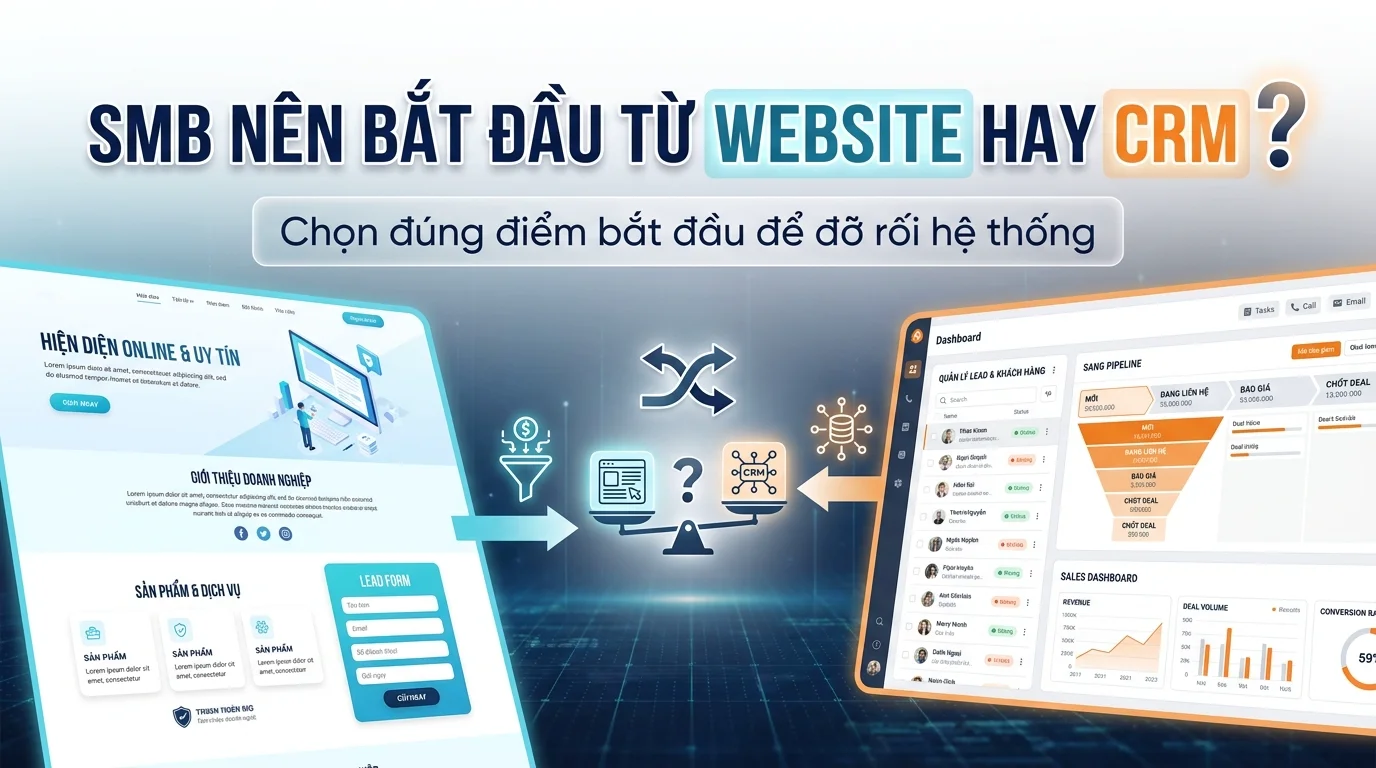
When starting their digital transformation, many small and medium-sized enterprises (SMEs) don't face a lack of tools. The problem often lies in having too many options .
Some advise building a website first to increase credibility. Others say you should implement CRM early for systematic customer management. Some focus on running ads and creating landing pages first. Others prioritize messaging systems for faster customer service. For an SMB looking for a streamlined, tool-efficient, and practical implementation, the question easily arises: should you start with a website or CRM first?
The answer is that not all businesses are the same.
Websites and CRMs are both important, but each solves a different problem. Choosing the right starting point will help businesses progress faster and save on trial-and-error costs. Choosing the wrong order can easily lead to a situation where you've used the tools but haven't seen clear results.
Therefore, instead of asking a general question like "which is better, a website or a CRM?", a more accurate approach is to look at your business's current goals: do you need credibility , leads , sales tracking , or better customer service ?
Why do many SMBs get confused when they start their digital transformation?
For small businesses, resources are always limited. There's a small team, a tight budget, and little time for implementation. Therefore, every investment decision in tools must be quite practical.
But in reality, many SMBs start by doing what they see is necessary first. Today they think they need a website, so they build one. Tomorrow they see leads dropping, so they look for a CRM. The day after that, they see too many customer messages, so they add another messaging tool. The more they do, the more fragmented their system becomes.
As a result, businesses are not truly undergoing digital transformation according to a clear roadmap, but are instead piecing things together piecemeal based on immediate needs.
That's why the question of whether to prioritize a website or CRM is far more important than many people realize. It's not just a question of the tool. It's a question of which starting point will have the most significant impact on the business at this stage .
What is the difference between a website and a CRM?
Simply put, a website helps businesses establish a presence and build trust . CRM helps businesses gather, track, and manage customers more effectively .
A website is suitable when a business needs a place for customers to learn about the business, check its credibility, view services or products, and leave a comment such as filling out a form or contacting them. Meanwhile, a CRM system plays a powerful role when a business already has leads or customers have gone through multiple touchpoints and require more centralized management.
It can be understood like this:
| Item | team | printer |
|---|---|---|
| Main role | Online presence, building credibility, supporting conversions. | Lead management, customer tracking, and process monitoring. |
| What problem are we solving? | Customers come in but don't yet understand or trust the business. | The lead has arrived, but it's easy to lose track of it and difficult to keep an eye on. |
| Suitable when | Businesses need a clearer online platform. | The business already has many leads or many touchpoints. |
| Strong impact | Trust, identify, and convert traffic. | Sales operations, customer service, data management |
| If missing | Customers quickly become confused and disbelieving. | Sales teams often miss leads due to scattered data. |
Looking at this table, it's clear that websites and CRM don't replace each other. They complement each other. But for SMBs looking to streamline their processes and take things step by step, businesses need to determine which should come first based on their primary goals .
Choose a framework based on your goals: what does your business need most?
If you're wondering where to begin your small business's digital transformation , consider these four goals.
1. If your current goal is to increase your online reputation, prioritize your website first.
This is a very common situation for businesses that have been operating for a while but have a weak online presence, or have a fan page but lack a clear place for customers to check their information.
When customers see you through advertising, social media, or referrals, they will usually seek more information before making a decision. If your business doesn't have a website, or if your website is too basic, customers will be less likely to trust you quickly.
At this point, a website should come first because it helps businesses:
- Clearly state who you are.
- Show the customer what you are doing.
- create a more professional impression
- Assist customers in leaving their information or contacting us.
Without a sufficiently clear "online home," businesses will find it difficult to build lasting trust in subsequent steps.
2. If the goal is to generate leads from advertising or traffic, the website or landing page should come first.
Many SMBs have started running ads, but the destination after a click is still too vague. Some drive traffic to their fan page, some to their homepage, and some just get customers to message them and wait for a consultation. This often reduces conversion rates.
In this case, a website or landing page should be the first priority because the business needs a place to:
- Catching traffic that delivers the right message.
- Create clear actions such as filling out a form or registering.
- better customer data retention
- Optimizing the effectiveness of each campaign
In other words, if the current problem is how to keep interested customers engaged after a click , then the website or landing page should precede the CRM.
3. If the goal is for sales to keep up with leads, CRM should be ahead.
This is a very common situation in SMBs where they have leads from multiple sources but a small sales team that can't process them quickly enough. Leads come in from websites, forms, inbox, Zalo, email, or various campaigns, but the data is scattered.
Right now, businesses don't lack input touchpoints. What they lack is a place to gather leads and track them more effectively.
CRM should be implemented before you start seeing signs like:
- Leads arrived, but the response was slow.
- The same customer appears in many different places.
- The salesperson doesn't know exactly how far the customer has progressed in the conversation.
- Marketing sees leads, but sales says they can't keep up.
- The data is scattered across files, inboxes, and personal notes.
If this part isn't addressed first, adding more leads to the system will only make things more complicated.
4. If the goal is to improve customer care after a lead is generated, CRM and messaging should work together.
Some businesses aren't short of new leads, but they miss opportunities in the customer care phase. Customers have messaged, shown interest, and even received initial consultations, but the subsequent journey isn't seamless enough.
At that point, the story is no longer about websites or CRM alone. Businesses need to look at CRM in combination with messaging to:
- Track exchange history
- Avoid missing out on customers who have previously shown interest.
- Support the team in better following up with customers.
- Gather all communication touchpoints into one clearer location.
This is a suitable option for businesses that are beginning to realize that their biggest challenge isn't attracting new people, but rather preventing the loss of those who are already interested.
4 types of SMBs and suitable starting points.
To make it easier to understand, consider these four very common scenarios:
| SMB style | Common symptoms | Where should we start? |
|---|---|---|
| SMBs need online credibility. | Having a fan page is one thing, but lacking a proper platform for promotion makes it difficult for customers to trust you quickly. | Previous website |
| SMBs need to get leads from advertising. | Ads are running but lack a clear destination, conversions aren't going well. | Website or Landing Page first |
| SMBs have small sales teams. | Leads come from multiple sources but I can't keep up; the data is fragmented. | front desk |
| SMBs need to provide better customer service. | Customers have shown interest, but follow-ups haven't been consistent. | CRM + Messaging |
This table isn't meant for rigid division, but rather to help businesses identify their immediate priorities.
So what if you want a simpler, less-tool-intensive approach?
This is a very real concern. Many SMBs are reluctant to deploy too many platforms because the more tools you have, the heavier the operational burden becomes. Small teams can easily end up using tools but not getting much out of them.
In that case, the sensible approach isn't to buy a lot of components and then assemble them later. A better approach is to choose a sufficiently clear roadmap and prioritize solutions that can connect multiple parts within the same system.
For a new business, the order should generally be:
Identify the most urgent goal.
Is reputation, leads, sales, or customer service the biggest priority right now?Choose a starting point that will create the most noticeable impact.
Which comes first: website, landing page, or CRM?Prioritize platforms that can be further scaled.
This way, as your business grows, you won't have to break the system down into too many separate pieces.
How does GTG CRM fit into this problem?
GTG CRM is suitable for small and medium-sized businesses that want to streamline their operations instead of using too many separate tools right from the start.
If businesses need to build an online presence, GTG CRM can help create websites and landing pages to provide a clearer touchpoint for customers.
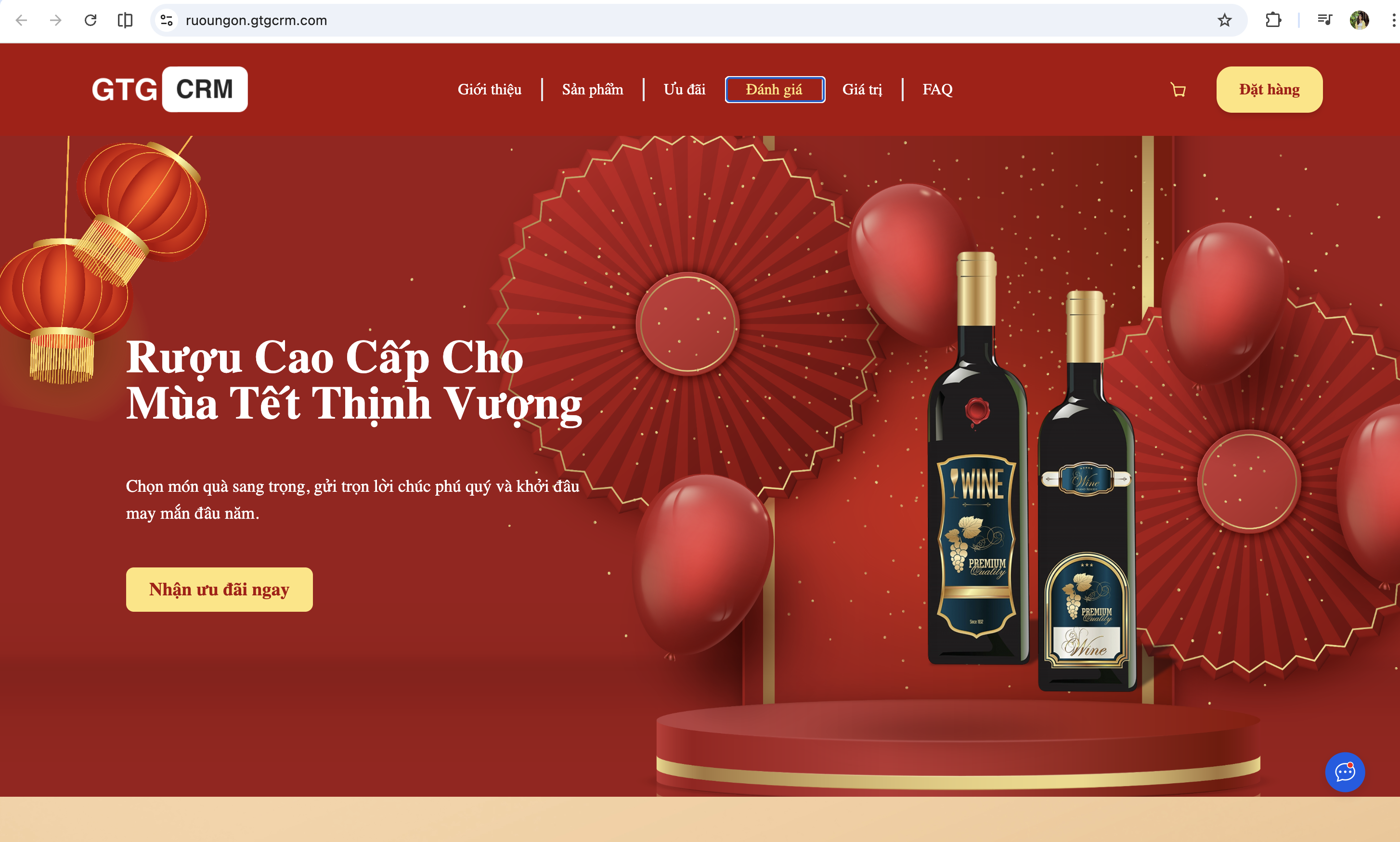 If your business has started generating leads and needs more centralized management, GTG CRM offers a CRM system to track customer data more effectively on the same platform.
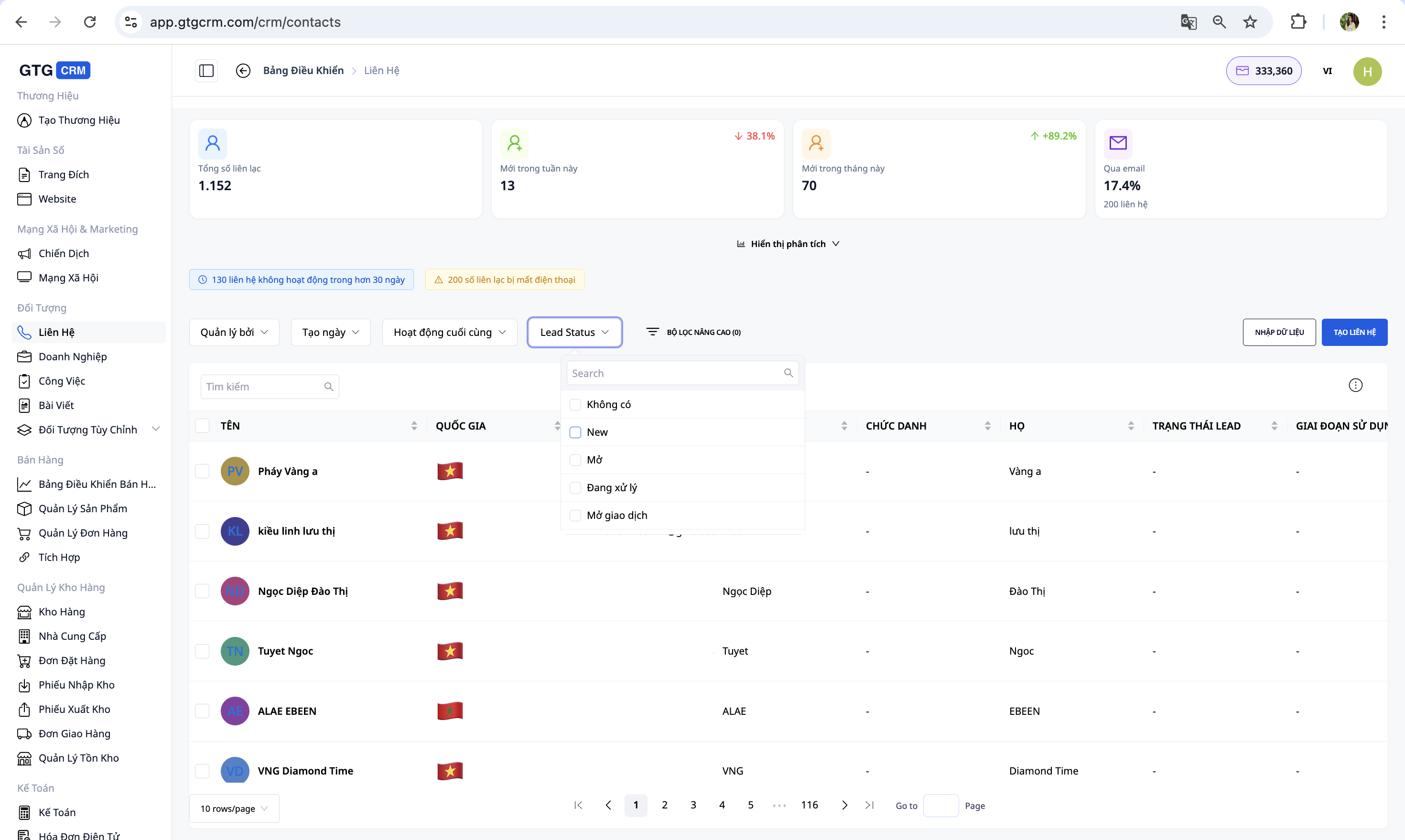 If businesses need to track customer interactions across multiple channels, the system also includes a messaging feature to help consolidate communication into a clearer management workflow.
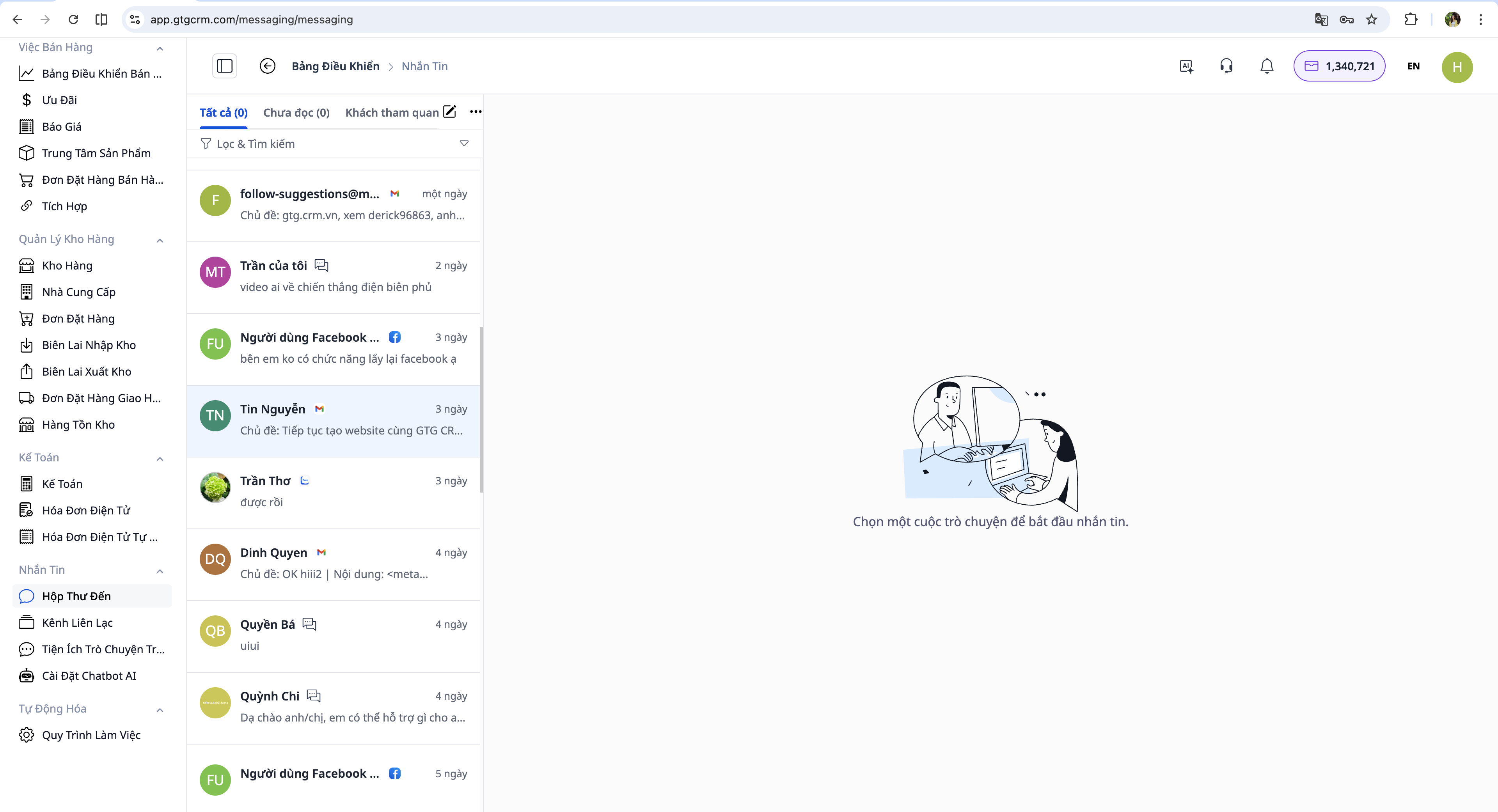 The value lies not only in the individual features, but in the fact that businesses can build a roadmap step-by-step without having to separate the website, landing page, CRM, and messaging into too many independent tools right from the start.
Conclude
The question of whether SMBs should start with a website or CRM first doesn't actually have a single answer. The important thing is to accurately identify the current needs of the business.
If you need to increase credibility and build customer trust faster, start with your website .
If you need to optimize lead generation from traffic and advertising, prioritize your website or landing page .
If leads have come in but sales can't process them in time, CRM should take the lead.
If your business is losing customers in the follow-up and customer care phase, consider CRM combined with messaging .
Digital transformation for small businesses doesn't necessarily have to start with a lot of tools. It should begin with choosing them in the right order.
And by following a clear roadmap, businesses can more easily build a leaner, more operational system that produces more tangible results in practice.
Turn what you've just read into tangible results — apply it now with GTG CRM, free.
Apply now