Introduction
Updated 29/10/2026: Decree 254/2026/NĐ-CP on invoices and documents takes effect from 01/07/2026 (Decree 254/2026/NĐ-CP, Article 43 Clause 1). Decree 123/2020/NĐ-CP and Decree 70/2025/NĐ-CP cease to be effective from that date (Decree 254/2026/NĐ-CP, Article 43 Clause 2); Circular 32/2025/TT-BTC ceases to be effective from 01/07/2026 (Circular 91/2026/TT-BTC, Article 25 Clause 2). This article discusses electronic invoices for sellers selling goods on e-commerce platforms such as Shopee, Lazada, and TikTok Shop. The sections on who must use electronic invoices and how to register have been updated according to current regulations.
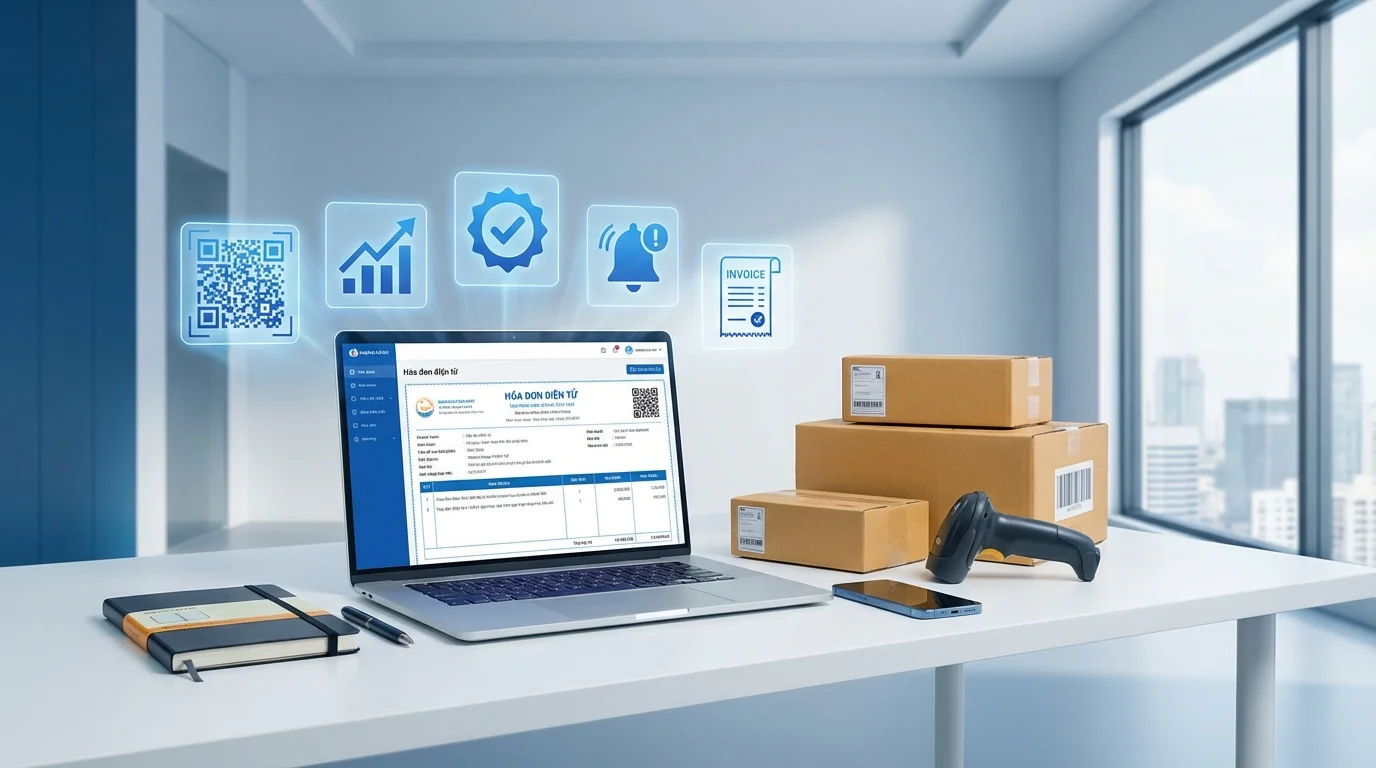
So what exactly is an electronic invoice? Who must use it? How can you comply effectively without disrupting business operations? This article will answer all these important questions.
Who Must Use Electronic Invoices? — Detailed Analysis by Category
To understand clearly whether you are required to use electronic invoices, you first need to understand the current legal regulations.
Enterprises
Economic organizations, other organizations, including limited liability companies, joint-stock companies, must use electronic invoices when selling goods or providing services, except for cases not requiring electronic invoices as mentioned in Decree 254/2026/NĐ-CP, Article 7. Electronic invoices may have a tax authority code, no tax authority code, or be generated from a cash register depending on the industry, trade, and conditions specified in Decree 254/2026/NĐ-CP, Article 6 Clause 1 Points a, b, and c (effective from 01/07/2026). Please ask your accountant which type of electronic invoice your business must use.
Business Households with Annual Revenue Exceeding 1 Billion Dong
Business households and self-employed individuals with annual revenue exceeding 1 billion dong, or selling assets that require registration of ownership rights or usage rights, must use electronic invoices with a tax authority code or electronic invoices generated from cash registers with data connection to the tax authority (Decree 254/2026/NĐ-CP, Article 6 Clause 1 Point d, effective from 01/07/2026; Decree 68/2026/NĐ-CP, Article 8 Clause 5, amended by Decree 141/2026/NĐ-CP). Some cases do not require electronic invoices, for example, income from real estate rental, or acting as an agent for lottery, insurance, or multi-level sales where the enterprise has already withheld taxes (Decree 254/2026/NĐ-CP, Article 7).
Business households with previous year revenue below 1 billion dong (excluding households that have registered to use electronic invoices according to Article 8 Clause 5 Point b of Decree 68/2026/NĐ-CP) but have revenue exceeding 1 billion dong in the current tax period must use electronic invoices with a tax authority code or electronic invoices generated from cash registers with data connection to the tax authority, and must register for electronic invoice use within 30 days from the last day of the tax period with cumulative revenue exceeding 1 billion dong (Decree 68/2026/NĐ-CP, Article 8 Clause 5 Point c, amended by Decree 141/2026/NĐ-CP). Newly established business households: please ask your accountant.
Sellers on E-commerce Platforms
This is the most confusing point. Many sellers believe that because they sell through Shopee, Lazada, or TikTok Shop, they don't need to issue separate invoices. According to current regulations, business households and self-employed individuals with annual revenue exceeding 1 billion dong must use electronic invoices with a tax authority code or electronic invoices generated from cash registers with data connection to the tax authority (Decree 254/2026/NĐ-CP, Article 6 Clause 1 Point d, effective from 01/07/2026), except for cases not requiring electronic invoices as mentioned in Article 7 of this Decree. Please ask your accountant whether your situation requires using electronic invoices.
Business Households with Annual Revenue Up to 1 Billion Dong
Businesses, individual traders with annual revenue of 1 billion dong or less, who meet the conditions and have the need, must register to use electronic invoices (Decree 68/2026/NĐ-CP, Article 8, Section 5, Point b, as amended by Decree 141/2026/NĐ-CP). For activities involving selling goods and providing services directly to consumers (retail, excluding automobiles, motorcycles, motorbikes and other motor vehicles; food and beverage; restaurants; hotels and other activities mentioned in the documents), Decree 254/2026/NĐ-CP, Article 6, Section 1, Point c requires the use of electronic invoices from cash registers. Please ask your accountant whether your case requires using electronic invoices. Additionally, proactively using electronic invoices from the start can bring many benefits: build credibility with customers, prepare for business expansion, and avoid rushing to implement when revenue suddenly exceeds the threshold.
What Does a Seller Online Need to Do?
Step 1: Register Electronic Invoices With Tax Authorities
- Register to use electronic invoices through the electronic invoice service provider of your choice (see Step 2), except for special cases mentioned in the same section (Circular 91/2026/TT-BTC, Article 6, Section 1, effective from 01/07/2026)
- Choose an electronic invoice service provider (or use pre-integrated software like GTG CRM)
- Receive invoice templates and begin issuing invoices
Step 2: Choose Suitable Software
This is the most important decision. There are 2 options:
Option 1: Standalone invoice software (MISA, SInvoice)
- ✅ Specialized in invoicing
- ❌ No integration with e-commerce platform orders
- ❌ Must manually enter invoice information
- ❌ Requires additional separate inventory management and CRM software
Option 2: Integrated software (GTG CRM)
- ✅ Invoices integrated with orders — order completed → automatically generate invoice
- ✅ Connect Shopee/Lazada/TikTok — order data flows directly into invoices
- ✅ Inventory management + CRM + marketing in one system
- ✅ Save data entry time
Step 3: Set Up Automated Processes
With GTG CRM, you can set up automation:
```
Shopee order completed
→ Automatically create electronic invoice
→ Send invoice via email to customer
→ Record revenue in reports
```
No manual entry needed, no fear of errors, no wasted time.
Compliance Costs
| Item | MISA Standalone | GTG CRM |
|---|---|---|
| Invoice software | 1-3 million/year | Included in package |
| Order management software | 0-500K/month (other tools) | Included |
| Inventory management software | 0-500K/month (Excel/tools) | Included |
| Total Cost | 2-8 million/year | From 199K/month (everything in one) |
Frequently Asked Questions
Q: I sell on Shopee, has Shopee issued invoices for me?
A: An invoice for service fees that the platform collects from you and an invoice for your sales transaction with the buyer are two different things. When selling through a platform, the platform owner is responsible for providing buyer information, transaction-related information, delivery time, and confirming order completion status on the system so that the seller can issue an electronic invoice (Decree 254/2026/NĐ-CP, Article 19, Section 2). From July 01, 2026, sellers of goods and service providers may authorize a third party to issue electronic invoices for the sale of goods and provision of services (Decree 254/2026/NĐ-CP, Article 4, Section 5, effective from July 01, 2026 according to Article 43, Section 1; Circular 91/2026/TT-BTC, Article 9, Section 1, point a). The authorized third party must be a qualified third party eligible to use electronic invoices, and both the seller and the authorized third party must not fall under the cases of suspension or temporary suspension of electronic invoice use according to Article 8 of Circular 91/2026/TT-BTC (Circular 91/2026/TT-BTC, Article 9, Section 1, point a). Authorization must be established in writing (contract or agreement) between the authorizing party and the authorized third party, and must be notified to the tax authority when registering for electronic invoice use (Circular 91/2026/TT-BTC, Article 9, Section 1, points b and c). If the e-commerce platform is a third party meeting those conditions, the seller may authorize the platform to issue invoices for sales transactions and service provision on the platform. Ask your accountant who issues invoices to your customers in your case.
Conclusion — Early Compliance to Avoid Risks and Seize Opportunities
Electronic invoices are mandatory for sellers in the cases specified in Decree 254/2026/NĐ-CP, Article 6, Section 1 (effective from July 01, 2026); ask your accountant whether your case requires the use of electronic invoices. Proactive preparation and early implementation not only help you comply with the law and avoid penalties, but also bring practical benefits to your business operations.
First, electronic invoices create professionalism and credibility with customers. In a highly competitive environment, customers tend to trust and prefer to purchase from sellers who can provide complete VAT invoices, especially business customers who need invoices for tax declarations.
Second, integrating electronic invoices into your sales process helps automate many steps, minimize manual data entry time and errors. When using an integrated solution like GTG CRM, each completed order will automatically generate an electronic invoice and send it to the customer without any manual intervention.
Third, data from electronic invoices helps you gain a more accurate view of your business's financial situation. Monthly and quarterly tax declarations become much simpler when all invoices are managed and stored electronically in an organized manner.
GTG CRM provides a fully integrated electronic invoice solution, helping you comply fully with all legal regulations without needing additional investment in separate invoice software. With 36,888 free credits when you sign up, you can issue over 3,000 electronic invoices to experience and evaluate effectiveness before making a long-term commitment.
Don't let unprepared electronic invoices become a legal risk for your business. Start today to be ready when your business operations fall under the requirement to use electronic invoices.
Register for GTG CRM and start using electronic invoices now at gtgcrm.com