Mr. Nguyễn Hoàng Long (38 years old) – the founder of GreenHouse Interior, a small interior design and construction company in Ho Chi Minh City – once believed that “giving everyone quyền (authority/access) would be faster.” But after three years of operation, he realized that it was precisely that approach that slowed his business down.
Each employee had full access to customer data, projects, and quotes. A single accidental action could delete contract information. Once, a marketing staff member mistakenly deleted a project landing page worth hundreds of millions, causing the advertising campaign to stop midway. “As the team grew, I realized I couldn’t rely on trust – I needed a control system,” shared Mr. Long.
When Access Control Becomes a Matter of Survival
At GreenHouse, each interior design project typically involves three teams: marketing for lead generation, sales for consultation and quoting, and technical for implementation. However, because everyone worked on a shared file, no one knew who was editing or deleting what. “One person would adjust material prices without the other knowing, leading to incorrect quotes sent to clients. Every mistake like that cost us our reputation,” he recounted.
Furthermore, without access levels, new employees could still access old customer data, copy lists, and take them elsewhere. GreenHouse began to suffer from internal distrust – and that’s when Mr. Long turned to GTG CRM.
Solution: Access Level Control – Clear Access, Clear Responsibilities
Immediately after implementation, GTG CRM helped Mr. Long restructure the entire way access was granted within the company.
He chose three default permission levels:
- Administrator for himself and the department heads, with full system access.
- Marketing Manager for the marketing department, only allowed to create and edit campaigns, landing pages, and posts.
- Sales Staff for the sales team, only able to view and update contacts, unable to edit marketing data.
After that, Mr. Long used Custom Roles to further refine permissions for individual employees. For example, the design team lead only had permission to view customer information for projects they were responsible for; customer service staff were only allowed to send emails and reply to messages, and could not view quotes.
“Initially, I was afraid that overly strict access control would slow down work,” he shared. “But the reality was completely the opposite. When everyone does only their assigned tasks, processing speed increases, responsibilities are clear, and disputes disappear.”
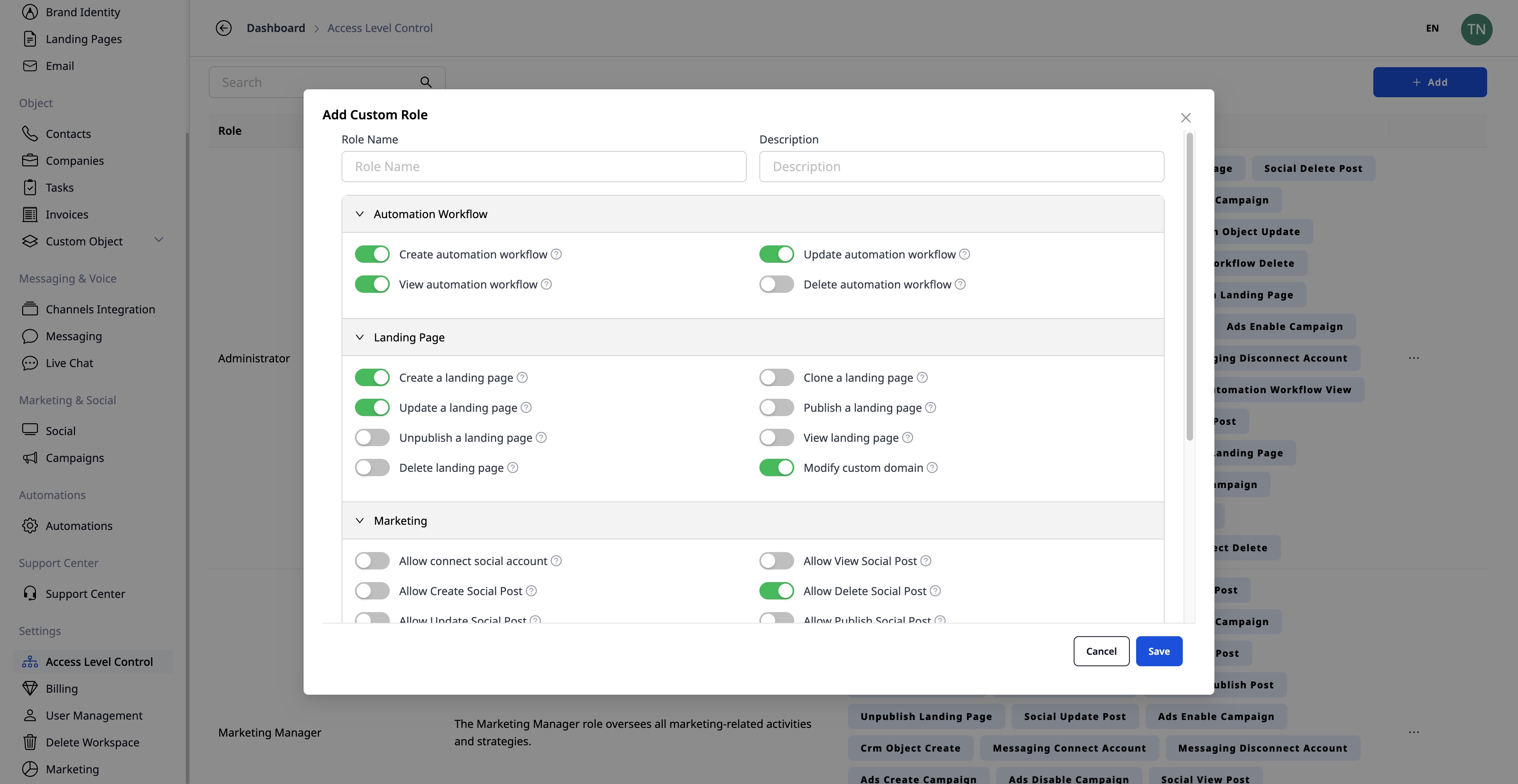
Customized access permissions and restrictions for each personnel level
Closed-Loop Process – Secure Data
Thanks to Access Level Control, customer and project data at GreenHouse is strictly controlled. Every action is logged: who made the change, when, and what was changed.
Accidental deletions, overwrites, and incorrect updates have virtually disappeared.
The marketing department can now focus solely on creativity and monitoring advertising effectiveness, while sales can concentrate on customer care and closing deals. Monthly reports have also become more accurate because data is no longer duplicated.
When a Small Business Operates Like a Large Corporation
Previously, Mr. Long thought access control was only necessary for large companies. But after operating with GTG CRM for a few months, he realized it was the foundation for sustainable small business growth.
“We only have 15 people, but thanks to GTG CRM, everything runs as smoothly as a team of 50. No one encroaches on anyone else’s tasks, and I no longer have to worry about data loss,” he said.
Besides Access Level Control, Mr. Long also utilizes the CRM Module to manage contacts, Invoices to track project payments, and Automations to send thank-you emails to clients after project handover. But he emphasized: “Without access control, all these other features would easily fall apart.”
Results After 4 Months
Just four months after implementing the new system:
- The number of operational errors in internal data decreased by nearly 90%.
- Project processing speed increased by 40% due to the elimination of overlapping permissions.
- New employees integrated faster thanks to clearly defined roles and responsibilities.
- The business operates transparently, with absolute protection of customer data.
Conclusion
Access Level Control from GTG CRM is not just a feature, but the “backbone” that helps GreenHouse Interior operate more efficiently, securely, and professionally.
Thanks to proper access control, Mr. Long no longer worries about “who does what,” but can focus on what matters most: developing services and customer experience.
“Before, I managed people. Now, the system helps me manage by principles – and everyone feels more comfortable.”
— Nguyễn Hoàng Long, Director of GreenHouse Interior
Your business can achieve similar results — start for free.
Start your journey