A sole proprietorship is a business organization established and operated by an individual or a group of household members. Due to this characteristic, tax obligations for sole proprietorships differ significantly from those of businesses. Understanding the types of taxes to be paid and how to fulfill these obligations will help business owners comply with the law and avoid administrative penalties.
The article below provides a comprehensive summary of the taxes and fees that sole proprietorships need to be aware of, along with detailed instructions on how to declare and pay taxes in accordance with current regulations from the Ministry of Finance.
Taxable Revenue Threshold
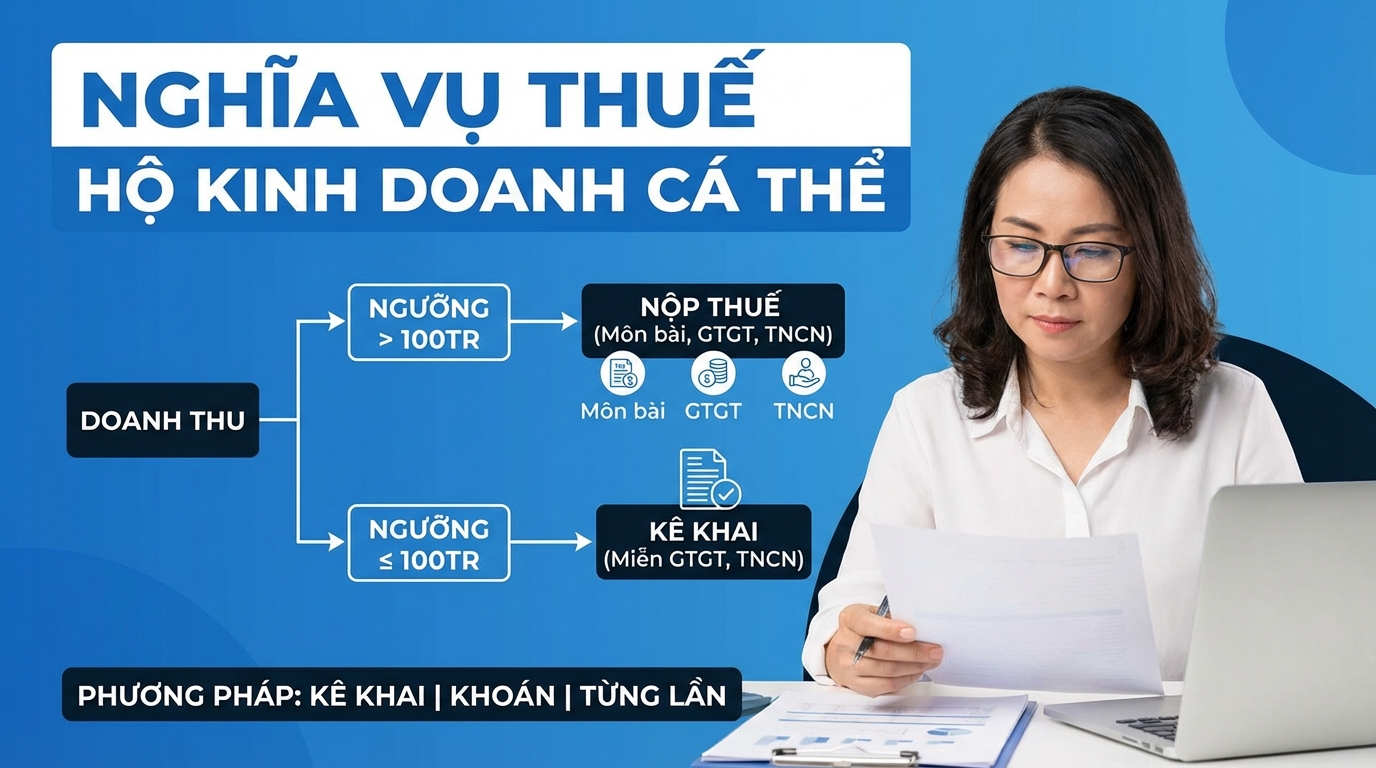
According to Circular 40/2021/TT-BTC, sole proprietorships with annual revenue from production and business activities not exceeding 100 million VND will be exempt from Value Added Tax (VAT) and Personal Income Tax (PIT). However, even if exempt from tax payment, sole proprietorships are still responsible for complete, accurate, and timely tax declarations as required.
For sole proprietorships operated by a group of individuals or households, the 100 million VND/year revenue threshold is calculated for the sole representative of the group during the tax year, not for each individual member.
Types of Taxes and Fees for Sole Proprietorships
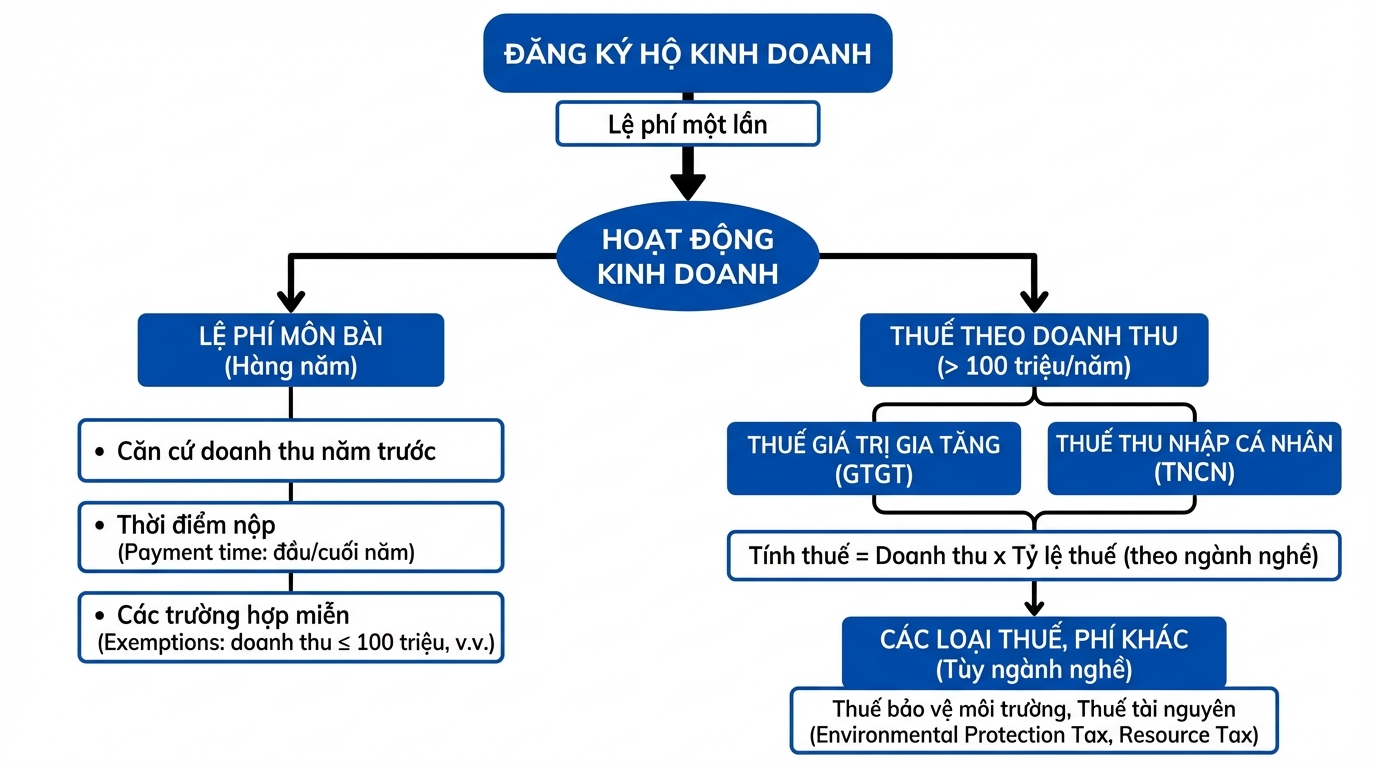
Business Registration Fee
This is a one-time fee paid when registering the establishment of a sole proprietorship with the competent authorities. The fee amount is specified by each locality and is generally not high.
License Fee
The license fee is an annual fee that sole proprietorships must pay, calculated based on the previous year's revenue. According to Circular 65/2020/TT-BTC, the fee varies depending on revenue scale and is divided into different tiers.
License Fee Payment Deadline:
Sole proprietorships commencing operations within the first six months of the year must pay the full year's license fee. If operations begin in the last six months of the year, only 50% of the annual license fee is payable.
Sole proprietorships that temporarily suspend operations and submit a written notice to the tax authority or business registration agency before January 30th each year, and have not yet paid the license fee for that year, will be exempt from paying the license fee for the year of suspension.
Determining Revenue for License Fee Calculation:
The revenue used as a basis for calculating the license fee is the total personal income tax-assessable revenue of the preceding year, excluding revenue from property leasing. For newly established sole proprietorships or those resuming operations after dissolution, revenue is determined based on the scale of businesses in the same industry and locality.
Cases Eligible for License Fee Exemption:
Sole proprietorships are exempt from the license fee in the following situations: annual revenue not exceeding 100 million VND; no fixed business location and not operating regularly; engaged in salt production; aquaculture, fishing, or fishery support services; in the first year of establishment or commencement of production and business activities.
Value Added Tax
VAT applies to sole proprietorships with annual revenue of 100 million VND or more. The tax rate is a percentage of revenue, depending on the specific business sector.
VAT Calculation Formula:
VAT Payable = Taxable Revenue for VAT × VAT Rate
Taxable revenue includes all receipts from sales, provision of services, processing, commissions, as well as bonuses, promotions, discounts, support payments, surcharges, and contract violation compensation.
Personal Income Tax
Similar to VAT, PIT also applies to sole proprietorships with annual revenue of 100 million VND or more. The PIT rate is detailed by industry in Appendix I issued with Circular 40/2021/TT-BTC.
PIT Calculation Formula:
PIT Payable = Taxable Revenue for PIT × PIT Rate
For sole proprietorships operating in multiple different fields and industries, taxes must be declared and calculated separately for each field according to the prescribed rates. If the revenue for each field cannot be determined or the declaration is inconsistent with reality, the tax authority will assess the tax according to tax administration regulations.
Other Taxes and Fees
Depending on the specific industry, sole proprietorships may also be subject to other taxes such as environmental protection tax (for businesses dealing in gasoline, oil, plastic bags), natural resources tax (for exploitation of natural resources), or other fees and levies as prescribed.
Tax Payment Methods
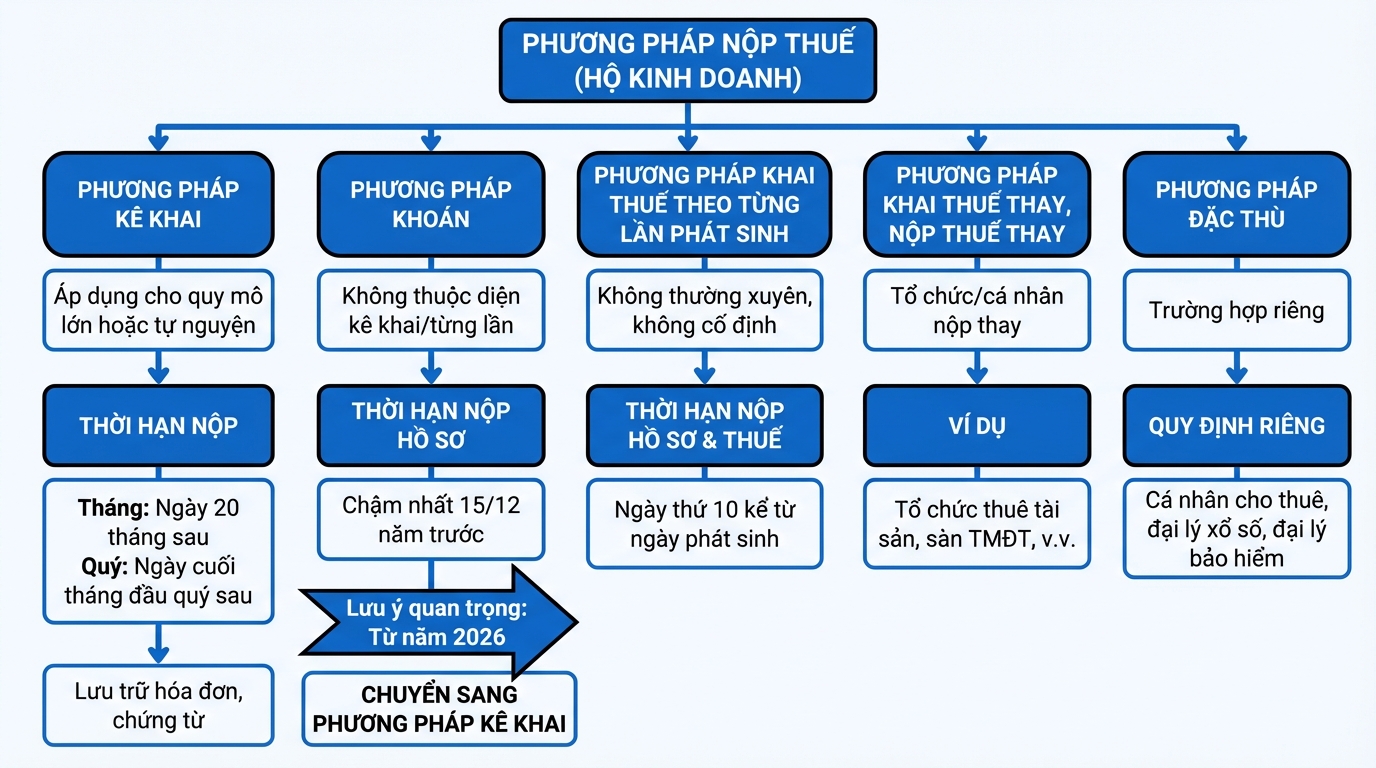
Sole proprietorships can adopt one of the following tax payment methods, depending on their scale and operational characteristics:
Declaration Method
Applicable to large-scale sole proprietorships or those not meeting the criteria for large-scale but voluntarily choosing this method.
The deadline for monthly tax declarations is the 20th day of the following month. For quarterly declarations, the deadline is the last day of the first month of the following quarter.
The tax payment deadline coincides with the tax declaration deadline. Sole proprietorships are not required to maintain full accounting records but must retain invoices, receipts, and contracts to prove the legality of goods and services.
Lump-Sum Method (Khoán)
Applicable to sole proprietorships not subject to the declaration method or one-time transaction taxation.
The deadline for tax declarations is the 15th day of December of the year preceding the tax year. For newly established businesses, those changing tax calculation methods, or altering industries or scales, the deadline is the 10th day from the date of change.
Important note: From 2026, in line with the tax sector's digital transformation roadmap, all sole proprietorships will be required to switch from the lump-sum method to the declaration method. This necessitates that sole proprietorships prepare their sales management systems, electronic invoices, and transparent tax declarations.
Tax Declaration for Each Transaction
Applicable to sole proprietorships that operate infrequently and do not have a fixed business location.
The deadline for tax declarations is the 10th day from the date the tax liability arises. The tax payment deadline coincides with the tax declaration deadline.
Tax Declaration and Payment on Behalf
In certain special cases, organizations or individuals will declare and pay taxes on behalf of sole proprietorships. Examples include organizations leasing property from individuals, organizations collaborating with individuals in business, organizations paying sales performance bonuses, and owners of e-commerce platforms.
Specific Methods
Applied individually to certain cases such as individuals leasing property, individuals directly signing contracts as lottery agents, insurance agents, or multi-level marketing distributors. Each case has its own regulations regarding the tax period and deadlines.
Tax Registration Deadline
According to Article 33 of the Tax Administration Law 2019, sole proprietorships have 10 working days from the date of being granted a business registration certificate to register for tax with the managing tax authority. Timely tax registration is mandatory to avoid administrative penalties.
Consequences of Late Tax Declaration
Late submission or non-submission of tax registration documents and tax declarations will result in administrative penalties according to Circular 166/2013/TT-BTC, ranging from a warning to a fine of 5,000,000 VND, depending on the severity of the violation and the delay period.
Specifically, a delay of 1-10 days in submitting tax declarations may incur a fine of 700,000 VND, 10-20 days a fine of 1,400,000 VND, 20-30 days a fine of 2,100,000 VND, 30-40 days a fine of 2,800,000 VND, and over 40 days a fine of 3,500,000 VND. Additionally, sole proprietorships will be subject to late payment interest on overdue tax amounts as stipulated by law.
Conclusion
A thorough understanding of tax regulations not only helps sole proprietorships comply with the law but also lays a solid foundation for sustainable development in an increasingly professional business environment.
Turn what you've read into real results — apply it now with GTG CRM, for free.
Apply Now