Many businesses run ads quite consistently but still encounter a very familiar problem: budgets are spent, clicks are coming in, and sometimes messages or forms appear, but the number of truly high-quality leads is not as high as expected. Worse, some leads that were once interested then disappear, the sales team can't keep up, and the marketing team doesn't know where they're falling behind.
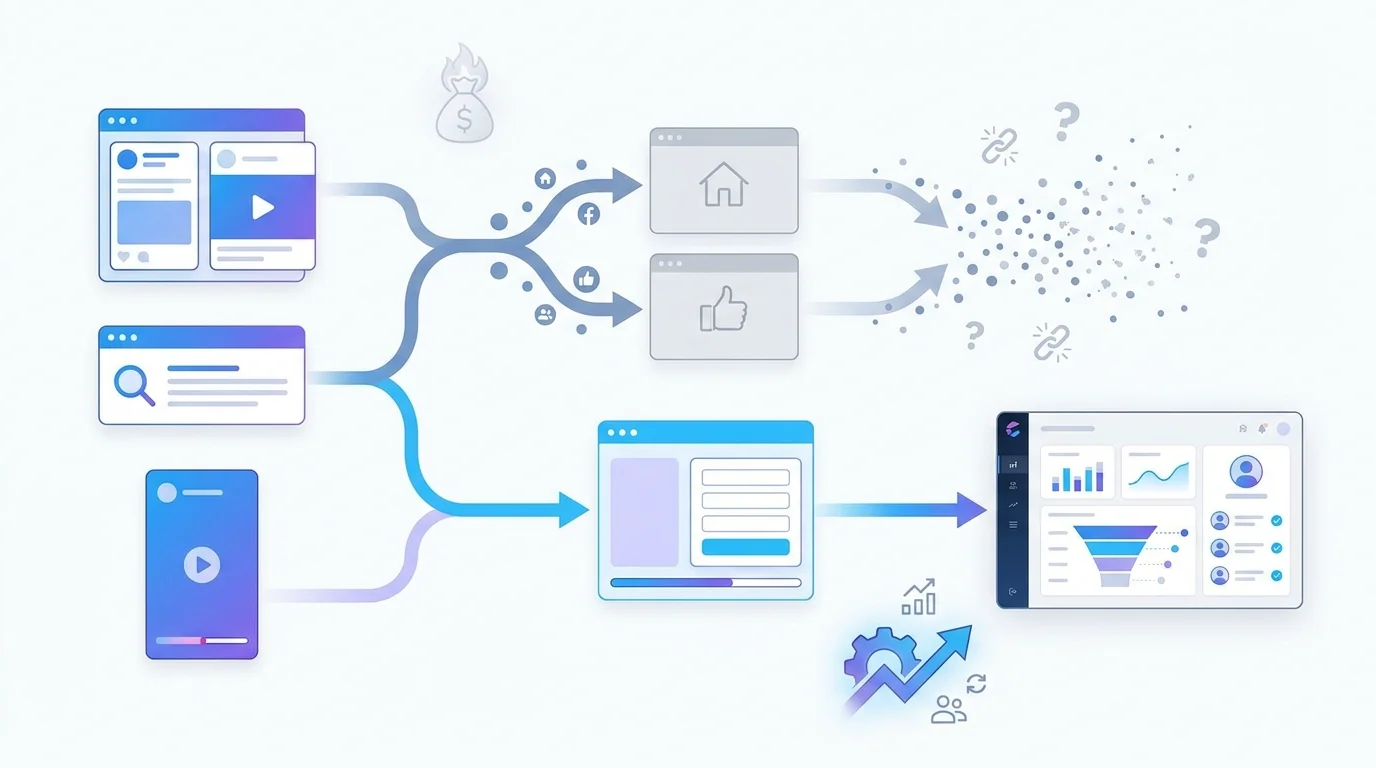
This is a common problem for businesses running Facebook Ads, Google Ads, or TikTok Ads but without dedicated landing pages for each campaign. After clicking on an ad, customers are often redirected to the homepage, fan page, or some other less focused destination. As a result, the journey becomes diluted, customers don't know what to do next, and businesses struggle to pinpoint the exact lead location.
The issue isn't just about having a visually appealing landing page. The real question is: after a click from the ad, does the business have a clear point of engagement to retain the customer, collect information, and feed data into the CRM?
Why are leads more likely to be lost when running ads without a dedicated landing page?
1. There is traffic, but there aren't enough concentrated destinations.
Advertising only does one thing well: bringing interested people closer to the business. But then, if customers are taken to the homepage with too many menus, too much content, too many product categories, or too many detours, chances are they will leave before leaving their contact information.
Homepages have a unique role. They provide an overview of the brand, showcase various content, and serve multiple objectives simultaneously. Meanwhile, traffic from advertising requires a more focused environment. Customers click because of a very specific promise, whether it's an offer, a solution, a service, or a particular product. They want to see it immediately, understand its value, and know the next step right away.
If the destination isn't clear enough, leads won't disappear in a flashy way. They'll just quietly leave the page.
What are the differences between a homepage and a landing page in the lead generation journey?
The biggest difference lies in the conversion goals .
The homepage is designed to help customers discover the brand.
A landing page is designed to prompt visitors to take a specific action.
For an advertising campaign, a landing page is often more effective because the content is built around a clear message, a specific target audience, and a clear call to action (CTA). When visitors arrive at the page, they don't have to figure out what to read first, where to message, or how to leave their information. The entire journey is already pre-planned.
For example, if you're running ads for a consulting service, the landing page could focus on the customer's problem, the solutions the business offers, credible evidence, a registration form, and a contact button. If you're running ads for a product, the landing page could focus on benefits, images, feedback, offers, and a form for consultation or ordering.

Where do leads typically fall when there isn't a dedicated landing page?
1. It falls immediately after the first click.
Customers click on the ads but don't see the content they expected. The message is interrupted, interest wanes, and they leave quickly.
2. Failed at the next action step.
Some websites aren't bad at all, but there's too much information, leaving visitors confused about the next step. They can't see the form, the CTA button isn't clearly visible, or they don't know where to leave their information.
3. Failed at the information entry step.
If the form is too long, cluttered, or lacks compelling reasons to fill it out, customers will stop halfway. This is a very common dropout, but many businesses fail to recognize it unless they have a landing page specifically designed for lead generation.
4. Dropped after leaving information.
A more serious problem is when customers fill out forms but the data isn't sent to a centralized management system. Leads can then be scattered across emails, text messages, manual files, or various other channels. This slows down sales team responses, makes tracking difficult for marketing teams, and causes businesses to miss opportunities for timely follow-up.
What should an effective lead generation landing page have?
A landing page for advertising doesn't necessarily need to be overly complex. But it needs to have enough elements to keep visitors engaged and lead them to the final action.
The headline is clear and relevant to the ad: Customers need to immediately see that this content is directly related to what they just clicked on.
The content should focus on a specific need: Don't try to say everything. A good landing page should typically serve only one main purpose.
The benefit is clear: Customers need to know what they'll receive if they leave their information or contact us immediately.
Reliable evidence: This could include customer feedback, actual photos, work processes, or other factors that help increase reassurance.
Built-in form: This is an extremely important part. The form must be clear, concise, and placed in a suitable location for easy customer interaction.
The CTA is clear: Customers need to be directed to a clear action such as signing up for a consultation, getting a quote, receiving a demo, or buying now.
In other words, a landing page is where traffic is converted into leads. Without this structure, ads can easily end up getting clicks but no valuable data.
The issue isn't just about getting leads, but also about how to manage those leads afterward.
Many businesses now understand the need for landing pages, but they face another bottleneck: the landing page is in one place, the form is in another, and the data is stored in yet another. This means the sales team has to manually filter the data, the marketing team has to manually check it, and managers find it very difficult to see the overall effectiveness.
When the system becomes fragmented, leads are easily lost in the operational phase, not just in the advertising phase.
That's why more and more businesses need not just a landing page to run ads, but a solution that helps create landing pages, receive leads, track visits, and bring data to the CRM all on one platform .
How does GTG CRM help businesses reduce lead loss?
GTG CRM helps businesses create landing pages with integrated forms , shortening campaign deployment and creating a clearer point of contact for advertising traffic.
Instead of directing customers to the homepage or an overly broad page, businesses can create separate landing pages for each campaign, product group, or specific service. The content on these pages is more focused, the call to action is clearer, and forms are readily available for customers to take action directly on the page.
An important feature is that businesses can monitor landing page visit metrics directly within GTG CRM . This helps marketing teams move beyond simply viewing campaigns based on intuition, allowing them to focus more closely on the actual performance of each landing page.
Furthermore, when customers fill out the form, the data can be transferred to the CRM for centralized management on a single platform. Instead of having leads scattered across multiple platforms, businesses can track customer information more clearly, coordinate marketing and sales more easily, and reduce the risk of missing leads during the processing.
The strength here isn't just having a landing page, but having a more seamless process from advertising, landing page, forms to CRM .
Conclude
If you're running ads but don't have your own landing page, your business not only faces the risk of losing clicks, but more importantly, losing leads right at the stage of conversion.
Guests may leave because the destination is not crowded enough.
Customers may stop because the form is unclear or the call to action (CTA) isn't strong enough.
And businesses can also miss out on leads because the data isn't centrally managed.
A dedicated landing page helps advertising campaigns have a clearer target audience. When the landing page also integrates a built-in form, tracks visits, and brings data to a CRM on the same platform as GTG CRM, businesses will reduce many bottlenecks in the lead generation journey.
If you've spent money to bring customers in, create a clear place for them to stay, leave their information, and continue their purchasing journey.
Turn what you've just read into tangible results — apply it now with GTG CRM, free.
Apply now