Selling on e-commerce platforms like Shopee, Lazada, and Tiki offers the opportunity to reach customers quickly from the very beginning. However, focusing solely on the platform without building your own sales channel will expose you to many long-term risks: increasing advertising costs, loss of control over customer data, difficulty building your own brand, and complete dependence on the platform's policies. For sustainable growth, sellers need their own sales website and customer management system to be more proactive in nurturing and reactivating existing customers.
Why do many sellers still rely entirely on the platform?
When starting an online business, e-commerce platforms are a logical choice for most sellers. They don't require large capital for infrastructure development or complex technical knowledge; you just need to register an account and start selling. The readily available traffic from the platform helps products reach customers immediately, especially during major sales events like 9.9, 11.11, or 12.12.
But this very convenience leads many sellers into a trap of complacency. When orders come in regularly and revenue gradually increases, they think they don't need to do anything more. The more they sell on the platform, the more they believe this is the only and sufficient path to long-term growth.
In reality, many sellers who have been in business for 2 to 3 years still only have a single shop on the platform, no website, no customer list, and no way to contact previous customers other than the platform's messaging system. When asked why, the answers are often: "All customers buy on the platform, nobody will visit a website anyway," "It's easier to focus on one place," or "I don't know how to create a website yet."
The risks and hidden costs of selling only on exchanges.
Advertising costs are constantly increasing.
E-commerce platforms operate on a highly competitive marketplace model. To get your products in front of customers, you have to pay for advertising, participate in promotional programs organized by the platform, or accept deep discounts to compete. The more sellers participate, the higher the advertising costs become.
A cosmetics seller might have to spend 15% to 25% of their revenue on advertising and platform commissions. If their monthly revenue is 100 million VND, they might have to spend 20 to 25 million VND just to get an order. This figure doesn't include the cost of discounts in flash sales or vouchers that the platform requires the shop to bear themselves.
Loss of ownership of customer data.
This is the biggest problem, yet few sellers realize it from the start. When customers buy on the platform, all their information belongs to the platform, not you. You only see the name, phone number, and address in the specific order, but you can't export the customer list to run retargeting ads, send email marketing, or build a customer loyalty program.
If a customer has bought from you 5 times in the past year but hasn't returned in the last 2 months, you have no way to proactively contact them to remind them or send offers. You are completely dependent on them remembering your shop and coming back to find you.
This means you're missing out on the opportunity to retain customer data, the most important asset in long-term business. Without data, you can't analyze purchasing behavior, personalize the experience, or build lasting relationships with customers.
It's difficult to build a unique brand.
When selling on a platform, customers often remember the platform first, then your shop. Many people buy on Shopee but don't remember the shop's name, only that they bought on Shopee. This makes it difficult to create a distinct brand identity in the customer's mind.
The shop interface on the platform is also limited by pre-existing templates. You can't customize the user experience in your own way, you can't tell your brand story in depth, and it's difficult to differentiate yourself from thousands of other shops selling the same products.
It depends on the exchange's policies and algorithms.
E-commerce platforms change their policies frequently. Today your shop might be at the top of search results, tomorrow the algorithm changes and you drop in ranking without understanding why. The platform might increase commissions, change refund policies, or prioritize larger shops in promotional programs.
If you violate the policy, whether intentionally or unintentionally, your shop may be temporarily or permanently suspended. This will halt your entire sales channel, resulting in zero revenue, and you will have no backup options.
Difficulty in retaining and reactivating existing customers.
In business, the cost of retaining an existing customer is often 5 to 10 times lower than the cost of acquiring a new one. However, when selling only on e-commerce platforms, you can't proactively nurture existing customers. You don't know who has bought once, who has bought five times, or who hasn't returned in a long time.
The platform's messaging system only allows you to reply to customers within the scope of a specific order. If you want to send notifications about new products or promotions, you have no way to reach them unless you run paid ads on the platform itself.
When should sellers start thinking about their own online store?
You don't necessarily need a website from day one. E-commerce platforms are still a good place to start, test products, and find product market fit. But when you see the following signs, it's time to think about building your own sales channel.
First sign: You've had consistent revenue on the platform for 3 to 6 months. This proves your product has real demand, not just a short-term experiment.
The second sign: The rate of customers returning for a second and third purchase begins to increase. If you see a group of loyal customers, this is a good sign to start building a dedicated channel to better serve them.
The third sign: Advertising costs on the platform start to account for a large proportion of your overall expenses. When you have to spend 20% to 30% of your revenue on advertising, profits are eroded, and you need to find additional channels to optimize costs.
Fourth sign: You want to build your own brand instead of just being an anonymous shop among thousands of others. When you have long-term ambitions, not only selling products but also creating brand value, a personal website is an indispensable step.
How does a personal website help sellers succeed in the long run?
We have complete ownership of customer data.
When customers make purchases on your website, you own all of their information: email, phone number, purchase history, favorite products, and frequency of return visits. This is first-party data, the most valuable data source in an era of increasingly stringent data security measures.
With this data, you can categorize customers according to various criteria: new customers, loyal customers, and infrequent customers. From there, you can design tailored customer care campaigns for each group, increasing repeat purchases and average order value.
Reduce long-term marketing costs.
An e-commerce website allows you to do SEO, creating useful content to attract customers organically from Google. When your articles or product pages rank well on search engines, you have a free and sustainable source of traffic, independent of your monthly advertising budget.
Furthermore, once you have a customer list, you can send email marketing or Zalo messages at a much lower cost than running ads on e-commerce platforms. An email campaign sent to 10,000 existing customers might only cost a few hundred thousand dong, but could generate tens of millions in revenue if the content is engaging.
Building a unique brand
Your website is entirely your space. You can customize the interface, tell your brand story, and design the user experience in your own way. Customers visiting your website will remember your brand name, not the name of your trading platform.
Once a brand is established, you can increase product prices without having to compete on price like you would on the marketplace. Customers are willing to pay more for a brand they trust.
Proactive in business strategy
You are no longer dependent on the platform's policies or algorithms. You decide which promotions to run, how much to offer, and how to provide customer service. If the platform changes its policies to your disadvantage one day, you still have a backup channel to maintain revenue.
Increase customer return rates.
With a CRM system integrated into your website, you can track customer behavior and send automatic notifications when they abandon their shopping cart, when new products that match their interests are available, or when it's their birthday. These small touches help increase engagement and repeat purchase rates.
A 3-step roadmap for sellers to build their own sales channel outside of e-commerce platforms.
Step 1: Create a simple online store.
You don't need a complex website right from the start. A basic e-commerce website with features like product display, shopping cart, payment, and contact form is enough to get you started.
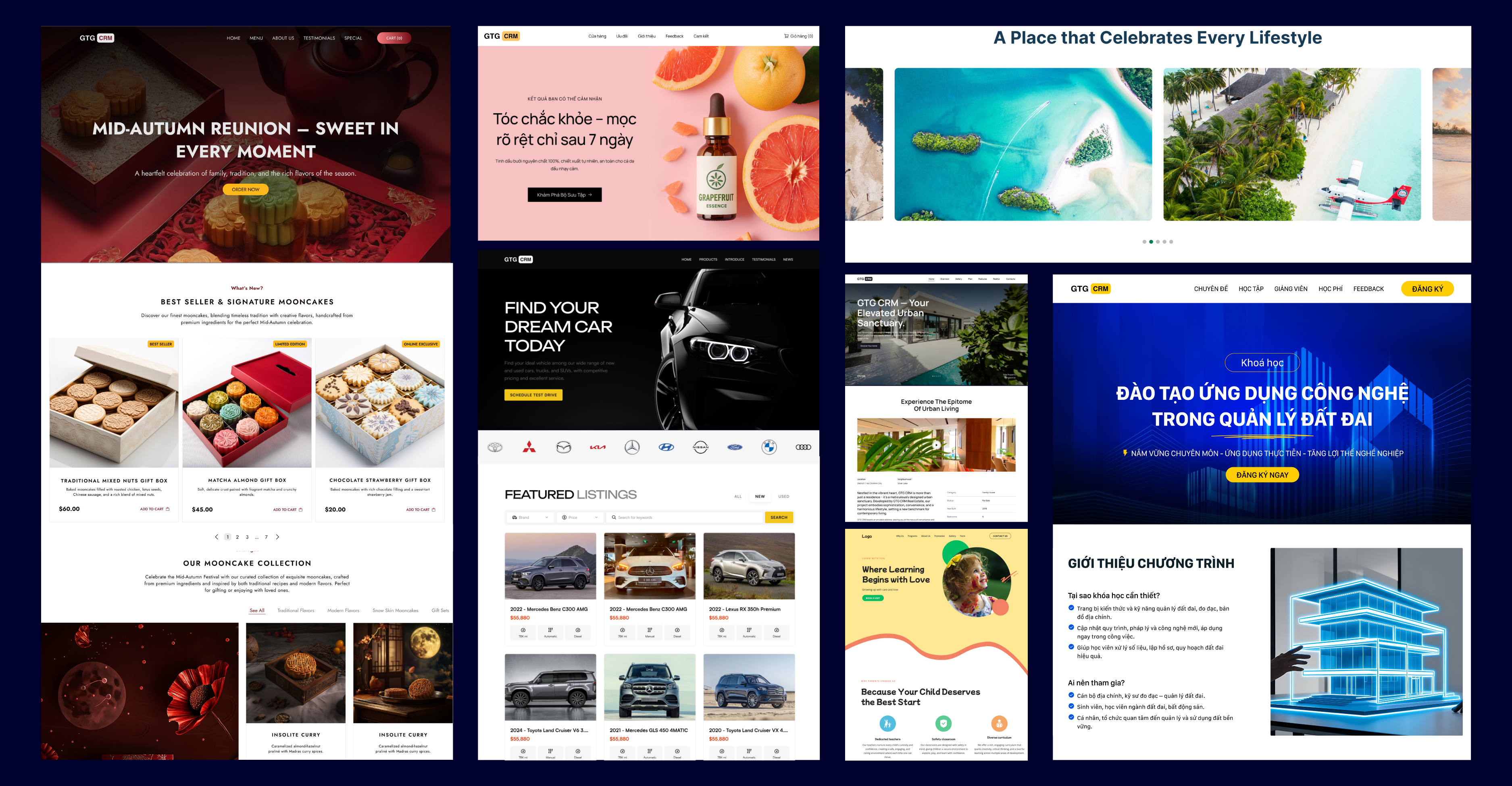
If you have a limited budget, you can use platforms that help you build websites quickly without needing programming knowledge. GTG CRM is one example, allowing you to create e-commerce websites with pre-made, easily customizable templates and a built-in order management system.
Don't procrastinate in the hope of having the perfect website. Start with a simple version, then gradually improve it based on customer feedback.
Step 2: Build landing pages for each campaign.
A landing page is a destination page designed to focus on a specific goal: collecting customer information, introducing new products, or promoting a special offer. Unlike a general website, a seller's landing page allows you to clearly track the effectiveness of each marketing campaign.
For example, when you run Facebook ads for a new product line, instead of directing customers to your website's homepage, you direct them to a landing page that focuses solely on that product. This page includes detailed information, attractive images, and a clear call-to-action button such as "Order Now" or "Get a Offer".
When customers fill out a form on a landing page, whether they make a purchase immediately or not, you collect data for future follow-up.
Step 3: Use CRM to manage and nurture customers.
CRM is a system that helps you store and manage customer information systematically. Once you have a website and start collecting data, the next step is to use CRM to categorize customers, track interaction history, and set up automated customer care processes.
For example, when a new customer signs up for information on a landing page, the CRM can automatically send a welcome email with a discount code. When the customer makes their first purchase, the system records it and after 7 days automatically sends a message to inquire about their experience. If the customer does not return after 30 days, the CRM can send a special offer to reactivate their account.
A CRM system not only saves you time but also ensures you don't miss any customer care opportunities.
A specific sales flow example, from traffic to lead generation and customer follow-up.
Let's look at a real-world scenario to better understand how websites, landing pages, and CRM work together.
Phase 1: Attracting traffic
You're still selling on Shopee and have a stable customer base. You decide to run Facebook ads to introduce your new skincare product line. These ads don't lead to Shopee, but instead to a landing page on your own website.
Phase 2: Gathering customer information
This landing page has an attractive title, high-quality product images, and a simple form asking customers to fill in their name, phone number, and email to receive a 15% discount on their first order. When customers fill out the form, their information is automatically saved to the CRM.
Phase 3: Immediate care
Immediately after the customer fills out the form, the system automatically sends a thank-you email or Zalo message along with a discount code and a link to the product page on the website. Customers can purchase immediately or save it for later.
Phase 4: Monitoring and Reminding
If a customer hasn't made a purchase after 3 days, the CRM automatically sends a gentle reminder message: "You viewed product X but haven't placed an order. Your discount code is valid until the end of this week."
If a customer makes a purchase, the CRM records the first order and moves them to the "New Customer" group. After 7 days, the system sends a follow-up message and introduces related products.
Phase 5: Reactivating existing customers
After 30 days, if the customer does not return, the system automatically sends special offers or introduces new products relevant to their purchase history. If they have made multiple purchases, the CRM can send loyalty programs or customer appreciation offers.
The entire process is automated; you only need to set it up once. The result is a sustainable sales system that is not entirely dependent on the platform and is capable of proactively serving customers.
GTG CRM helps sellers build their own sales channels.
If you're looking for a simple solution to start building your own sales channel outside of marketplaces, GTG CRM might be the right choice. This system is designed specifically for online businesses, especially sellers who want to transition from selling on marketplaces to having their own sales channel.
GTG CRM provides the essential features you need:
E-commerce website: You can create a SEO-optimized e-commerce website with a ready-made, easily customizable template, requiring no programming knowledge. The website includes a built-in system for managing products, orders, and customers.
Landing page: Create a separate landing page for each marketing campaign to collect customer information more effectively.
CRM: Stores and manages customer information, tracks interaction history, and categorizes customers according to various criteria. The system helps you know who has purchased, who hasn't, and who needs further attention.
Automated process: Set up an automated customer care process from the moment they leave their information on the landing page until they become loyal customers.
GTG CRM isn't the only solution, but it's suitable for sellers transitioning from online marketplaces to building their own channels. The system is simple, easy to use, and reasonably priced for small and medium-sized businesses.
Conclude
E-commerce platforms are a good starting point, but not the ultimate destination if you want to build a sustainable business. Selling solely on platforms means losing control of customer data, becoming dependent on third-party policies, and struggling to build your own brand.
Having a separate sales website doesn't mean you have to abandon the marketplace entirely. You can still sell on both channels, but the website will be where you own the data, build your brand, and provide customer service in your own way. This is a sustainable sales strategy that helps you reduce risk and achieve long-term growth.
If you've already established a steady stream of sales on the marketplace, now's the time to start thinking about building off-platform sales channels. Begin with a simple website, create landing pages to collect customer information, and use a seller CRM to manage data effectively. You don't need to do everything at once, but start today to avoid being left behind.
Create an e-commerce website with GTG CRM to be more proactive in your business, maintain customer data, and build your own brand.
Frequently Asked Questions
I've only been selling on the platform for 3 months, do I need to create a website right away?
It's not necessary right away. Focus on finding the right products and building a stable revenue stream on the platform first. Once you've had consistent revenue for 3 to 6 months and see repeat customers, then you should start thinking about your own website.
Is creating a website expensive?
Website development costs vary depending on your requirements. If you use website building platforms like GTG CRM, the cost will be significantly lower than hiring a dedicated development team. You can start with a simple website and gradually expand as your revenue increases.
I'm not technically inclined, how do I manage a website?
Modern platforms like GTG CRM are designed to be user-friendly even for those without technical knowledge. You only need to navigate a simple interface to add products, edit content, and manage orders. If you encounter any difficulties, the support team will assist you.
Should we abandon the trading platform entirely to focus on our website?
No, you shouldn't. E-commerce platforms are still important sources of traffic and revenue. The best strategy is to maintain both channels: selling on the platform to reach new customers, while simultaneously building a website to better manage data and provide better service to existing customers.
How can we attract visitors to our website when people are already used to buying on e-commerce platforms?
You can start by running Facebook or Google ads that lead directly to your website. Additionally, create exclusive offers only available on your website to encourage customers to experience your business. Gradually, as you improve your SEO and build your brand, customers will find your website on their own.
Is CRM complicated? Do I need to learn a lot to use it?
Modern CRMs are designed to be simple and intuitive. You don't need extensive training; just understand the basic concepts like how to add customers, categorize customer groups, and set up automated workflows. Most CRM systems have detailed tutorials and support teams ready to help.
Turn what you've just read into tangible results — apply it now with GTG CRM, free.
Apply now