In the course of daily business operations, many businesses, shops, and households encounter situations where they have issued invoices to customers but have not received purchase documents from suppliers. This may be due to delays from suppliers or lax internal procedures, but whatever the reason, the lack of input invoices still poses many serious consequences.
This is not just a technical accounting issue; it directly impacts tax obligations, legitimate expenses, and even the legal existence of the business. If not handled promptly and correctly, the business may face administrative penalties, tax arrears, or the risk of being deemed to be using illegal invoices.
This article will help you understand the relevant legal regulations, the specific risks of lacking input documents, how to look up and verify electronic invoices, and smart invoice management solutions to prevent violations.
What are input invoices and why are they important?
According to Decree 123/2020/ND-CP, an invoice is an official accounting document issued by the seller when delivering goods or providing services. Input invoices are the documents that businesses receive from suppliers when purchasing raw materials, goods, services, or assets for production and business purposes.
The role of input invoices extends beyond simply proving purchase and sale transactions. They also serve as the basis for deducting value-added tax, calculating eligible expenses during corporate income tax settlements, and proving the origin of goods during inspections by authorities. Without input invoices, businesses cannot prove the expenses incurred, even if they have actually paid in full.
Does the law permit issuing output invoices when input invoices are unavailable?
According to Article 9 of Decree 123/2020, as amended by Decree 70/2025, the time of issuing output invoices is specifically regulated as follows:
For the sale of goods, the invoice must be issued when ownership or the right to use the goods is transferred to the buyer, regardless of whether payment has been received or not. For the provision of services, the invoice must be issued immediately upon completion of the service, or upon receipt of payment if payment is received before or during the provision of the service.
This regulation does not require businesses to have input invoices before issuing output invoices. However, this does not mean that businesses can freely conduct business without input documentation. The law requires that all transactions involving the purchase and sale of goods and services by organizations and individuals with business registration must be accompanied by invoices. Failure to present input invoices when necessary will result in a series of serious legal and financial consequences for businesses.
Specific risks associated with a lack of input invoices.
Loss of the right to deduct value-added tax.
Without valid input invoices, businesses cannot deduct the VAT paid to suppliers. This significantly increases the amount of tax payable. For example, if you sell goods and issue an invoice for 220 million VND, including 20 million VND in VAT, but do not have purchase invoices to deduct, you will have to pay the entire 20 million VND instead of just the difference between output and input tax.
Expenses that are not recognized during tax settlement.
For an expense to be considered a deductible expense, it must be supported by complete invoices and documentation. Without input invoices, the entire cost of goods and services purchased will be excluded from deductible expenses when calculating corporate income tax. As a result, taxable profit increases, and the business ends up paying more corporate income tax than it actually should.
Risk of administrative penalties
According to Decree 98/2020 and its amendments, if a business trades in goods of unknown origin, the fine can reach tens of millions of VND depending on the value of the goods. Specifically, if the value of the goods is 100 million VND or more, the fine can range from 40 million to 50 million VND.
Subject to back taxes and late payment penalties.
During inspections, tax authorities will compare input and output invoices. If no input documents are found, the business may be subject to retroactive collection of both VAT and corporate income tax, along with late payment penalties. This represents a significant financial loss, especially for small businesses.
Impact on reputation and business operations.
Lack of transparency in accounting records raises doubts about the legitimacy of business operations from partners, banks, and regulatory authorities. This affects the ability to obtain loans, participate in tenders, and collaborate with major partners.
Risk of criminal prosecution
In cases of fraud or the use of illegal invoices, businesses may face criminal prosecution. This is the most serious risk, potentially leading to imprisonment or suspension of business operations.
How to look up and verify electronic input invoices
To proactively manage and verify the validity of input invoices, businesses can directly check the General Department of Taxation's electronic portal. Below are detailed step-by-step instructions:
Step 1: Access the website https://hoadondientu.gdt.gov.vn
Step 2: Log in using the tax identification number and password provided by the tax authority.
Step 3: On the main interface, select "Lookup", then select "Lookup invoices".
Step 4: Continue by selecting "Look up electronic purchase invoices".
Step 5: Enter the seller's tax identification number if you want to look up invoices from a specific supplier. If you want to view all purchase invoices, you can leave this field blank.
Step 6: Select "All" in the "Test Results" section, or filter by specific status if needed.
Step 7: Enter the time period you want to search in the "Invoice Date" box.
Step 8: Click "Search". The system will display the results under two tabs: "Electronic invoices" (containing invoices with tax authority codes) and "Invoices generated from cash registers" (if applicable).
If you need to export a list of invoices, you can click the "Export Invoices" button to upload an Excel file for reconciliation and storage purposes. 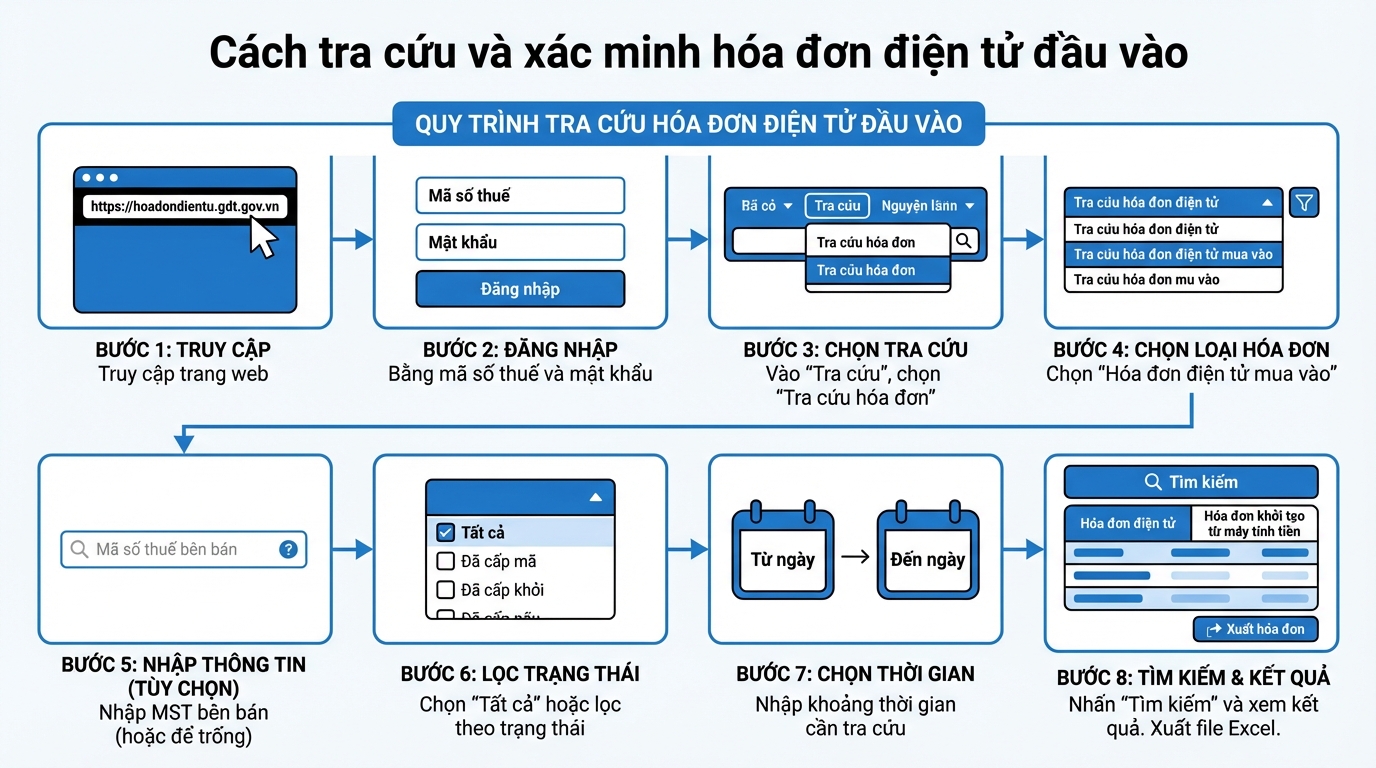
Smart invoice management solution with GTG CRM
To avoid the risk of missing input invoices and ensure legal compliance, businesses need a robust and automated document management system. GTG CRM provides comprehensive invoice management features, helping businesses tightly control both input and output invoices.
Generate sales invoices automatically and accurately.
GTG CRM allows businesses to issue electronic invoices immediately upon sales transactions. The system automatically synchronizes order information, saving time and minimizing errors. All invoices are securely stored, easily retrieved, and cross-referenced when needed.
Automated collection and management of input invoices.
One of GTG CRM's standout features is its ability to automatically collect incoming invoices. The system connects directly to email, automatically downloading and storing all purchase invoices (invoices sent to email). This eliminates the need for accountants to worry about lost documents or forgetting to reconcile invoices.
Practical benefits of using GTG CRM
Firstly, businesses always have complete input documents to prove the origin of goods, avoiding penalties or tax arrears. Secondly, comparing input and output invoices becomes simple and quick, helping to detect discrepancies or omissions promptly. Thirdly, businesses can fully deduct VAT, optimize tax obligations, and reduce unnecessary costs.
Secondly, all documents are stored electronically, making them easily accessible for reporting, auditing, or tax settlement purposes. Finally, the system helps businesses fully comply with legal regulations regarding invoices, avoiding legal risks and protecting their business reputation.
Conclude
Issuing output invoices without input invoices is not only a technical issue but also carries significant legal and financial risks. Businesses need to proactively manage documentation, utilize supporting tools to automate processes, and ensure full compliance with regulations. GTG CRM, with its features for automatically issuing output invoices and collecting input invoices, is a comprehensive solution that helps businesses operate more transparently, efficiently, and securely in the digital age.
Turn what you've just read into tangible results — apply it now with GTG CRM, free.
Apply now