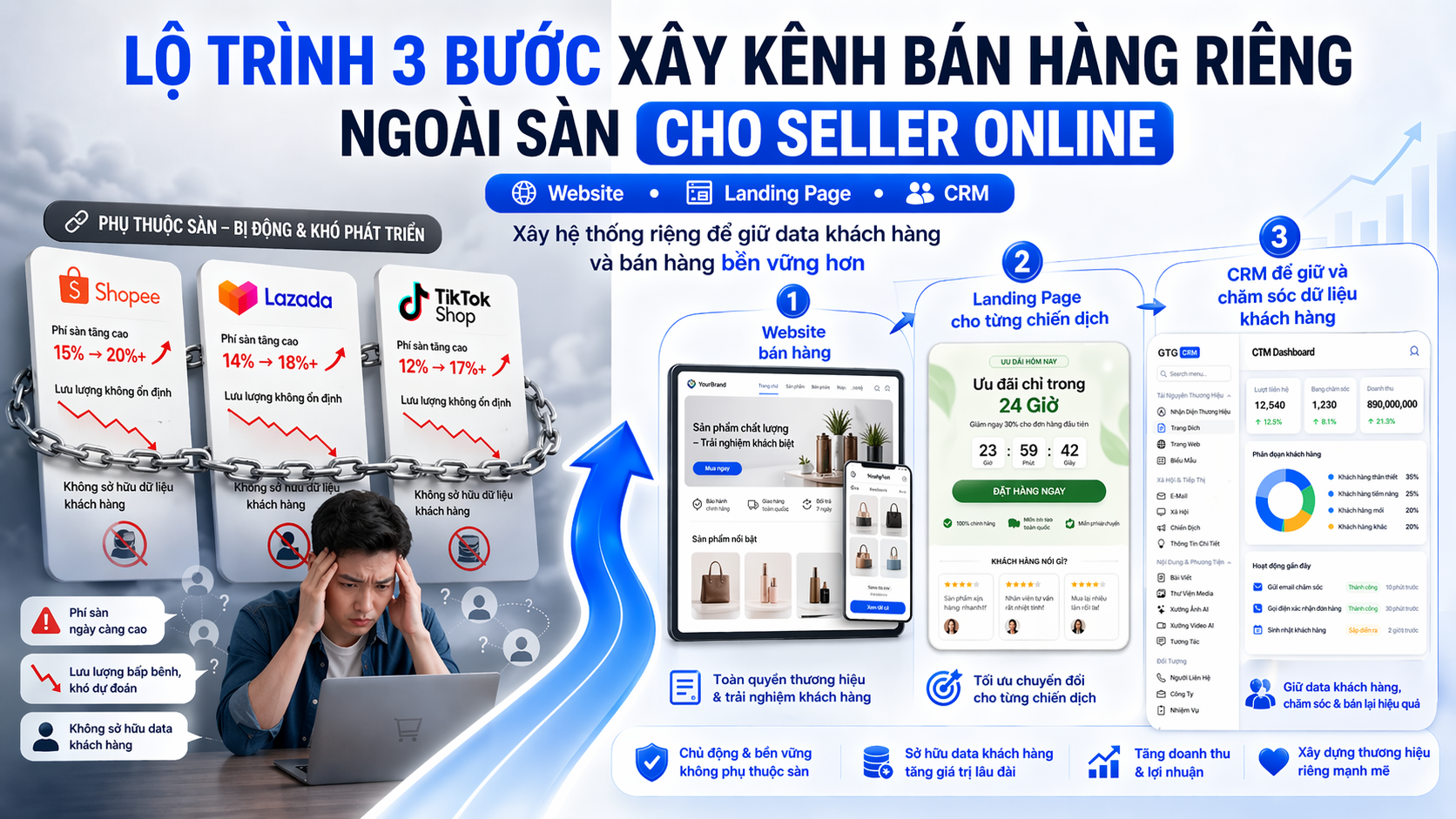
To build a separate sales channel outside of e-commerce platforms, sellers need a clear roadmap instead of trying to implement everything at once. A logical three-step roadmap is: start with a dedicated website to create an independent presence, then build landing pages for specific campaigns, and finally connect to a CRM to maintain and manage customer data. Once a solid foundation is established, sellers should then expand into email marketing and automation to optimize long-term operations.

Many online sellers are doing well on e-commerce platforms like Shopee, Lazada, or TikTok Shop. Sales are stable, orders are regular, and everything seems to be going in the right direction. But when they look at the bigger picture, many are starting to realize that they are becoming too dependent on third-party platforms.
Policies change, fees increase, algorithms change, traffic drops suddenly. All of these factors are beyond the seller's control. And more importantly, customer data, the most valuable asset of any online store, doesn't truly belong to them.
Many sellers have realized this and started thinking about building their own sales system. But when they begin, they are often overwhelmed by the sheer number of things to implement: website, landing page, CRM, email marketing, automation, advertising, data analytics. Then they give up halfway, or do things haphazardly without focus, wasting both time and money.
In reality, building a separate sales channel outside of e-commerce platforms doesn't mean doing everything at once, nor does it mean abandoning the platform entirely. What sellers need is a clear, step-by-step roadmap, prioritizing tasks based on practical business logic.
Why Do Many Sellers Want Their Own System But Often Get Stuck?
Thinking you have to do too many things at once.
When deciding to build their own sales channel, many sellers naturally think of a complete system: a beautiful website, a high-quality CRM, automated email marketing, a chatbot, and a mobile app. The list just keeps getting longer, and the pressure keeps increasing.
As a result, sellers don't know where to start. They hire someone to build a website but don't have a clear goal, buy a CRM but don't have customers to manage, set up email marketing but don't have a recipient list. Everything is implemented haphazardly, without logical connection, and ultimately doesn't yield the expected results.
Lack of Understanding of Priorities
One of the main reasons sellers get stuck is a lack of understanding of priorities. They don't realize that before thinking about automated customer service, they need to acquire customers first. Before acquiring customers, they need a place to collect customer information. And before collecting information, they need a place for customers to learn about the product and brand.
Websites, landing pages, CRM, email marketing, and automation are not interchangeable tools. They are interconnected layers within a system. Without the foundational layer, the layers above cannot function effectively.
Concerns about excessive cost and effort.
Many sellers believe that to have a fully functional sales channel, they have to invest a lot of money and time upfront. They hear about complex CRM systems, email marketing campaigns that take months to build, and highly technical automation processes.
In fact, if following the right path, sellers can start with simple steps and reasonable costs. The important thing is to understand what stage you are in, what needs to be prioritized first, and gradually build each layer in a solid manner.
The Right Mindset When Building Your Own Sales Channel Off-Platform
Build Layer by Layer According to Development Logic
Instead of trying to do everything at once, sellers should think about building the system in layers. Each layer has a clear goal and serves as the foundation for the next layer.
The first layer is your personal presence. This is where customers can learn about your brand and products without being constrained by the interface and policies of the e-commerce platform. A dedicated website for sellers is the solution for this layer.
The second layer is where conversions are finalized for specific campaigns. When a seller has a general website, creating pages focused on a specific product or promotion will help increase conversion rates. Landing pages for sellers play this role.
The third layer is the system for storing and managing customer data. Once you have visitors and they leave their information, storing and organizing this data scientifically is crucial for reselling and long-term customer care. This is where CRM for e-commerce becomes essential.
Once these three foundational layers are well-established, new sellers should expand to optimization tools such as email marketing for online sellers and automation for online sales.
No need to leave the floor immediately.
One important thing to clarify: building your own sales channel doesn't mean abandoning e-commerce platforms immediately. Platforms are still a good source of traffic and sales, especially in the early stages when your own system is still developing.
The correct approach is to continue selling on the exchange to maintain cash flow while gradually building your own channel. Once your own channel is strong enough, sellers can be more proactive in allocating resources and gradually reduce their dependence on the exchange.
Focus on Retaining Customer Data
One of the biggest reasons for building a private sales channel is to retain customer data. On e-commerce platforms, sellers don't own customer information. Every time they make a sale, they have to start from scratch, depending on the traffic the platform brings.
With a dedicated system, each time a customer leaves their information, the seller is building a valuable asset. This asset can be used to re-engage, nurture, and sell to customers multiple times in the future without incurring the same advertising costs as the initial purchase.
3-Step Roadmap to Building Your Own Sales Channel
Step 1: Build a Sales Website
Why a Website Is a Logical Starting Point
A sales website is the first platform in the roadmap to building a separate sales channel outside of marketplaces. This is where sellers create an independent presence, where customers can learn about the brand, view all products, and understand the story the seller wants to convey.
Unlike online stores which are limited by templates and general policies, a private website allows sellers to showcase their brand identity, arrange products in their own way, and build trust with customers in a manner they have complete control over.
Furthermore, a website serves as the primary destination for sellers when running ads or sharing content on social media. Instead of directing traffic to a store on an e-commerce platform, where customers might be diverted to other competitors, a website helps sellers retain customers within their own ecosystem.
What You Need in the Initial Stage of a Website
The website doesn't need to be overly complex in the initial stages. Sellers should focus on the core elements: a homepage providing an overview, product pages with clear descriptions and images, a brand introduction page, a contact page, and a sales policy.
It's crucial that the website is easy to navigate, loads quickly, displays well on mobile devices, and has clear contact channels. Customers need to feel secure when buying from a new website, so trust-building factors such as customer reviews, return policies, and transparent contact information are essential.
Key KPIs to Consider During the Website Development Stage
In the initial stages of a new website launch, sellers should monitor key metrics such as:
- Number of website visits per day/week
- Fast bounce rate
- Which page gets the most views?
- Average time visitors stay on the site
- Number of customers who clicked the contact button or contacted via Zalo/Messenger.
These metrics help sellers understand whether customers are interested in the content, which pages need improvement, and whether the website is serving as an effective marketing platform.
Step 2: Create Landing Pages for Each Campaign
Why Do You Need a Landing Page When You Already Have a Website?
A website is generally great for showcasing a brand and all its products. But when a seller runs a specific campaign, such as a weekend flash sale or a new product launch, directing customers to a generic homepage will reduce conversion rates.
Landing pages for sellers are the solution to this problem. These pages are designed with a single goal in mind: to encourage customers to take a specific action, such as filling out a form, signing up for information, or purchasing a discounted product.
An effective landing page has concise content, striking images, a clear call to action, and not too many exit paths. Customers who visit the page will know exactly what they need to do next.
When Should You Start Building a Landing Page?
Sellers should start building landing pages once they have a stable, active website and have started specific marketing campaigns. If the seller is running Facebook ads for a new product or has a special discount program, that's when a separate landing page is needed.
Landing pages are also very useful when sellers want to collect information from potential customers. Instead of asking customers to buy immediately, sellers can create landing pages to offer free ebooks, vouchers, or useful materials in exchange for contact information.
Key KPIs to Consider During the Landing Page Stage
Once the landing page is launched, sellers need to monitor the following metrics:
- Conversion rate: how many visitors take the desired action
- Number of completed forms
- Advertising cost per conversion
- Which traffic source generates the highest conversions?
- Which call-to-action button is clicked the most?
This data helps sellers optimize landing pages and allocate advertising budgets more effectively.
Step 3: Connect to CRM to Maintain and Manage Customer Data
Why CRM is the Most Important Step
While websites and landing pages help sellers reach and attract customers, CRM for e-commerce is the tool that helps retain and nurture those customers. It stores all the information customers have left behind: name, phone number, email, products they are interested in, and their interaction history.
Without a CRM, sellers often store customer information in a fragmented way: some in Excel, some in Zalo messages, and some in their phone contacts. This makes customer management and care chaotic and inefficient.
CRM helps sellers organize data scientifically, categorizing customers by group, behavior, and level of interest. From there, sellers can proactively re-engage the right customers at the right time with the right message.
More importantly, CRM helps sellers avoid having to start from scratch every time they want to sell. Instead of running ads every time to find new customers, sellers can resell to loyal customers who have previously purchased from them at a much lower cost.
How CRM Connects to Websites and Landing Pages
For a CRM to function effectively, it needs to be directly connected to the information collection forms on the website and landing pages. When customers fill out forms to register for consultations or receive vouchers, that data should be automatically transferred to the CRM instead of being manually entered.
This integration saves sellers time, reduces errors, and ensures that no potential customers are missed. As soon as new information is available, sellers can immediately establish a follow-up process.
Key KPIs to Consider During the CRM Phase
Once they have a CRM system, sellers should track metrics such as:
- Total number of contacts stored in the system
- Number of new contacts per week
- The conversion rate of potential customers into actual customers.
- Average number of attempts required to close a sale.
- Rate of returning customers making purchases
These metrics help sellers evaluate the effectiveness of their customer management and care, and adjust their strategies accordingly.
Expand: Email Marketing and Automation
When Should You Start Email Marketing for Online Sellers?
Once a website, landing page, and CRM are running smoothly, the seller will have a large enough amount of customer data to start thinking about email marketing. This is the expansion phase, not the foundation phase.
Email marketing for online sellers allows them to send information about new products, promotions, or useful content to their existing customer list. Unlike paid advertising, where you pay per reach, email marketing helps sellers interact with customers without incurring additional advertising costs.
However, email marketing is only effective when the seller has a quality email list compiled from people who are genuinely interested in the product. If the list is not large enough or not clearly segmented, sending emails will not yield the expected results.
The Role of Automation in Online Sales
Once the system is running smoothly and has a high volume of customer interaction, sellers will realize that some repetitive tasks can be automated. Examples include sending welcome emails to new customers, sending reminders for abandoned carts, sending birthday offers, or providing post-purchase customer service.
Automation for online sales helps sellers set up automated customer service processes based on specific behavior and timeframes. This saves time, ensures no customers are missed, and creates a consistent experience.
However, automation should only be implemented when the seller has a thorough understanding of the customer journey and has a well-functioning manual customer care process. Automating too early, when the process is still unclear, will not yield the desired results.
Key KPIs to Consider During the Expansion Phase
When implementing email marketing and automation, sellers should monitor:
- Email open rate
- Click-through rate of links in emails
- Email unsubscribe rate
- Revenue from email campaigns
- The effectiveness of each automated workflow.
These metrics help sellers understand which campaigns are performing well, which content is engaging to customers, and what adjustments are needed to optimize effectiveness.
30-60-90 Day Timeline: A Realistic Roadmap for Sellers
First 30 Days: Focus on Building the Website
During the first 30 days, sellers should focus entirely on building and perfecting their e-commerce website. This is the stage to create the most fundamental foundation.
Weeks 1-2: Plan content, prepare product images, write product descriptions, and determine page structure. If you already have content from your store on the marketplace, this is the time to edit and refresh it to fit your own website.
Week 3: Deploy the website, set up the basic pages, and install tracking tools like Google Analytics to measure traffic.
Week 4: Thoroughly test and optimize page load speed, ensure good display on mobile devices, and begin experimenting with driving traffic from existing channels such as personal Facebook profiles or customer groups.
Goal by the end of the first month: to have a stable, user-friendly website ready to receive customers.
The Next 60 Days: Adding Landing Pages and Starting Data Collection
Once the website is up and running and generating initial traffic, the next 60 days are crucial for sellers to build landing pages for specific campaigns and begin systematically collecting customer data.
Weeks 5-6: Identify which products or programs need a dedicated landing page. This could be a best-selling product, a new product, or an upcoming promotion. Design a simple landing page that focuses on a clear objective.
Weeks 7-8: Run small test advertising campaigns that lead to landing pages, monitor conversion rates, and adjust content or design as needed.
Weeks 9-10: Implement basic CRM, connect website and landing page forms to the CRM so customer data is automatically saved. Begin categorizing customers by source and level of interest.
Weeks 11-12: Experiment with manual customer service processes. Call or text customers who have left their information to understand their journey and identify areas for improvement.
Goal by the end of the second month: have at least one effective landing page and begin accumulating customer data in the CRM.
The Next 90 Days: System Optimization and Expansion Considerations
After the first 90 days, the seller has a basic system in place: website, landing page, and CRM. This is the time to optimize and consider expansion steps.
Weeks 13-16: Analyze data from the first three months. Which pages have the highest conversion rates? Which traffic sources are most effective? Which customers are most likely to return for repeat purchases?
Weeks 17-20: Based on data analysis, optimize website content, improve landing pages, and refine customer service processes.
Weeks 21-24: If you have a sufficiently large and well-categorized amount of customer data, you can begin experimenting with email marketing with a small campaign. Send valuable information or special offers to specific customer groups and monitor their responses.
Week 25 onwards: Continue optimizing and gradually expanding. If email marketing yields good results, you can set up simple automation workflows to automate customer care.
Goal by the end of the third month: to have a stable operating system, clear data on the performance of each channel, and be ready to expand or invest further in effective channels.
Comparison: Doing Everything Simultaneously vs. Taking Things in Stages
Scenario A: Seller does everything at once.
One seller decided to build their own sales channel. They hired someone to create a website, bought a CRM, signed up for email marketing services, and started running aggressive advertising campaigns. All within two weeks.
Results: The website's content wasn't optimized, the CRM lacked data for management, and the email marketing campaign lacked a recipient list. Advertising costs were being wasted, but optimization was unclear due to unknown bottlenecks. After two months, the seller felt overwhelmed, unsure of what to focus on, and began to doubt whether their own channel was truly suitable for them.
Scenario B: Seller Follows a Stage-by-Stage Approach
Another seller also decided to build their own channel, but started by focusing entirely on the website for the first month. They carefully edited the content, optimized the images, and began driving traffic from their personal Facebook page to test it out.
After confirming that the website was functioning properly, they created a landing page for a weekend flash sale and ran a small advertising campaign. Only when customers left their information did they begin using the CRM to record and track it.
Result: After 3 months, this seller had a simple but effective system. They knew exactly what value each part brought, knew where to invest further, and felt confident to continue expanding.
Mini Case: From Floor-Dependent to Owned System
Ms. Lan has been selling cosmetics on Shopee for two years. Her monthly sales are around 50-70 million VND, which is quite stable. However, she realized that whenever Shopee changes its algorithm or increases fees, her profits decrease immediately. More importantly, she has no way to contact customers who have already purchased from her unless they return on their own.
She decided to build her own sales channel but didn't know where to start. After doing some research, she chose to take a step-by-step approach.
During the first month, she focused on creating a website to showcase her main product lines. She didn't try to make the website overly complex, focusing instead on presenting the products beautifully, providing clear descriptions, and including a contact form. She started sharing the website link on her personal Facebook page and in groups with loyal customers.
In the second month, she noticed a serum product that was generating a lot of customer interest. She created a separate landing page for this product with a buy-two-get-one-free offer. She ran a small Facebook ad campaign leading to the landing page and asked customers to fill out a form to receive a consultation. As a result, within two weeks she collected over 100 potential customer contacts.
At this point, she started using CRM to store and categorize these customers. She divided them into groups: those who had purchased, those who were interested but hadn't purchased yet, and those who needed further follow-up. She proactively called and messaged each group via Zalo with appropriate messages.
After three months, she had a list of over 300 potential customers in her CRM. She started sending weekly emails sharing skincare tips and introducing new products. The initial email open rate was around 20-25%, and about 5-7% of customers returned to make purchases after each email campaign.
Lan hasn't abandoned Shopee, but now she has a separate sales channel operating in parallel. When a customer buys on Shopee, she proactively includes a thank-you card with a website link and a discount voucher for their next purchase. Gradually, some customers from Shopee have switched to buying directly through her own channel, where she can proactively manage customer service and resell without having to share fees with the platform.
Determine Where You Are in Your Journey
To determine their next priorities, sellers can evaluate themselves based on the following questions:
Regarding the Website: - Do you already have a website? - Does the website display well on mobile devices? - Is it easy for customers to find product information and contact details? - Are you tracking website traffic and customer behavior?
Regarding Landing Pages: - Do you already have a landing page for a specific product or program? - Does the landing page have a clear conversion goal? - Are you collecting customer information through a form?
Regarding CRM: - Where are you storing customer information? - Can you easily retrieve information for a specific customer? - Are you categorizing customers by group or behavior? - Are you proactively re-reaching out to former customers?
Regarding Email and Automation: - Do you have a large enough customer email list? - Do you send marketing emails regularly? - Do you have any automated customer care processes running?
If most of the answers for the Website section are "no" or "not yet," that's a sign you should focus on step 1. If you have a website but no landing page or haven't collected data systematically, move on to step 2. If you have a website and landing page but your customer data is fragmented, then it's time to prioritize step 3 with CRM.
GTG CRM: A Solution to Help Sellers Follow a Shorter Journey
Once the seller understands the 3-step process and is determined to implement it, the next question is: what tools should they use?
One of the biggest challenges for sellers is having to use many different tools for each step. The website uses one platform, the landing page uses another, the CRM is a separate system, and email marketing needs to be integrated from a fourth-party service. Each tool has its own usage, its own costs, and connecting them is often complicated.
GTG CRM is built with the goal of helping sellers follow this path more smoothly. In a single platform, sellers can:
- Build a multi-page website with a professional interface.
- Create landing pages for each specific campaign or product.
- Use a customer information collection form.
- Data from the automated form is transferred to the CRM for management.
- Store and categorize customer contacts in a systematic way.
- Send marketing emails with a simple drag-and-drop tool.
- Set up workflow automation to provide customer service according to a process.
This means sellers don't have to waste time learning how to use multiple different tools, worry about integration, or pay for numerous separate services. Everything is in one unified system, allowing sellers to focus on selling and customer service instead of struggling with technology.
For new sellers, GTG CRM helps implement the roadmap from step 1 to step 3 smoothly. For sellers who already have their own website but don't have a CRM, GTG CRM helps add the missing layers without having to build from scratch.
Conclude
Building a separate sales channel outside of the official marketplace is not a sudden decision or a project to be completed in a month. It's a long-term journey that requires a clear strategy and perseverance.
This three-step roadmap provides sellers with a clear path to follow: start with a sales website to create a unique presence, continue with a seller landing page to increase conversions per campaign, and complete the process with a CRM for e-commerce to maintain customer data and foster long-term customer relationships. Once this foundation is solid, expanding to email marketing for online sellers and automation for online sales will become more natural and effective.
The most important thing is that sellers shouldn't try to do everything at once. Focus on one step at a time, building each layer solidly, measuring results, and making adjustments before moving on to the next. That's the only way to build a sustainable and truly valuable personal sales system.
If you're an online seller looking to break free from your reliance on marketplaces, start with the first step today. You don't need to leave the marketplace immediately, but you do need to start building your own system if you want a more sustainable business future.
Start building your own sales website with GTG CRM today to lay the foundation for your own sales channel.
Frequently Asked Questions
1. Do I need to leave the e-commerce platform when building my own sales channel?
Not necessarily. Building a separate sales channel outside the marketplace doesn't mean abandoning the marketplace immediately. Sellers should continue selling on the marketplace to maintain cash flow while gradually building their own system. Once their own system is strong enough, they can be more proactive in allocating resources.
2. Where should I start if I have nothing yet?
If you don't have anything yet, start with step 1: a separate website for the seller. This is the most basic foundation for creating an independent presence. Once the website is running smoothly, proceed with the landing page and CRM in the correct order.
3. How long does it take to have a personal sales system that works effectively?
With a 3-step roadmap, sellers can have a basic, operational system within 3 months. The first 30 days focus on the website, the next 60 days add landing pages and CRM, and the following 90 days optimize the system. However, the specific timeframe depends on the resources and level of focus of each seller.
4. How much does it cost to build a dedicated sales channel?
Costs depend on the tools and scale of implementation. Using an integrated platform like GTG CRM can save sellers money compared to buying multiple tools separately. It's important to invest gradually according to your financial capabilities rather than trying to do everything at once and exceeding your budget.
5. I don't know anything about technology; is it possible for me to build a website and landing page myself?
Yes, it's possible. Modern platforms like GTG CRM are designed so that even those without technical knowledge can build websites and landing pages themselves through a simple drag-and-drop interface. You don't need advanced programming or design skills to get started.
6. When should I start using email marketing and automation?
Email marketing and automation should be implemented only after you have a stable website, landing page, and CRM system, and have a sufficient amount of customer data. Implementing them too early, without data or a thorough understanding of the customer journey, will not be very effective.
7. How do I know if my own sales channel is performing effectively?
Track key performance indicators (KPIs) relevant to each stage: website traffic, conversion rate on landing pages, number of new contacts in the CRM, and customer return rate. It's crucial to compare the cost of acquiring new customers with the cost of reselling to existing customers to understand the true value of retaining customer data.
8. Can I transfer customer data from the marketplace to my own system?
Typically, e-commerce platforms don't provide sellers with detailed customer contact information. That's why building a private channel and collecting data directly from customers is crucial. You can proactively invite customers who have purchased from your platform to join your private channel through offers or loyalty programs.
Turn what you've just read into tangible results — apply it now with GTG CRM, free.
Apply now