In the context of the booming e-commerce sector in Vietnam, tax management for online businesses is becoming increasingly stringent. On March 9th, the General Department of Taxation held a specialized press conference to announce new regulations under Government Decree 68/2026/ND-CP and Ministry of Finance Circular 18/2026/TT-BTC. These are important changes that every business operating on e-commerce platforms needs to understand to ensure legal compliance.
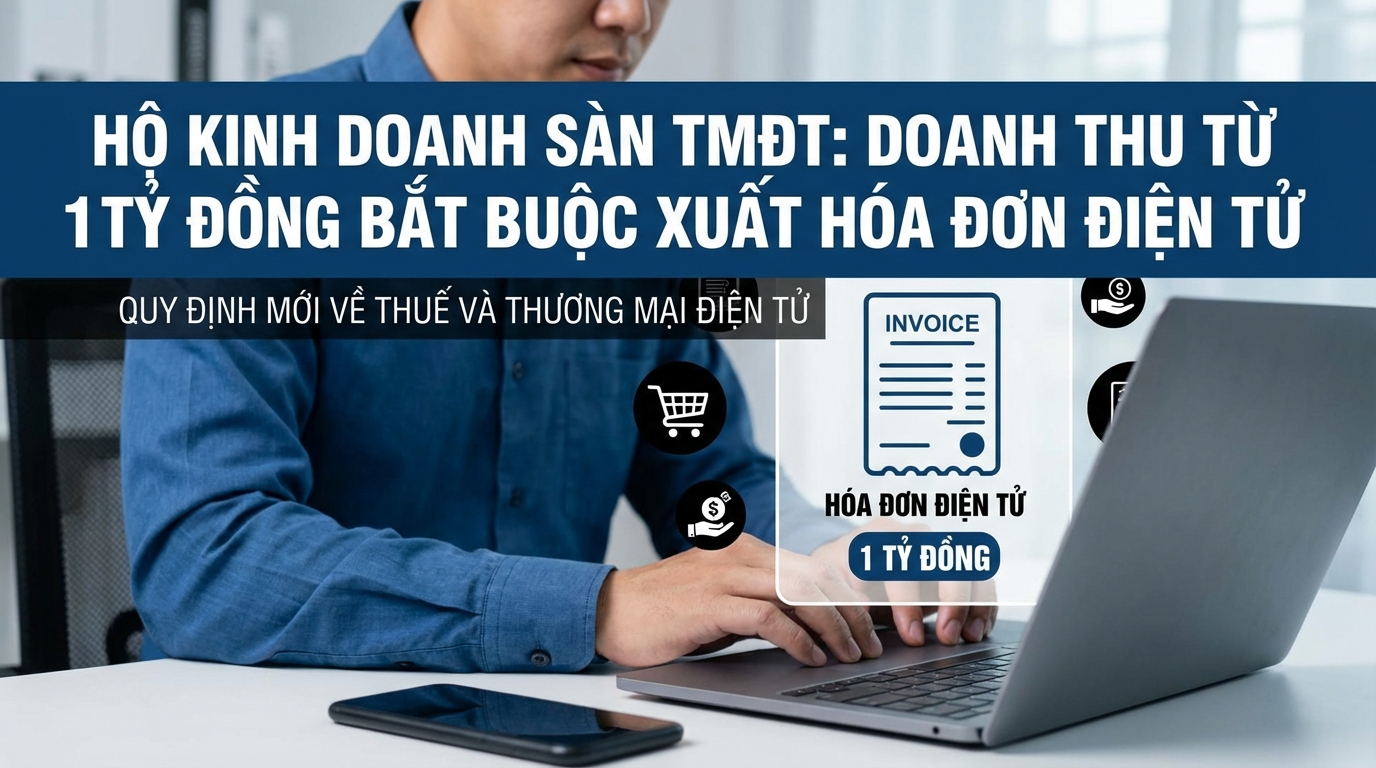
Notably, one of the most significant points is the mandatory issuance of electronic invoices for businesses with an annual revenue of VND 1 billion or more. This marks a crucial shift towards transparency in online business operations and safeguarding consumer rights.
New Regulations on Revenue Thresholds and Tax Declaration
Decree 68/2026/ND-CP clearly divides revenue levels and their corresponding tax obligations. For businesses with annual revenue below VND 500 million, they are required to declare actual revenue and file taxes using Form 01/TKN-CNKD, submitted to the tax authority no later than January 31st of the following year.
Ms. Pham Thi Minh Hien, Deputy Head of the International Tax Policy Department at the General Department of Taxation, highlighted a new aspect of this decree: businesses are now obligated to report their bank account numbers or e-wallet identifiers to the tax authorities. This will enable tax management agencies to monitor cash flow more closely.
Businesses with annual revenue ranging from over VND 500 million to VND 3 billion can opt to apply the personal income tax calculation method based on a percentage of revenue, filing and paying taxes quarterly. Those with revenue exceeding VND 3 billion or choosing to calculate tax based on actual income will face more complex declaration procedures, with monthly or quarterly provisional tax payments depending on their revenue scale.
Obligation to Issue Electronic Invoices with a VND 1 Billion Threshold
Under the new regulations, businesses with value-added tax (VAT) calculable revenue of VND 1 billion or more annually are mandated to use electronic invoices. This is a non-negotiable legal obligation aimed at ensuring transparency in commercial transactions and protecting consumer rights.
For businesses with multiple locations, invoices will be issued using a unified tax code but must clearly state the address of each business establishment on the invoice. This helps prevent confusion and ensures accuracy in tax declarations.
A special case to note involves newly established businesses or those whose previous year's revenue was below VND 1 billion but whose current year's revenue reaches VND 1 billion or more. These businesses must register to use electronic invoices within 30 days from the last day of the tax period in which their cumulative revenue reaches this threshold.
The tax authorities are also researching specific mechanisms for applying invoices to businesses operating in traditional markets with revenues exceeding VND 1 billion. The goal is to ensure compliance with invoice regulations while accommodating the transactional characteristics of these areas.
Invoice Issuance Authorization Mechanism for E-commerce Platforms
One of the issues of significant concern to many online businesses is the authorization of invoice issuance to e-commerce platforms. According to Circular 32/2025/TT-BTC, businesses can fully authorize e-commerce platforms to issue invoices for sales and service transactions conducted on their platforms.
When authorization occurs, the e-commerce platform is responsible for notifying the tax authorities. The electronic invoice will display complete information for both parties, including the name, address, and tax code of both the seller and the e-commerce platform. In practice, this mechanism has already been implemented on some major platforms when sellers authorize them.
A representative from the General Department of Taxation affirmed that according to Decree 70 on invoices and documents, when selling goods or providing services, sellers must issue invoices in accordance with legal regulations. Therefore, for individuals and businesses selling on e-commerce platforms with an annual revenue of VND 1 billion or more, issuing invoices is a mandatory obligation.
Currently, tax authorities are closely collaborating with e-commerce platforms and the E-commerce Tax Department to widely implement the invoice authorization mechanism. The objective is to maximize convenience for sellers in complying with regulations on invoices and documents when doing business on e-commerce platforms.
Future Direction
Regulatory bodies are drafting amendments to the Decree on invoices and documents, which will include provisions on consolidated invoices and cases where invoices are not required. This aims to address practical challenges and create a legal framework that better suits the specifics of each business type.
The tightened tax management and mandatory issuance of electronic invoices will not only enable the state to manage revenue more effectively but also foster a transparent and fair business environment for all businesses. Consumers will also have their rights better protected with complete invoices and documents for every purchase.
For businesses on e-commerce platforms, understanding and complying with these new regulations is not just a legal obligation but also a way to build credibility and achieve sustainable growth in the increasingly fierce e-commerce competition.
Turn what you just read into real results — apply it now with GTG CRM, for free.
Apply now