This article delves into the analysis of core principles, from classifying user search intent to applying in-depth keyword strategies. The goal is to provide a solid theoretical framework, enabling managers and marketing professionals to build effective advertising campaigns, optimize costs, and increase sustainable profits.
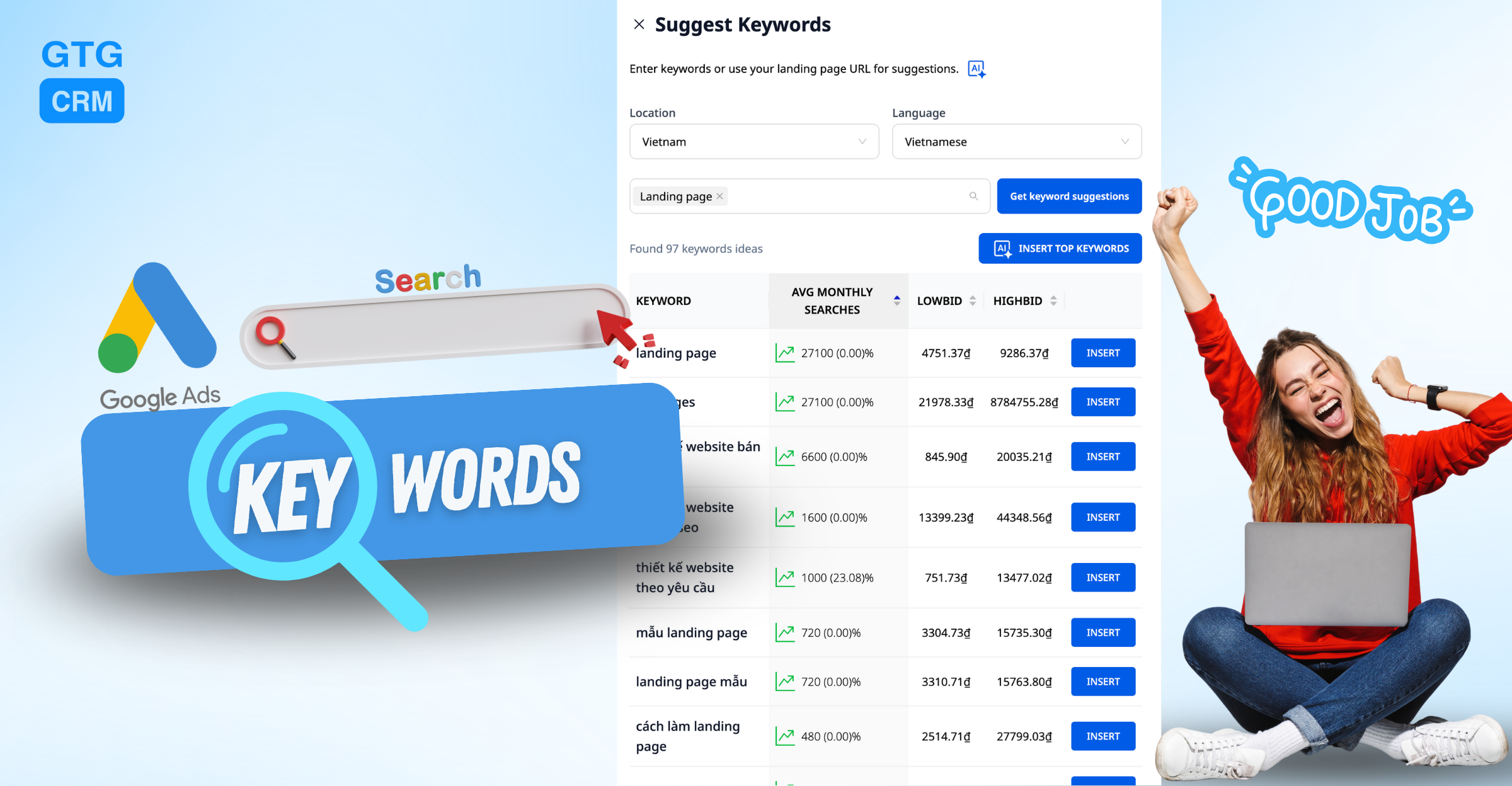
Keyword research made easier with GTG CRM
The Importance of Keyword Selection
In today's competitive online advertising world, keyword selection is not just the first step, but also a deciding factor in 80% of a Google Ads campaign's success or failure. A meticulously crafted keyword strategy not only helps you reach the right target audience but also optimizes costs, avoiding budget waste on clicks that don't lead to conversions.
This article will delve into the professional aspects, helping everyone from beginners to experienced individuals build a powerful and sustainable keyword list.
Analyzing Search Intent - The First Step
Before thinking about finding keywords, put yourself in the customer's shoes. What are they looking for? What is their goal? Analyzing Search Intent helps you identify the most suitable keyword types:
-
Informational Intent Keywords:
These are typically queries for learning or answering questions.
- Examples: "how to use Google Analytics", "what is CRM".
- Application: Suitable for blog posts, in-depth documentation to attract traffic and build brand credibility.
-
Transactional Intent Keywords:
These clearly indicate purchase intent.
- Examples: "buy CRM software", "order GTG CRM", "sales management software price".
- Application: Use for direct sales campaigns, product/service ads on Google Shopping or Search.
Clearly differentiating between these two types of intent will help you avoid wasting your budget on informational keywords when your main goal is sales.
Mastering Keyword Match Types
Google Ads offers three main keyword match types to control your ad's reach. Flexible use of these match types is the secret to optimizing effectiveness and costs.
-
Broad Match:
Has the widest reach, allowing ads to show for searches related to your keywords.
- Example: The keyword "CRM software" can show for searches like "customer management tool", "business management app".
- Advice: Use cautiously, combined with negative keywords to avoid waste. Suitable for discovering new keywords.
-
Phrase Match:
Maintains the keyword's context. Ads will show when your keyword phrase appears in the query, potentially with other words before or after.
- Example: The keyword "customer management software" will show for "effective customer management software" or "best software for customer management".
- Advice: This is the most common and safest match type, balancing reach and relevance.
-
Exact Match:
The narrowest reach, only showing when the search query exactly matches or has a similar intent.
- Example: The keyword [GTG CRM software] will only show when users search for exactly "GTG CRM software", “CRM GTG software”, “GTG CRM solutions”.
- Advice: Prioritize using this for keywords with high purchase intent, helping to optimize costs and increase conversion rates.
Strategy with Long-tail Keywords
Instead of focusing only on short, generic keywords like "CRM" or "software", prioritize long-tail keywords. These are keyword phrases of 3-5 words or more that clearly express the user's intent and have higher conversion rates.
- Examples: "CRM software for small and medium businesses", "advertising management software price", "how to effectively manage multi-channel messages".
Why use long-tail keywords?
- Lower Cost: Competition is usually lower, helping to reduce bids.
- High Conversion Rate: Customers have a clear purchase intent, increasing the likelihood of conversion.
- Reach the Right Audience: Minimizes irrelevant clicks, increasing traffic quality.
Data Analysis and Using Negative Keywords
An advertising campaign cannot be successful without data analysis.
- Keyword Selection Based on Data: Use Google Keyword Planner to evaluate Search Volume and Competition. If the budget is limited, prioritize keywords with moderate search volume (around 1,000 - 3,000 searches/month) for better visibility opportunities.
- Negative Keywords: This is a secret weapon to optimize costs. Use negative keywords like "free", "jobs", "compare", "review" to eliminate queries that don't lead to conversions.
Optimize the Process with GTG CRM
GTG CRM integrates AI Keyword Research to make keyword discovery fast, accurate, and data-driven like never before:
- Smart Keyword Suggestions: AI analyzes based on website topics, ad content, and market trends, then suggests a list of keywords with the highest potential. You no longer have to manually filter hundreds of keywords.
- In-depth Analysis of Competition & CPC: Each keyword is analyzed by GTG CRM for search volume, competition level, and estimated CPC, making it easy for you to identify the optimal keywords for your budget and advertising goals.
- Competitor Analysis: Instead of guessing, you can enter your competitor's website and the AI system will extract the keywords they are using. This provides a comprehensive view, helping you position your advertising strategy more accurately.
With GTG CRM, you have a comprehensive keyword picture: saving time, optimizing costs, and enhancing your competitive edge on Google Ads.
Conclusion
GTG CRM is not just a customer management software, but also a powerful multi-channel marketing platform that helps you run effective advertising campaigns, from keyword research to managing and optimizing the entire marketing funnel.
Are you ready to elevate your Google Ads campaigns with a sound keyword strategy? Contact GTG CRM today for in-depth consultation on comprehensive marketing solutions.
Turn what you just read into real results — apply it now with GTG CRM, free.
Apply Now